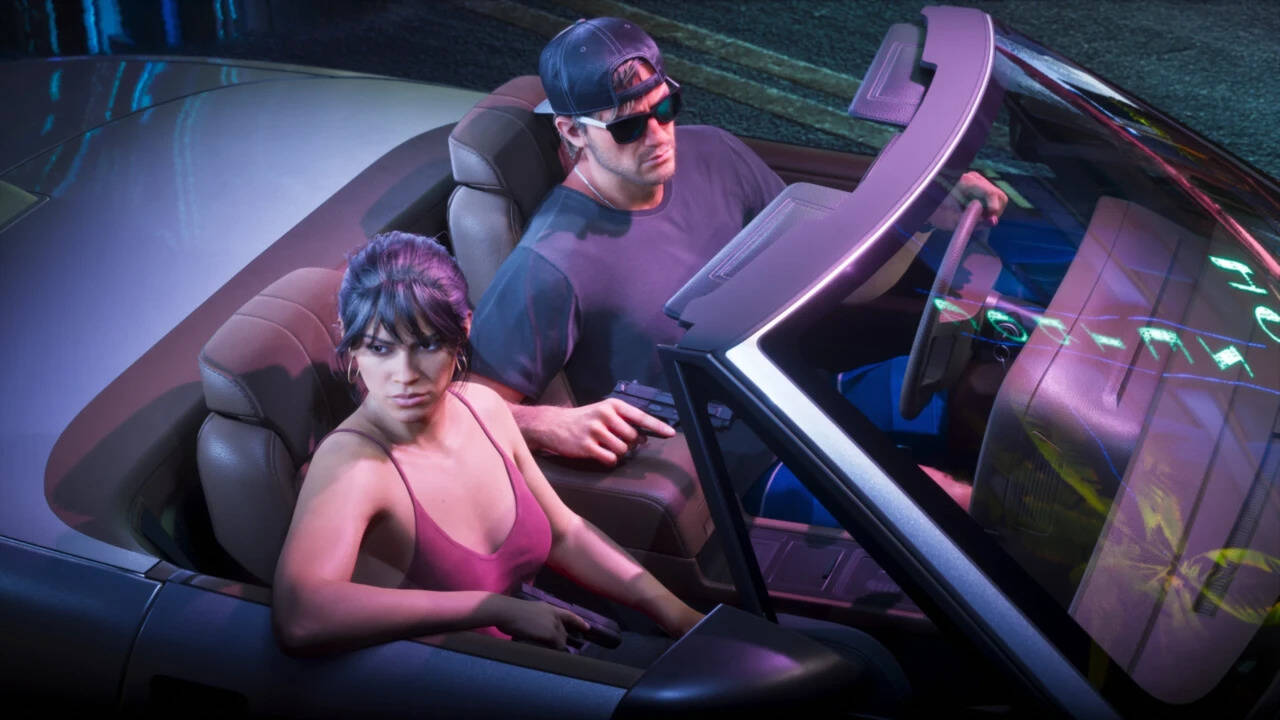
At 4:58 AM on a Tuesday, a twenty-seven-year-old software developer named Marcus—a hypothetical stand-in for millions of workers staring at their ceilings right now—reaches for his nightstand. He isn't reaching for a thermometer. He doesn't have a fever, a scratchy throat, or the dull, creeping ache behind the eyes that signals a genuine winter virus. His sinuses are clear. His lungs are fine. Yet by 6:15 AM, his manager will receive a carefully worded Slack message about a sudden, violent bout of food poisoning.
Down the hall, or across town, a high school junior named Elena is practicing a remarkably similar cough into her pillow.
Welcome to the "GTA Flu."
If you look at the cold, hard telemetry of modern human behavior, this phenomenon isn't a medical mystery at all. It is a massive, decentralized cultural sick-out triggered by the release of Grand Theft Auto VI. For over a decade, Rockstar Games has held the collective imagination of the entertainment world in a vice grip, turning a video game launch from a simple retail event into a seismic disruption of the global labor force and the public school system. Human resources departments are quietly bracing for impact. School administrators are dusting off attendance protocols.
Why? Because when a cultural monolith drops after thirteen years of anticipation, the invisible contract between an employee and a timecard suddenly feels very, very fragile.
The Anatomy of a Digital Epidemic
To understand the sheer scale of what happens when a generational title hits digital storefronts, you have to look at the numbers behind the screen. When Grand Theft Auto V launched back in September 2013, it generated $800 million in its first twenty-four hours and crossed the $1 billion mark in three days. Back then, the gaming industry was already massive, yet it still existed somewhat apart from mainstream corporate anxiety.
Today, the math is terrifying for anyone trying to staff a morning shift.
The global gaming audience has swelled past three billion people. More importantly, the demographics have shifted. The teenagers who stood in midnight lines at strip-mall game stores in 2013 are now senior project managers, line cooks, high school teachers, nurses, and logistics coordinators. They have disposable income, paid time off, and an acute, bone-deep nostalgia for the last time a digital world felt truly boundless. Industry analysts and workforce management firms have tracked spikes in unscheduled absences around major entertainment releases for years, from Call of Duty launches to Starfield and Elden Ring. When Grand Theft Auto VI finally arrives, projections suggest tens of millions of copies will move in the opening week alone.
Multiply those millions of copies by an eight-hour workday, and you begin to see the ghost town forming in office cubicles and second-period algebra classes.
I remember the last time I caught a phantom fever. It wasn't for a game, though the mechanics were identical. Years ago, a record I had waited half a decade to hear dropped at midnight on a Thursday. I sat on the edge of my bed in a cramped apartment, headphones clamped over my ears, watching the digital clock bleed into Friday morning. By 3:00 AM, the outside world—with its fluorescent office lights, its lukewarm breakroom coffee, its endless spreadsheets—felt entirely optional. At 7:30 AM, I called my boss, pitched my voice down half an octave to simulate congestion, and claimed I couldn't keep water down. The guilt was sharp for about four minutes. Then I hit play again, and the guilt evaporated.
That sensory pull is what corporate risk assessments routinely fail to measure. A spreadsheet can calculate the cost of lost productivity per absent employee—often estimated by workforce researchers at hundreds of dollars per day depending on the sector—but a spreadsheet cannot measure the electric hum of a download bar hitting 100 percent at midnight.
Why We Lie About Taking a Day Off
Consider what happens when a worker simply asks for a random Tuesday off three weeks in advance. In many workplaces, especially in retail, hospitality, education, and entry-level corporate tiers, requesting personal time without a socially sanctioned excuse triggers subtle, unspoken scrutiny. A wedding? Approved. A dental surgery? Understood. "I want to spend fourteen uninterrupted hours exploring the neon-soaked streets of Vice City"? Denied, or worse, remembered during the next performance review.
We have built a work culture that deeply respects physical fragility while treating psychological joy as a luxury that must be justified.
Think of the immune system as an alibi. When you say you have a migraine or a stomach bug, you are invoking an authority that no manager dares challenge in a post-pandemic world. Nobody wants patient zero coughing in the conference room. Nobody wants a liability issue. By leaning into the "GTA Flu," millions of people aren't necessarily being lazy; they are navigating a bizarre cultural loophole where pretending to be sick is socially safer than admitting you want to play a video game.
There is an obvious friction here, and it is worth being honest about the fallout. When Marcus fakes a stomach bug, someone else has to cover his morning stand-up or pick up the slack on a looming deployment. When a high school teacher calls out, a substitute has to scramble to decipher lesson plans at 6:00 AM. When a warehouse worker stays home, the delivery chain tightens by a fraction of an inch.
Pretending this is a victimless prank ignores the very real exhaustion of the coworkers left holding the bag. If you have ever been the one person in a five-person department who actually showed up on a Friday before a holiday weekend, you know the quiet resentment of doing three people's jobs while your colleagues post suspiciously vague photos of their living rooms online.
The History of Cultural Sick-Outs
The "GTA Flu" feels uniquely modern because it is driven by fiber-optic download speeds and Discord servers, yet the behavior itself is older than the microchip. Humans have always found ways to quietly mutiny against the clock when something larger than their daily routine calls to them.
Look back at the late 1990s. When Star Wars: Episode I – The Phantom Menace hit theaters in May 1999, outplacement firm Challenger, Gray & Christmas famously estimated that 2.2 million full-time workers skipped work to see it, costing the American economy hundreds of millions of dollars in lost productivity. A few years later, the same pattern emerged during the World Cup, during the release of the final Harry Potter books, and every single March when the first round of the NCAA basketball tournament tips off on a Thursday afternoon.
Historians of labor will tell you that this tension between rigid industrial schedules and spontaneous human celebration goes all the way back to "Saint Monday"—a widespread nineteenth-century tradition in Britain and parts of Europe where artisans and factory workers simply refused to show up on Mondays after a weekend of leisure, forcing employers to grudgingly adapt until assembly lines tightened their grip.
We are hardwired to seek collective moments. For decades, those moments were delivered via broadcast television—the MASH* finale, the moon landing, the Super Bowl. Everybody watched at the exact same time, and the next morning, everybody talked about it around the water cooler. Today, algorithmic feeds have shattered that shared monoculture into a million tiny niches. You might watch a show nobody at your office has ever heard of. Your coworker might listen to a podcast that is entirely invisible to you.
A monolithic release like Grand Theft Auto VI is one of the last remaining monocultural campfires. People aren't just rushing to play it because the graphics look extraordinary or the satire cuts close to the bone. They are rushing to be present at the exact second the digital doors swing open, before the internet spoils every plot twist, every hidden easter egg, and every chaotic moment on social media within forty-eight hours. Missing launch day feels like arriving at a legendary party after the sun has already come up and the cleaners are sweeping the floor.
How Smart Managers and Schools Are Defusing the Trap
Panic. That is the default setting for old-school leadership when faced with a predictable wave of absences. Some supervisors respond by issuing stern, preemptive memos reminding staff about doctor's note policies or threatening disciplinary action for "unverified illnesses" during a specific week.
It rarely works. In fact, heavy-handed warnings usually backfire, turning a playful cultural moment into an adversarial game of cat-and-mouse where employees simply become more elaborate with their excuses. You cannot threaten someone out of wanting a break; you only teach them how to lie more convincingly.
The organizations that survive cultural sick-outs with their morale intact are the ones that stop fighting human nature and start accounting for it.
Look at how forward-thinking tech studios, creative agencies, and even some progressive corporate teams handle major entertainment launches. Instead of pretending the event isn't happening, they acknowledge it out loud weeks in advance. A smart manager doesn't ask, "Are you planning to fake sick on Tuesday?" They say, "We know a massive game is dropping next month. If you want a personal day, put it on the calendar now so we can balance the workload and make sure nobody gets buried."
When you remove the shame from the request, something remarkable happens: people plan ahead. They finish their deliverables on Monday. They hand off their open tickets cleanly. They take their paid time off honestly, enjoy their day without checking their work email every twenty minutes in a cold sweat, and come back on Wednesday morning sharper and fiercely loyal to a boss who treated them like an adult.
Schools face a much trickier calculus. You cannot simply declare a "video game snow day" for a public high school district bound by state instructional hour mandates and standardized testing calendars. For teachers and administrators, the approach has to be rooted in engagement rather than permissive absence. The educators who navigate these weeks best often lean into the cultural moment—using the economics of the gaming industry in business classes, analyzing media saturation in English, or simply acknowledging the elephant in the room so students feel seen rather than policed.
Even so, the attendance sheets will have gaps. The sub-requests will spike.
The Morning After
It is easy to look at the "GTA Flu" and see a symptom of a distracted, unserious society—a workforce willing to abandon its post for pixels on a screen. That is the cynical reading, and it misses the deeper truth sitting right underneath the surface.
People aren't faking sick because they hate their responsibilities. They are faking sick because modern life leaves almost zero room for unstructured, unapologetic wonder. Between side hustles, rising costs, endless notifications, and the low-grade hum of constant crisis, adulthood has become an endurance sport. A massive, meticulously crafted digital world offers a rare promise: for a few hours, the rules make sense, the horizon is wide open, and nobody is asking you to circle back on an email before end of day.
Think back to Marcus, sitting in his dark bedroom at 5:00 AM, thumb hovering over his phone screen.
If he sends that fake sick text, he gets his day in the sun, though he spends half of it looking over his shoulder, hoping his status indicator on Discord doesn't betray him to a coworker. If his workplace instead gave him the space to claim his own time without inventing a phantom fever, he gets the exact same day—only this time, he breathes easy.
Eventually, the launch week will pass. The servers will stabilize, the initial frenzy will cool into routine evening sessions, and the empty chairs in the third-period classroom and the fourth-floor cubicle will fill back up. The economy will not collapse. The world will keep spinning on its axis.
Yet somewhere in the quiet hum of an early morning, right before the alarm clocks start ringing across the country, millions of people will still pause for a second in the dark, listening to the stillness of their own bedrooms, deciding whether today belongs to the clock on the wall—or to themselves.