The mud of the Narta Lagoon remembers everything. It remembers the brutal winters of the isolationist communist regime, the chaotic rush of the 1990s capitalism, and the quiet, rhythmic thud of thousands of webbed feet hitting the shallow water every spring.
If you stand perfectly still on the salt flats of southwestern Albania, the sound is overwhelming. It is not silence. It is a low, vibrating murmur—the collective breathing of thousands of greater flamingos. They look like a soft pink cloud trapped between the gray Balkan mountains and the brilliant blue of the Adriatic Sea. To the locals in the nearby city of Vlorë, these birds are not just wildlife. They are a living clock. When the flamingos arrive, the earth is waking up. Expanding on this theme, you can find more in: The Gray Zone Waves That Keep a Taiwanese Fisherman Awake at Night.
But recently, a new sound has begun to puncture the coastal air. The sharp, metallic whine of drills. The heavy thud of construction boots.
Suddenly, the pink cloud is swirling in panic. Observers at Al Jazeera have shared their thoughts on this situation.
An unlikely battle line has been drawn in the wet sand of Vjosë-Nartë. On one side stands Jared Kushner, the son-in-law of former U.S. President Donald Trump, armed with hundreds of millions of dollars in private equity and blueprints for an ultra-luxury eco-resort. On the other side stand local environmentalists, international scientists, and a population of birds that cannot speak for themselves but have somehow become the global face of a sovereign nation’s identity crisis.
Albania is at a crossroads, caught between the intoxicating promise of billionaire-backed tourism and the irreplaceable sanctuary of its own wild landscapes.
The Currency of Untouched Places
To understand why a luxury hotel has sparked an international outcry, you have to understand what Albania used to be. For decades, under the paranoid dictatorship of Enver Hoxha, the country was the hermit kingdom of Europe. While the coasts of Italy, Greece, and Croatia were paved over with concrete, mega-resorts, and cruise ship terminals, Albania remained locked in a time capsule.
When the country finally opened its doors, it possessed something far more valuable than gold in the modern world: untouched space.
The Vjosë-Nartë protected area is one of the last undisturbed coastal wetlands on the European continent. It is a critical pit stop along the Adriatic Flyway, a massive aerial highway used by millions of migratory birds traveling between Europe and Africa. For a flamingo, a Dalmatian pelican, or a slender-billed curlew, this lagoon is not a luxury destination. It is a matter of survival. It is the only place to rest, feed, and nest after crossing vast expanses of open sea.
Imagine running a marathon across a scorching desert, knowing there is exactly one oasis where you can drink. Now imagine arriving at that oasis only to find a five-star villa sitting on top of the well.
This is the metaphor that local activists are trying to scream over the noise of impending development.
The Pitch from New York
Enter Affinity Partners, the Miami-based private equity firm founded by Jared Kushner. In early 2024, Kushner unveiled plans for a massive investment portfolio in the Balkans, with the crown jewel located right on the Albanian coastline.
The vision is dazzling, at least on glossy presentation slides. We are talking about hundreds of high-end villas, luxury hotel suites managed by the ultra-exclusive Aman brand, infinity pools that seem to merge with the Adriatic, and fine-dining restaurants catering to the world’s one percent. The marketing materials promise an "eco-luxury" experience that respects the local environment while injecting billions of dollars into a developing economy.
For the Albanian government, led by Prime Minister Edi Rama, the proposal looks like a golden ticket.
Albania has spent years trying to shake off its old reputation as a stagnant, post-communist backwater. Tourism is the vehicle for that transformation. Rama’s administration argues that high-end resorts elevate the country's global profile, create thousands of jobs for young Albanians who would otherwise emigrate to Western Europe, and generate massive tax revenues.
From a purely financial standpoint, the logic seems ironclad. Why leave a muddy swamp filled with birds alone when you could transform it into the next Monaco?
The Architecture of a Loopholes
The problem is that the swamp was supposed to be protected by law.
In Albania, the legal framework safeguarding nature reserves has a history of being remarkably fluid when large amounts of foreign capital arrive at the door. Shortly before the Kushner project was publicized, the Albanian parliament passed amendments to the country's law on protected areas. These changes opened the door for high-intensity tourism development within nature reserves, provided the projects received strategic investment status from the government.
Environmental lawyers and local NGOs watched in horror as the legal boundaries designed to protect Vjosë-Nartë were effectively redrawn with the stroke of a pen.
But the resort is only part of the equation. Just a few kilometers away, the new Vlora International Airport is already under construction. Its runway cuts directly into the migratory path of the birds. The airport is intended to funnel wealthy tourists straight from London, Paris, and New York to the steps of the luxury villas.
Scientists have warned that operating a major commercial airport next to a wetland packed with thousands of large-bodied birds like pelicans and flamingos is a recipe for disaster. Not just for the birds, but for the planes. Bird strikes are a terrifying aviation hazard. Yet, the construction continues. The momentum of international capital is incredibly difficult to slow down once it gains traction.
The Human Cost of a Plastic Paradise
Walk into Zvërnec, a sleepy fishing village bordering the lagoon, and you will find a community torn in half.
Besnik, an older fisherman whose hands are calloused from decades of mending nylon nets, looks out over the water with a mixture of grief and resignation. He remembers when the lagoon was so thick with fish you could catch them with your bare hands. He worries that the luxury resort will poison the water with runoff, kill the traditional fishing industry, and price his children out of the land they were born on.
"They tell us it will bring jobs," Besnik says, pointing a nicotine-stained finger toward the construction site in the distance. "But what kind of jobs? Cleaning toilets for rich Americans? Serving them drinks? We are independent people. We belong to this land. We don't want to be servants in our own home."
A few houses down, a younger man named Ilir sees it differently. He has spent the last five years working grueling hours on construction sites in Germany, sending money back to his parents.
"Look around," Ilir says defensively. "There is nothing here for the youth. No future. If a billionaire wants to spend money to build something beautiful here, we should welcome him. The birds can fly somewhere else. My life cannot wait for a flamingo."
This is the heartbreaking friction at the center of the Albanian resort debate. It is not a simple story of good versus evil, or greedy developers versus saintly tree-huggers. It is a clash between two desperate needs: the economic survival of a generation of young human beings, and the ecological survival of an ancient natural system.
When the Birds Become Protesters
Because the flamingos cannot speak, the people of Albania have begun to speak for them in increasingly creative ways.
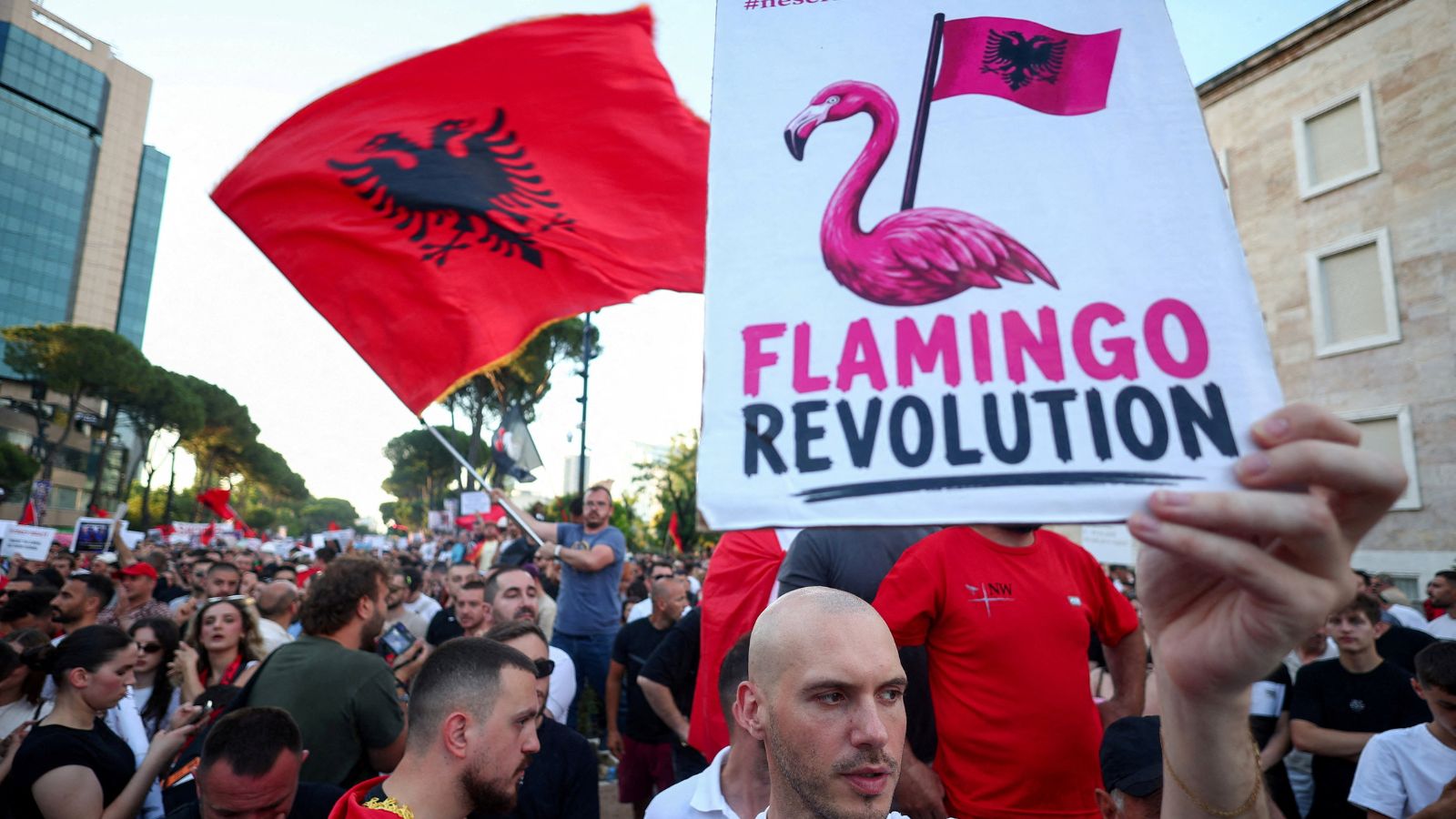
In Tirana, the nation's capital, and along the streets of Vlorë, protests have taken on a surreal, vibrant hue. Activists don't just carry signs; they carry giant, neon-pink paper-mâché flamingos. Young people paint their faces pink and march through the streets, mimicking the synchronized movements of the birds.
The flamingo has become an ironic symbol of resistance against unchecked corporate globalization.
The message is clear: if the government sells off Vjosë-Nartë, it is selling off a piece of the Albanian soul. There is a profound dignity in wildness. Once a wetland is paved over, once the underground aquifers are disrupted by concrete foundations, once the night sky is permanently blotted out by the ambient glow of luxury hotel lobbies, you cannot undo it. You cannot buy a wetland back from a private equity firm.
International conservation bodies are taking notice. The Council of Europe, through the Bern Convention, has repeatedly called on the Albanian government to suspend construction of the airport and halt development plans within the protected area until comprehensive, independent environmental impact assessments are completed.
But international declarations carry very little weight against the promise of American luxury branding.
The Illusion of "Eco-Luxury"
We live in an era where every major development project claims to be green. The marketing copy for the proposed Vlorë resort will undoubtedly use words like sustainable architecture, low-impact design, and carbon-neutral footprint.
We must look past the vocabulary.
True luxury does not require the displacement of an ecosystem. You cannot build an authentic eco-resort on a foundation of altered environmental laws and disrupted migratory flyways. The very concept is an oxymoron. It is an attempt to soothe the conscience of the ultra-wealthy traveler while erasing the natural heritage of a local population.
The tragedy of Vjosë-Nartë is that Albania doesn't need to copy the mistakes of the rest of the Mediterranean. It doesn't need to become a cheap imitation of the French Riviera or a playground for New York real estate moguls. The country’s true competitive advantage lies precisely in its wildness. Agro-tourism, sustainable hiking trails, community-led guesthouses, and controlled, small-scale eco-tourism could bring wealth directly to families like Besnik’s without destroying the lagoon.
But that path requires patience. It requires a long-term vision that prizes national heritage over quick injections of foreign cash.
The Changing Light on the Mud
As the sun begins to dip below the Adriatic horizon, the light over the Narta Lagoon shifts from gold to a deep, bruised purple. The flamingos grow quiet, settling into the shallow water for the night, thousands of silhouettes etched against the glowing water.
For now, they are still here.
They do not know about Affinity Partners. They do not know about Jared Kushner, or the shifting geopolitical alliances between Washington and Tirana. They do not know that the ground beneath their feet has been valued, itemized, and negotiated in high-rise offices thousands of miles away.
They only know that the water is warm, the shrimp are plentiful, and this is the place they are supposed to be.
Tomorrow, the drills will start again. The trucks will roll in, kicking up dust that settles on the wild sea rosemary. The politicians will give speeches about progress, and the investors will monitor their capital allocations. But out on the water, the pink birds will continue to stand, a fragile, beautiful barrier between a nation’s wild past and its concrete future.
The tide is coming in, and the footprints in the mud are already beginning to disappear.