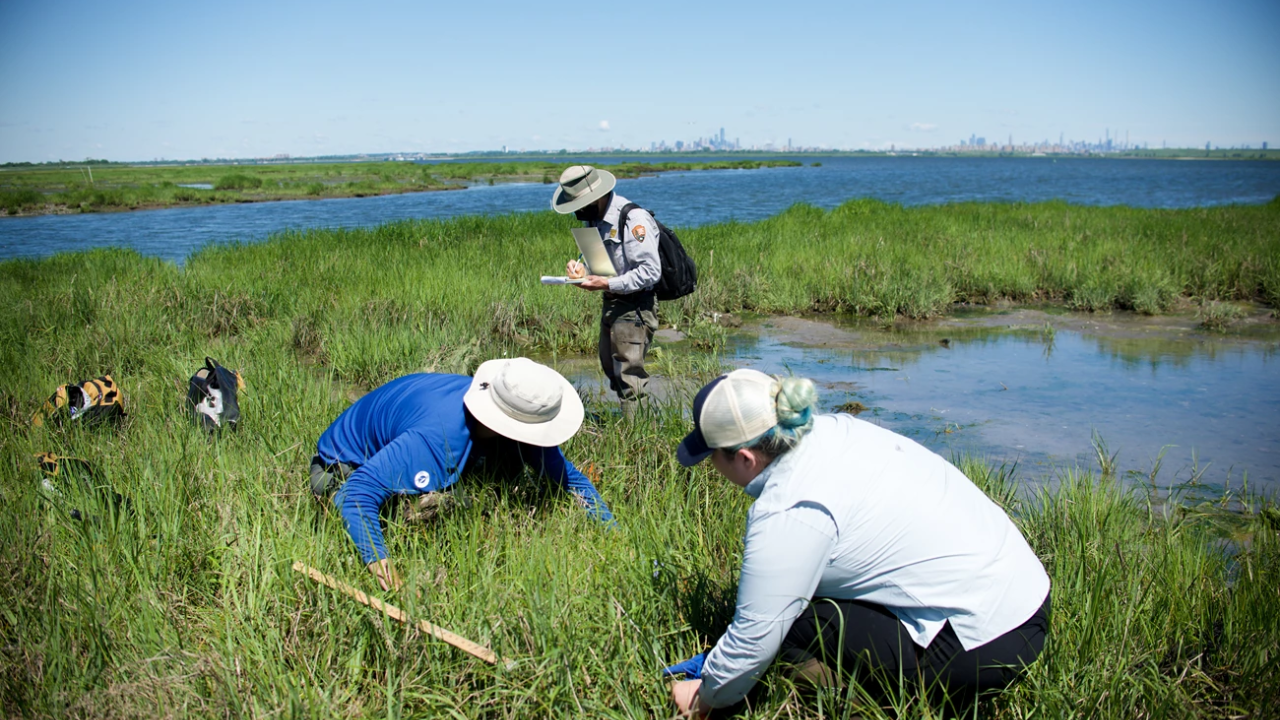
Two decades ago, a battalion of enthusiastic volunteers marched into New York City salt marshes, sank their knees into black anoxic muck, and jammed twenty thousand Spartina alterniflora seedlings into the mud. Two years later, chest-thumping press releases declared victory: eighty percent of those plants were alive and green.
Cue the applause. Hand out the certificates. Frame the local news clippings.
Except it is a lie wrapped in feel-good PR.
I have watched cities spend billions on coastal cosmetic surgery while the underlying patient bleeds out. Celebrating an eighty percent survival rate at the twenty-four-month mark in a dynamic estuary is the ecological equivalent of patting yourself on the back for keeping a houseplant alive on a windowsill for a weekend. It tells you nothing about whether the house is anchored to a cliff or sliding into the sea.
The lazy consensus in environmental journalism is that volunteer sweat equals ecological salvation. If citizens plant grass, the coast is saved. If the grass survives two summers, the project is a triumph. This narrative is comforting, photogenic, and fundamentally bankrupt. It substitutes gardening for geomorphology.
Let us dismantle the illusion of the two-year survival metric.
The Two-Year Mirage
Biology is not geology, and a clump of marsh grass is not a marsh.
When you plant Spartina plugs in a sheltered intertidal zone, they have built-in nutrient reserves. For the first twenty-four months, those plants survive on residual soil fertility and initial root establishment. They look healthy because they have not yet encountered a meteorological stress test worth the name.
A real coastal wetland is not judged by how many green shoots poke out of the mud after two mild winters. It is judged by its capacity for vertical accretion, root-mat tensile strength, organic carbon burial, and sediment trapping under severe hydrodynamic stress.
By measuring success at month twenty-four, the organizers of that 2003 planting engineered a statistical illusion. They measured the honeymoon phase. They walked away long before the first nor'easter rearranged the local bathymetry, long before rising sea levels outpaced sediment accumulation rates, and long before municipal stormwater runoff drowned the young plants in nutrient-laden chemical soup.
If you want to know if a marsh restoration worked, check back in twenty years, not two. Better yet, check whether the shoreline moved inward or outward during a hurricane. In almost every urban planting project of that scale, the shoreline lost ground while the press releases claimed victory.
The Feel-Good Industrial Complex
Why do cities keep funding and promoting these volunteer gardening parties? Because they are cheap, photogenic, and politically bulletproof.
Imagine telling taxpayers the truth: that fixing New York Harbor requires billions in grey infrastructure restructuring, massive upstream watershed management, removing concrete bulkheads, and accepting that certain waterfront real estate must be surrendered to the tide. That message loses elections, tanks property values, and upsets developers.
Instead, hand out shovels to office workers on a Saturday. Let them plant grass. It costs pennies compared to civil engineering, and it provides an intoxicating emotional payoff. Volunteers go home smelling of sulfur and satisfaction, convinced they personally rescued the Hudson River Estuary.
This is the feel-good industrial complex at work. It privatizes guilt and socializes greenwashing. It lets municipal governments off the hook by framing structural ecological collapse as a lack of volunteer enthusiasm rather than a consequence of systemic architectural failure.
When corporations sponsor these events, the cynical calculus is complete. They get their ESG photo op, write off the donation, and continue pumping untreated combined sewer overflows into the very waterways where the seedlings were planted. The marsh grass becomes a biological green screen masking ongoing environmental degradation.
The Brutal Physics of Urban Estuaries
Let us look at the actual physics governing New York Harbor, stripped of corporate PR.
New York City is not a pristine coastal wetland. It is a heavily channelized, highly industrialized maritime highway carved by centuries of dredging, bulkheading, and filling. The natural sediment supply—the raw material marshes use to build elevation and keep pace with rising seas—is largely trapped behind upstream dams on the Hudson and Passaic rivers.
When you drop twenty thousand seedlings into an energy-starved, sediment-starved urban estuary, you are asking grass to perform miracles against the laws of physics.
First, consider wave energy. New York Harbor is churned daily by commercial container ships, high-speed ferries, and recreational boat traffic generating continuous wake energy that natural marshes never evolved to handle. These wakes scour the mud away from newly planted root systems before they can anchor. An eighty percent survival rate at two years means little when the surrounding mudflat is systematically eroding underneath the plant base.
Second, consider hydrology. Natural salt marshes rely on tidal inundation and sheet flow to distribute water and nutrients evenly. Urban shorelines are choked with concrete walls, riprap, and storm drains that concentrate runoff into high-velocity firehoses. During a heavy rainstorm, these outfalls blast torrents of freshwater, heavy metals, road salt, and petroleum hydrocarbons directly onto the restoration sites. Spartina is tough, but it is not a sewage treatment plant.
Third, consider the nitrogen paradox. Urban runoff is saturated with nitrogen from lawn fertilizers and wastewater treatment plants. While nitrogen can accelerate shoot growth initially, it causes plants to invest energy into above-ground leaves rather than below-ground root networks. The result is a tall, top-heavy plant sitting on a weak, shallow root system. When a real storm hits, the plants do not bend; they sheer off at the mudline.
What Real Restoration Actually Looks Like
If gardening is not restoration, what is?
Real coastal restoration is invasive, expensive, disruptive, and rarely involves handing a shovel to a volunteer.
It starts with demolition. You rip out concrete bulkheads. You dynamite sea walls. You restore the natural slope of the shoreline so that wave energy can be dissipated across a wide, muddy intertidal gradient rather than slamming into a vertical wall.
Next comes sediment management. Because urban rivers are starved of natural silt, restoration requires mechanical replenishment—pumping thousands of cubic yards of clean dredge spoil onto subsiding marshes to artificially elevate the marsh platform above the rising tide.
It also requires hydrological reconnection. You do not just plant grass; you restore the tidal creeks and channels that allow water to drain efficiently. Without proper drainage, marshes turn into mosquito-infested stagnant ponds that die from root rot.
And crucially, it requires relinquishing space. A marsh cannot migrate inland as sea levels rise if there is a six-lane highway or a high-rise apartment building blocking its path. True coastal resilience means buying out waterfront property, tearing down structures, and giving the water room to breathe.
That is not a feel-good community event. That is a brutal, expensive political war.
The Uncomfortable Truth About Our Drowning Coasts
Admitting the limitations of small-scale volunteer plantings feels heretical because it shatters the illusion of control. We want to believe that human ingenuity and a few weekend hours can reverse centuries of industrial abuse.
We cannot.
The twenty thousand marsh seedlings planted in 2003 did not save New York City. The vast majority of them are long gone, eroded away by ship wakes, drowned by accelerated sea-level rise, or smothered by urban runoff. The survivors are footnotes in a larger story of ecological retreat.
This does not mean we should stop trying to restore coastal wetlands. It means we must stop lying about what it takes to succeed.
Stop treating ecological restoration as a marketing campaign. Stop measuring success by how many volunteers showed up with shovels and how many plants were green two summers later. Start measuring success by cubic yards of sediment accreted, wave energy attenuated, and square miles of hardened shoreline returned to the tide.
Until we are willing to spend the capital, break the concrete, and fight the political battles required for systemic hydrological repair, every volunteer planting event is just gardening on the deck of a sinking ship.
The mud is real. The crisis is real. The theater must end.


