Silence.
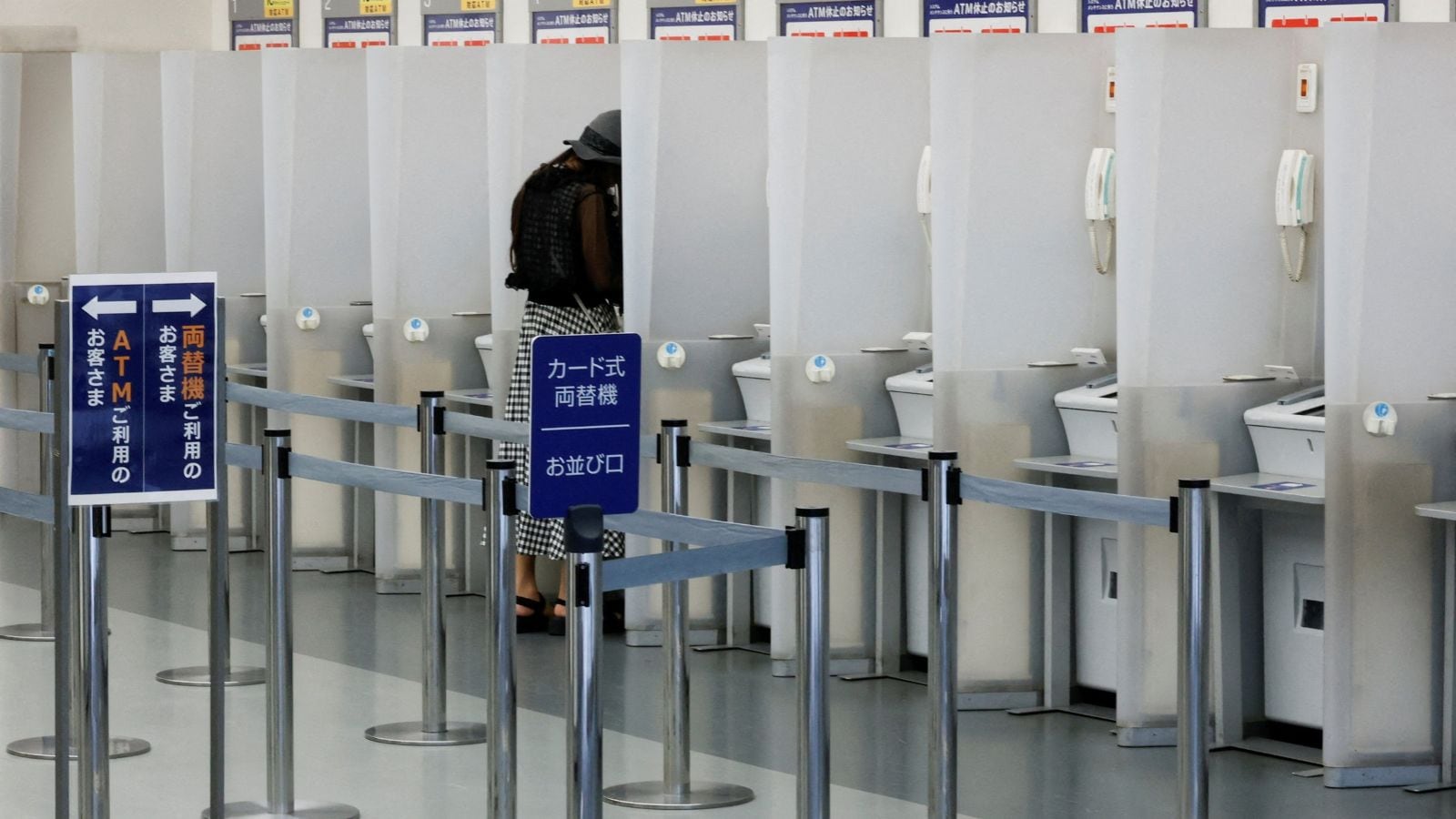
That is the first thing you notice when a financial system dies—not an alarm, not a siren, not a frantic ticker tape spilling onto a trading floor, just the sudden, unnatural hum of an ATM screen frozen in a pale blue purgatory while a line of commuters shifts from foot to foot in the morning rain.
Consider a hypothetical Tuesday in a mid-sized town outside Osaka. Let us call the man standing at the front of that line Kenji, a fifty-eight-year-old owner of a precision metal-stamping shop that employs twelve people. Kenji does not trade derivatives in Tokyo, nor does he keep his operating capital in offshore vaults; he banks with his local Shinkin bank, the exact sort of cooperative regional lender that has financed Japanese family workshops since the postwar reconstruction. Today is payroll day. Kenji inserts his plastic card, taps the familiar sequence on the glass, and waits for the mechanical whir of crisp ten-thousand-yen notes counting themselves out behind the shutter. Instead, the machine spits his card back into his palm with a dull click and displays a polite, bloodless apology about temporary maintenance. He pulls out his phone, opens his internet banking app to wire the wages manually, and watches a spinning wheel turn endlessly against a white background.
Multiply Kenji’s quiet panic by tens of thousands of shopkeepers, nurses, retirees, and delivery drivers across the archipelago, and you begin to grasp the true weight of what happened when a massive system failure severed ATM and internet banking services across 128 Shinkin banks in Japan.
The Architecture of Trust
To understand why a glitch inside a network of regional credit cooperatives feels like a tremor beneath the floorboards of an entire nation, you have to understand what a Shinkin bank actually is. In the West, banking is often treated as an adversarial sport—a cold transaction between a giant balance sheet and an interchangeable customer. In Japan, the 254 Shinkin banks scattered across prefectures and small cities are something closer to civic organs. They are non-profit cooperative institutions owned by their local members, built specifically to recycle neighborhood savings back into neighborhood enterprise. When a megabank in Tokyo looks at a third-generation noodle maker or a rural clinic and sees too little margin for too much paperwork, the local Shinkin branch manager shows up on a bicycle with a ledger and a thermos of tea.
Because these institutions are small by global standards, they survive by sharing their nervous system. Rather than each cooperative building and maintaining its own multi-billion-yen mainframe, they pool their resources into joint data centers—massive, centralized digital arteries operated by the Shinkin Central Bank and its technology partners. On paper, this shared infrastructure is an engineering triumph, allowing a tiny credit union in rural Hokkaido to offer the same mobile transfers and nationwide ATM access as a financial titan in Marunouchi.
In practice, however, centralization creates a single, terrifying point of failure.
When the central processing hub stumbled, the failure did not trickle outward like a localized power outage; it snapped shut across 128 independent institutions simultaneously, cutting off roughly half of the entire Shinkin network in a single stroke. One moment, millions of accounts were liquid, reachable, and real. The next, they were locked behind glass.
The Illusion of Modern Money
I have spent years reporting on financial infrastructure, and if there is one uncomfortable truth I have learned from sitting in cramped back offices with exhausted systems engineers, it is that modern money is largely a consensus hallucination held together by aging code.
We like to imagine our savings sitting in a neat, physical stack inside a steel vault, waiting patiently for us to ask for them. Think of your bank balance instead like a seat reservation on a bullet train. The seat itself—your purchasing power—is real enough, but your ability to sit in it depends entirely on a central computer agreeing that your ticket is valid at the exact second the conductor walks past. If that computer loses its connection to the carriage, you are left standing in the aisle holding a piece of paper that nobody can verify, even though you paid full price for the journey.
During the Shinkin outage, that theoretical vulnerability became visceral. Across affected branches, customers could not withdraw cash from their own bank’s machines, could not check balances online, and could not execute domestic fund transfers. Even more jarring was the ripple effect across Japan’s famously interconnected ATM ecosystem. Because Shinkin banks link into convenience store networks—the ubiquitous 7-Eleven, Lawson, and FamilyMart terminals that serve as the true financial capillaries of daily Japanese life—a customer trying to grab lunch money before catching a train suddenly found their card rejected at the corner store as well.
Cash is still king in Japan, despite a decade of aggressive government campaigns to push QR codes and contactless payments. People carry folding bills precisely because they trust physical paper over digital promises during earthquakes and typhoons. Yet even a cash-heavy society cannot function when the digital bridge between the vault and the wallet collapses. You cannot spend the yen you cannot reach.
Why Japan’s Plumbing Keeps Creaking
If this feels like déjà vu, it is because Japan’s financial sector has been fighting a quiet, exhausting war against its own legacy technology for years. Anyone who remembers the string of catastrophic outages at Mizuho Bank—where customers had their cards swallowed by ATMs and hundreds of thousands of transfers stalled in limbo—recognizes the symptoms immediately.
The root cause is rarely a Hollywood-style cyberattack by shadowy hackers in hoodies. More often, it is something far more mundane and far harder to fix: decades of patched-together software architecture collapsing under the weight of modern complexity.
In the 1970s and 1980s, Japanese banks built some of the most advanced, customized mainframe systems on earth. They wrote millions of lines of bespoke code tailored to uniquely intricate domestic banking rules—systems capable of handling massive batch settlements at the end of every month without breaking a sweat. For thirty years, those mainframes were monuments to reliability. Then came the smartphone era, real-time twenty-four-hour transfers, third-party payment apps, and strict new regulatory compliance checks. Instead of tearing down the old concrete foundations and pouring new ones, institutions bolted modern web interfaces onto legacy cores, creating towering digital Jenga structures where a single mistimed software update or hardware fault in a routing switch can trigger a cascade failure across dozens of connected banks.
Consider what happens next when an error occurs inside a shared clearing hub. To protect against data corruption—the absolute cardinal sin of banking, where a glitch might accidentally double-credit one account or erase another—the system is designed to fail closed. It slams the emergency brakes. Every transaction in flight is halted, queues back up like traffic behind a jackknifed lorry on the Tomei Expressway, and engineers have to painstakingly inspect millions of records by hand before they dare turn the ignition key again.
To the customer standing in the rain outside a shuttered ATM, that safety mechanism looks indistinguishable from a bank run.
The Invisible Cost of Lost Hours
When financial commentators discuss banking outages, they love to measure the damage in basis points, regulatory fines, and institutional reputation. They rarely measure it in human dignity.
Return for a moment to our hypothetical workshop owner, Kenji, outside Osaka. When the ATM refuses his card and his banking app stalls, his problem is not an abstract technical inconvenience. In Japanese business culture, failing to pay employees or suppliers on the exact promised morning carries a heavy, lingering stain of shame. Kenji cannot simply tell his twelve machinists to wait until the servers reboot; they have mortgages, school fees, and utility bills scheduled for automatic debit that very afternoon.
So Kenji begins the humiliating scramble that millions of ordinary people endure whenever digital infrastructure betrays them. He drives across town to a secondary bank where he keeps a small personal emergency account, drains his own household savings in cash, stuffs the envelopes by hand in the front seat of his van, and apologizes profusely to his staff as if he were the one who wrote the faulty code. Meanwhile, at the local Shinkin branch down the street, stressed tellers in navy uniforms bow endlessly behind the counter, manually verifying passbooks with ink stamps and calculators because their terminals are dark, trying to calm elderly pensioners who fear their life savings have vanished into thin air.
Multiply that friction across 128 banks—spanning rural agricultural towns, industrial suburbs, and dense urban wards—and you see the hidden tax of fragile technology. Every hour a payment rail stays down steals productive time from small businesses, delays medical co-pays, disrupts supply chains, and erodes the quiet, unspoken social contract that makes modern commerce possible.
What Actually Happens When the Lights Go Out
Whenever a major banking failure hits the headlines, a predictable wave of anxiety washes through the public. People whisper about solvency. They wonder if their money is safe, if their deposits are insured, or if the bank itself is secretly failing behind closed doors.
Let us separate the real danger from the phantom fear. A system outage—even one paralyzing 128 institutions at once—is a plumbing failure, not a solvency crisis. Your deposits are recorded across redundant, offline backup ledgers, and in Japan, the Deposit Insurance Corporation protects standard deposits up to ten million yen per depositor, per institution, plus accrued interest. The money has not evaporated; the door to the room has simply jammed.
Yet knowing your money is safe on paper offers cold comfort when you need to buy groceries at six in the evening. The real vulnerability exposed by the Shinkin failure is our collective over-reliance on a single point of access. Over the past decade, governments and fintech companies alike have nudged citizens toward frictionless convenience—one app for everything, one primary account linked to every bill, one tap to pay for life. Convenience is wonderful right up until the moment the network hiccups, at which point frictionlessness turns into total paralysis.
Building Personal Resilience in a Fragile Grid
If there is a practical lesson buried inside the wreckage of a 128-bank blackout, it is that individual resilience requires deliberate, old-fashioned redundancy. You do not need to stuff gold bars into your mattress or abandon digital banking altogether, but treating a single financial institution as an infallible utility is a gamble no household or small business should take.
The smartest operators keep what engineers call an air-gapped fallback. In plain terms, that means maintaining a secondary account at an entirely separate banking group—one that does not share the same back-end clearing infrastructure—funded with enough liquid cash to cover at least two weeks of essential payroll, rent, and groceries. It means keeping a modest reserve of physical banknotes locked at home, untouched unless the screens go dark. And for business owners, it means staggering critical payment schedules so that an automated batch transfer does not hit a wall on the exact morning a creditor expects settlement.
None of these habits will prevent a central mainframe from stumbling in Tokyo or Osaka. The engineers at the Shinkin Central Bank and its technology vendors will eventually trace the fault, patch the offending subroutine, publish a formal apology accompanied by deep bows at a press conference, and promise stricter oversight. The green lights on the ATMs will flicker back on, the apps will refresh, and the lines outside the branches will dissolve back into the daily rush of commuter traffic.
Until the next time.
Walk past any neighborhood bank late at night, and you can see the faint glow of the ATM vestibule illuminating an empty stretch of pavement. Inside sits a sleek metal box promising instant, effortless access to the accumulated labor of your life, humming softly behind thick glass—a quiet monument to our faith in invisible machines, waiting for the next morning when someone presses a button and hopes the voice on the other side still answers.