Silence.
That is the first thing you notice when the briefing room empties, the camera lights click off with a sharp metallic snap, and the heavy oak doors swing shut behind the last retreating reporter, leaving nothing behind except the faint hum of the air conditioning and the sudden, suffocating weight of your own reflection in the dark glass of a teleprompter.
For months, the world measures your worth in soundbites, decibels, and the sheer velocity with which you can parry a hostile question under the unforgiving glare of cable news chyrons. You live inside an adrenaline loop where loyalty is currency, outrage is oxygen, and the distance between a career-defining triumph and a career-ending exile is measured in a single poorly phrased sentence or a shifted political wind. Then, one Tuesday afternoon, the badge stops working at the security turnstile, the phone stops buzzing with producers begging for a five-minute hit, and the quiet moves in like fog off the Potomac.
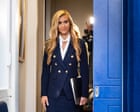
Yet for Katie Zacharia, the silence following her exit from the White House press operation did not bring the quiet obscurity that usually swallows former spokespeople. Instead, the noise simply changed frequencies, shifting from the chaotic theater of Washington media to the cold, methodical scrutiny of the State Bar of California.
According to public records and reporting surrounding the inquiry, the former White House press figure—who had previously traded the courtroom and legal commentary circuits for the high-wire act of executive branch communications—found herself facing an active investigation by California's attorney licensing body following her abrupt departure from the administration. The headline alone reads like standard Beltway schadenfreude, a five-second scroll item sandwiched between congressional gridlock and market tickers.
Look closer, though. Beneath the sterile administrative language of bar complaints and personnel exits lies a collision that has quietly defined modern American public life: what happens when the elastic rules of political combat crash headlong into the rigid, unforgiving architecture of legal ethics?
The Two Languages of Truth
To understand why a state bar investigation carries a gravity that a cable news scandal never will, you have to understand that lawyers and political operatives speak two entirely different languages, even when they occupy the exact same body.
Consider a hypothetical scenario—a composite of dozens of young attorneys who pack their bags for Washington every election cycle, believing their law degrees are merely shiny badges of credibility for the political arena. Imagine a sharp, ambitious thirty-something lawyer sitting in a sleek downtown Los Angeles office, drafting motions where every comma is anchored to a precedent and every factual assertion requires a sworn affidavit. In that room, words are load-bearing walls. If you misrepresent a fact to a tribunal or engage in conduct involving dishonesty, fraud, or deceit, the entire structure collapses, and the licensing board takes away your livelihood.
Now put that same lawyer behind a podium in Washington or in front of a bright studio ring light.
Suddenly, the incentives invert overnight. In the ecosystem of modern political communications, ambiguity is an art form, deflection is a survival skill, and framing is everything. Nobody cross-examines a press secretary under oath in the briefing room; they shout over each other until the segment goes to commercial. Over time, if you are not careful, the boundary between aggressive advocacy and ethical boundary-crossing blurs until you can no longer see the line beneath your boots.
I have watched colleagues walk that exact tightrope, and the sensory memory of it never quite leaves you—the metallic taste of lukewarm coffee at five in the morning, the frantic thumb-typing on a cracked phone screen while trying to spin a breaking story before the morning shows go live, the intoxicating rush of believing that because you are fighting for a cause or a principal, the ordinary rules of professional gravity no longer apply to you. It is confusing, seductive, and deeply disorienting, because the people applauding you loudest in the moment are never the ones sitting on the disciplinary committee three years later.
The Anatomy of the Inquiry
When reports surfaced that Katie Zacharia had been fired from her White House press role and was simultaneously under investigation by the State Bar of California, observers immediately tried to map the story onto familiar partisan templates. Critics saw vindication; defenders saw targeted institutional pressure. Both reactions miss the more sobering institutional reality of how state bar oversight actually works.
The State Bar of California—the largest state bar association in the country, overseeing more than a quarter-million licensed attorneys—does not operate like a television panel or a congressional committee. Its Office of Chief Trial Counsel functions as a slow-moving, largely invisible investigative apparatus. Unlike political controversies, which burn hot for forty-eight hours and vanish into the algorithmic memory hole, bar inquiries move at a glacial, bureaucratic pace that can stretch across months or even years.
Think of a state bar investigation less like a courtroom showdown and more like an audit of a building's foundation after an earthquake. Inspectors do not care how loudly the tenants argued during the tremor; they care whether the steel beams met code before the walls went up.
Under California's Rules of Professional Conduct—specifically rules governing honesty, trustworthiness, and fitness to practice law—an attorney's obligations do not evaporate when they step away from representing a traditional client in court. Rule 8.4 explicitly states that it is professional misconduct for a lawyer to engage in conduct involving dishonesty, fraud, deceit, or reckless or intentional misrepresentation, regardless of whether that conduct occurs inside a courtroom or out in the public square.
For Zacharia, whose public profile had been built at the intersection of legal punditry, conservative political commentary, and ultimately White House communications, that dual identity created an acute vulnerability. When you step up to a microphone and identify yourself—explicitly or implicitly—as an officer of the court, the bar association retains jurisdiction over your professional integrity even when your paycheck comes from a press office.
Why Firing Does Not Close the File
There is a widespread misconception outside Washington that being fired from a high-profile government post is the ultimate punishment—the final chapter of a public reckoning. In the private sector or in politics, termination is often treated as a reset button. You clean out your desk, endure a bruising news cycle, wait six months, and resurface at a consulting firm, a think tank, or a podcast network.
Law does not offer that kind of amnesty.
If a press secretary is dismissed from the White House, the employment relationship ends the moment the separation paperwork is processed. The West Wing moves on to the next news cycle within hours. Yet a state bar inquiry operates on an entirely separate track, indifferent to whether the subject still holds a government title, a security clearance, or a media contract.
In fact, a public firing can sometimes sharpen the focus of disciplinary investigators rather than dull it. When a departure from public office is abrupt and shrouded in competing narratives, bar investigators often examine the underlying conduct that precipitated the exit to determine whether any professional rules were breached along the way. Did the attorney make false statements in an official capacity? Were there conflicts of interest, improper disclosures, or ethical lapses tied to their work before or during their government tenure?
Until the State Bar of California either closes an investigation without action or files formal disciplinary charges in the State Bar Court, the details of an active probe remain largely confidential under California law—a deliberate mechanism designed to protect attorneys from reputational ruin over unsubstantiated complaints, while still allowing investigators to subpoena records and interview witnesses behind closed doors.
That confidentiality creates a strange purgatory for the person at the center of it. You cannot easily clear your name in the court of public opinion because the proceeding itself is opaque, yet the mere existence of an open inquiry hangs over every future job interview, board appointment, and client pitch like a low ceiling before a storm.
The Historical Echoes of Podium Peril
We have seen versions of this collision play out across decades of American political history, and the pattern is remarkably consistent whenever lawyers step into the blast radius of executive branch messaging.
During the Watergate era, the nation was stunned not simply by the political espionage at the heart of the scandal, but by the sheer number of licensed attorneys—men who had sworn solemn oaths to uphold the law—who treated legal ethics as an inconvenience to be navigated around in service of the presidency. That crisis forced the American Bar Association to overhaul its Model Rules of Professional Conduct, embedding stricter requirements around truthfulness and professional responsibility specifically because the profession realized how easily proximity to power corrodes ethical judgment.
More recently, the aftermath of the 2020 election produced a wave of high-profile bar proceedings against attorneys who blurred the line between political rhetoric and legal representation. Some lost their licenses entirely; others faced suspensions that effectively ended their careers in the law, even while they remained welcome guests on sympathetic media outlets.
The lesson across fifty years is blunt. Television networks and political campaigns reward audacity, speed, and unconditional loyalty. Licensing boards reward restraint, precision, and fidelity to institutional rules. When an individual tries to maximize their value in the first arena, they frequently accumulate liabilities in the second.
The Invisible Stakes for Everyone Watching
It is tempting to view the saga of a fired White House spokesperson facing a California bar inquiry as an insider drama reserved for political junkies and legal ethicists. After all, most people do not stand behind a White House lectern, and most do not hold a California bar card.
Look at what is actually at stake beneath the surface, though.
Every time a credentialed professional—a lawyer, a doctor, an engineer, an auditor—steps into the public square to speak on matters of public consequence, the public relies on their professional license as a silent guarantee of baseline trustworthiness. When we hear someone introduced as an attorney, we subconsciously assume there is an institutional floor beneath their words, a threshold of honesty they cannot cross without risking the credential that defines their career.
If that floor erodes, or if the public comes to believe that professional licenses are merely decorative props to be weaponized by partisans on one side and ignored by operatives on the other, something vital breaks in civic life. Trust does not collapse all at once in a single dramatic explosion. It drains away slowly, drop by drop, every time a title is used to lend authority to spin, and every time accountability looks indistinguishable from political retaliation.
At the same time, fairness demands recognizing the human reality inside the crucible. Anyone who has ever worked in high-stakes communications knows how disorienting the pressure can be—the sleeplessness, the conflicting directives from superiors, the relentless demand to defend positions that shift by the hour, and the sudden isolation when the institution decides you have become a liability rather than an asset. Accountability is necessary, and ethical rules exist precisely to hold firm when pressure mounts, yet the human cost of watching a career unravel in real time is undeniably real.
What Happens When the Noise Stops
For Katie Zacharia, the road ahead runs through quiet rooms far removed from the cameras of Washington—conference tables in Los Angeles or San Francisco where investigators examine documents line by line, ask questions without dramatic pauses, and weigh answers against written standards that have existed for generations.
There will be no viral clips from those meetings. No chyrons will flash across the bottom of a screen while attorneys review correspondence and timelines. Either the State Bar of California will find insufficient evidence of a violation and quietly close the file, or it will bring formal charges that force a public reckoning in State Bar Court, where the consequences range from private reproval to suspension or disbarment.
Outside, the political machine has already moved on, churning out new spokespeople, new controversies, and new headlines designed to last until tomorrow morning. Inside that quiet room, however, the ink on a law license dries slowly, and every word ever spoken into a microphone waits to be measured against the one standard that never changes when the cameras turn off.