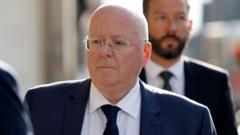
The push for an unprecedented joint inquiry by Holyrood and Westminster into Peter Murrell’s embezzlement of £400,310.65 from the Scottish National Party (SNP) exposes a fundamental vulnerability in UK political finance regulation: the systemic overlap of devolved party administration and sovereign public funding. While First Minister John Swinney argues that the five-year forensic investigation by Police Scotland under Operation Branchform concluded the matter via Murrell’s guilty plea, this position conflates criminal culpability with institutional governance. The proposal by former First Minister Lord Jack McConnell to deploy a concurrent probe via the House of Commons Public Accounts Committee and its Scottish Parliament equivalent is not merely a political maneuver; it represents a structural intervention designed to resolve a regulatory blind spot that allowed a decade-long financial extraction to persist undetected.
A rigorous evaluation of this crisis requires moving beyond political rhetoric to analyze the dual-jurisdiction operational structures, the specific capital flows under scrutiny, and the constitutional bottlenecks preventing a unilateral legislative resolution.
The Dual-Source Revenue Architecture of Devolved Parties
To quantify the institutional risk, a political party operating within a devolved framework must be understood as an enterprise funded by two distinct capital streams, each subject to separate oversight mechanisms.
- Private and Membership Capital: This stream comprises individual donations, legacy bequests, and grassroots membership dues. Governance of these funds is dictated by internal party constitutions and regulated externally by the Electoral Commission under the Political Parties, Elections and Referendums Act 2000 (PPERA).
- State-Funded Public Capital: This stream is designed to support opposition parliamentary infrastructure. At Westminster, this manifests as "Short Money," distributed to opposition parties to assist with parliamentary business. Given that the SNP functioned as the third-largest party in the House of Commons for nearly a decade, it received millions of pounds in statutory state funding. Concurrently, "Cranborne Money" supports opposition activity in the House of Lords, while equivalent operational allowances fund party structures within Holyrood.
The core administrative failure occurs at the point of convergence. While the statutory purpose of Short Money is strictly bound to parliamentary duties, the internal executive leadership of a political party—in this instance, managed unilaterally by Murrell as Chief Executive from 2001 onward—exercises central administrative control over how staff resources, regional offices, and shared operational infrastructures are allocated.
Because party accounts aggregate these funds into broad operational expenditure categories, a systemic vulnerability emerges. If an executive figure extracts capital from the central party pot, the lack of granular, real-time separation between state-funded assets and membership-derived assets means that public capital effectively subsidizes the deficit caused by criminal extraction. This overlapping capital matrix forms the technical basis for Westminster's jurisdictional claim over what the current Scottish Government insists is an entirely internal party matter.
The Governance Failure and Internal Whistleblower Bottlenecks
The structural breakdown that facilitated an embezzlement operation spanning from August 2010 to October 2022 cannot be explained by individual criminality alone. It requires analyzing the internal checks and balances that suffered systemic failure. Within standard corporate governance models, the chief executive officer reports to a board of directors, and financial reporting is insulated by independent audit committees. In the SNP’s governance model during this period, this hierarchy was compromised by an acute concentration of executive power and a profound lack of structural independence.
The primary systemic vulnerability was the centralization of financial authority. The roles of political strategy, administrative oversight, and financial management converged within a highly insulated leadership structure. When internal actors attempted to exercise their fiduciary duties, they encountered structural barriers designed to suppress dissent.
[Internal Whistleblower / Elected Treasurer]
                 │
                 ▼ (Attempts Financial Audit)
[Systemic Barrier: Executive Centralization of Information]
                 │
                 ▼ (Information Denied / Marginalization)
[Governance Failure: Prolonged Capital Leakage 2010-2022]
The resignation of senior party figures, including elected treasurers who publicly cited an inability to access the full management accounts, demonstrates a deliberate informational asymmetry. Under standard corporate accountability, a refusal to grant an elected CFO or treasurer access to the underlying general ledger would trigger an immediate statutory audit failure. Within this political structure, the executive apparatus possessed the authority to deny information to its own oversight officers, effectively decoupling accountability from executive action. This created a prolonged period of undetected capital leakage.
The Institutional Limitations of Unilateral Accountability
The current standoff between Westminster’s Scottish Affairs Committee and Holyrood’s executive leadership reveals the constitutional limitations of relying on a single legislative chamber to police cross-border political structures.
The Holyrood Jurisdictional Constraint
The Scottish Parliament operates under delegated powers, and its committee structures are highly susceptible to the balance of power within the chamber. When the Scottish Government exercises a tight legislative grip or relies on cross-party arrangements to maintain executive control, parliamentary committees can be effectively neutralized. John Swinney's executive veto of a Holyrood parliamentary inquiry demonstrates that devolution lacks a completely insulated mechanism to compel a ruling party to investigate its own historical executive machinery. The committee system in Edinburgh faces an existential bottleneck: it cannot easily separate party loyalty from its constitutional duty to oversee public administration.
The Westminster Partisan Asymmetry
Conversely, if the House of Commons Scottish Affairs Committee or the Public Accounts Committee initiates a unilateral investigation, it encounters an immediate challenge to its institutional legitimacy. Because the committee’s composition inevitably reflects the wider UK parliamentary balance—currently dominated by unionist parties—any unilateral findings face being dismissed by a nationalist executive in Edinburgh as a politically motivated attack. This dynamic introduces a high risk of partisan bias, where the objective investigation of financial systems is obscured by constitutional optics.
A unilateral Westminster probe has the statutory power to compel witnesses and documents under parliamentary privilege, but it lacks the local institutional buy-in required to implement structural reforms within Scotland’s distinct civic and legal landscape.
The Joint Committee Framework as a Regulatory Mechanism
To bypass the partisan asymmetry of Westminster and the executive bottleneck of Holyrood, the implementation of a concurrent, joint parliamentary inquiry offers a stable regulatory path forward. This approach utilizes the comparative advantages of both legislative bodies while neutralizing their respective institutional vulnerabilities.
| Operational Dimension | Unilateral Westminster Committee | Unilateral Holyrood Committee | Proposed Joint Inquiry Framework |
|---|---|---|---|
| Statutory Mandate | Oversees Short Money and federal electoral compliance. | Oversees domestic administrative governance and local public funds. | Dual-mandate tracking of both federal Short Money and devolved assets. |
| Political Legitimacy | High risk of partisan framing; vulnerable to accusations of cross-border bias. | Vulnerable to domestic executive stonewalling and internal party defense mechanisms. | Cross-jurisdictional composition neutralizes simple partisan dismissal. |
| Subpoena Scope | Broad UK-wide powers, but faces logistical friction regarding devolved executives. | High local proximity, but limited by executive resistance and narrow constitutional scope. | Full unified access to internal party logs, bank records, and civil service communications. |
The mechanism for this joint framework relies on the alignment of the House of Commons Public Accounts Committee (PAC) and the Scottish Parliament’s equivalent audit committees. The PAC brings an established methodology for tracking the exact ROI and compliance of public fund allocations, while the Holyrood component provides direct operational access to the domestic actors and institutions involved.
This structural alignment changes the inquiry from a retrospective political tribunal into a prospective regulatory assessment. The objective shifts from assigning personal criminal blame—which remains the domain of the judiciary—to analyzing the reporting gaps between the Electoral Commission, independent commercial auditors, and parliamentary accounting officers.
The Strategic Objective: Upgrading Political Finance Risk Models
The final strategic move cannot simply be the exposure of past administrative failures; it must be the establishment of an upgraded risk framework for political party governance across all UK jurisdictions. If political parties continue to operate as multi-million-pound enterprises managing a blend of public and private capital, their financial reporting requirements must be elevated to match those of regulated financial institutions or public corporations.
The implementation of a joint inquiry serves as the catalyst for three mandatory structural reforms:
- The Separation of Capital Mandates: Political entities receiving public funds must legally segregate Short Money and other state allowances into ring-fenced bank accounts, subject to continuous, independent, real-time auditing by the National Audit Office (NAO), completely independent of the party’s internal auditors.
- Statutory Whistleblower Protection within Political Structures: The expansion of employment and governance law to ensure that elected party officials (such as national treasurers and executive committee members) possess explicit, legally enforceable rights to all underlying transaction data, with immediate statutory recourse to external regulators if information is withheld by executive employees.
- The Elimination of Familial Co-Dependency Vectors: The establishment of strict regulatory restrictions preventing the simultaneous holding of top political leadership roles and senior executive administrative positions by individuals with immediate familial or marital ties. This step addresses the structural risk of concentrated control that compromised the internal checks and balances in this case.
Failing to execute this dual-parliamentary inquiry leaves the systemic vulnerabilities unaddressed. A purely judicial resolution punishes the individual asset extraction but leaves the institutional channels open for future exploitation across any political organization operating within the UK's complex devolved architecture.