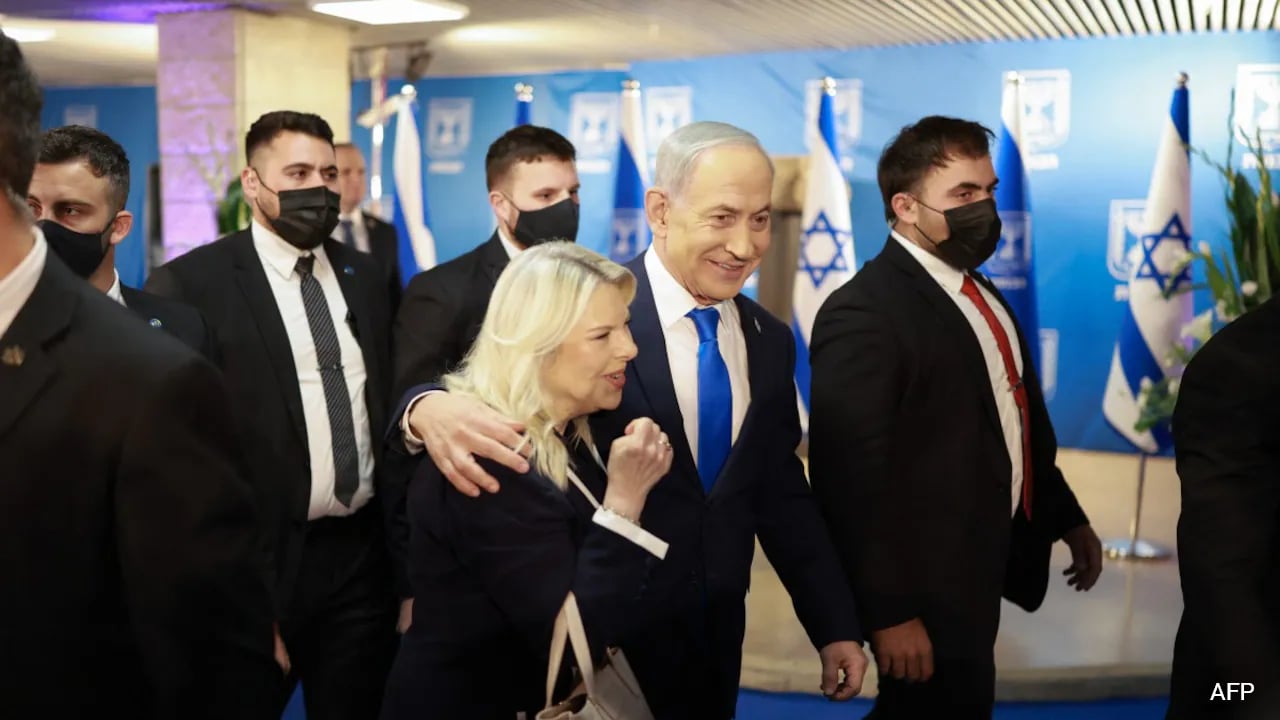
Public confrontations inside legislative chambers rarely occur as isolated emotional outbursts; rather, they represent the surface rupture of prolonged institutional friction, personal rivalry, and strategic signaling. When a widely circulated video captures Sara Netanyahu, the spouse of Israeli Prime Minister Benjamin Netanyahu, engaged in a heated verbal exchange with a former prime minister inside the Knesset, conventional media coverage typically reduces the event to personality-driven spectacle. A rigorous structural analysis, however, reveals how interpersonal hostility within parliamentary spaces operates as an informal political instrument, reshaping coalition dynamics, media attention cycles, and public perceptions of institutional decorum.
The Structural Context of Parliamentary Proximity
Legislative architecture is designed to enforce physical proximity among political adversaries. Unlike executive residences or private party headquarters, the Knesset functions as a shared operational arena where ruling coalition members, opposition leaders, family members in the visitors' gallery, and parliamentary staff occupy overlapping corridors and viewing zones. This spatial compression eliminates the buffer zones that normally insulate high-level political actors from unscripted encounters. For a more detailed analysis into similar topics, we suggest: this related article.
According to standard parliamentary governance models, the visitors' gallery and adjacent legislative hallways serve as semi-public stages. Every interaction occurring within sightlines of press pools or mobile phone cameras carries immediate broadcast potential. In Israeli politics, where coalition majorities are frequently narrow and legislative sessions involve high-stakes procedural votes, ambient tension inside the plenum remains elevated. When personal grievances intersect with legislative deadlines, the probability of an unscripted confrontation increases substantially.
Deconstructing the Confrontation Mechanism
To understand why an exchange featuring sharp personal insults—such as the phrase "You worthless man" reported in media accounts of the incident—gains traction, analysts must separate the interpersonal trigger from the systemic amplification loop. For additional background on this issue, comprehensive coverage is available on The Guardian.
The Triggering Asymmetry
Political spouses occupy an ambiguous institutional role. They hold no formal electoral mandate or statutory portfolio, yet they wield substantial informal influence over personnel decisions, political messaging, and access to the head of government. When a political spouse confronts an elected former prime minister, the exchange bypasses traditional parliamentary rules of order. A sitting member of the Knesset is bound by ethics committee guidelines and floor decorum; a private citizen or family member in the gallery operates outside direct legislative sanction, creating an asymmetrical dynamic where standard institutional deterrents fail to apply.The Historical Rivalry Variable
Israeli political leadership over the past two decades has been characterized by recurring cycles of alliance and rupture among a relatively small cohort of senior figures. Former prime ministers—such as Ehud Barak, Ehud Olmert, Naftali Bennett, or Yair Lapid—have transitioned from coalition partners or senior cabinet ministers into vocal critics of Benjamin Netanyahu. These relationships carry deep personal and ideological baggage, including disputes over security doctrine, judicial reform, coalition betrayals, and media coverage. An acute verbal clash in the Knesset corridor is rarely about the immediate legislative agenda; it is the cumulative discharge of multi-year political warfare.The Viral Capture and Distribution Loop
Modern parliamentary reporting relies heavily on real-time video capture by aides, lawmakers, and accredited journalists. Once a confrontation occurs, the distribution mechanism follows a predictable sequence:
- Immediate Extraction: A short, emotionally charged clip is isolated from its broader chronological context.
- Headline Framing: News outlets anchor coverage around the most provocative verbatim quote to maximize click-through rates.
- Partisan Weaponization: Opposition surrogates frame the footage as evidence of executive arrogance, erratic temperament, or a breakdown in statecraft. Conversely, coalition defenders characterize the exchange as a justified reaction to relentless personal attacks or political hypocrisy by the former prime minister.
Media Attention Economics and Strategic Distraction
In high-intensity political environments, attention is a finite resource. Every hour that cable news panels and social media feeds dedicate to analyzing a personal altercation in the Knesset is an hour diverted from substantive policy scrutiny—such as budget allocations, military readiness, diplomatic negotiations, or judicial legislation.
Media economists refer to this phenomenon as agenda displacement. While an unscripted outburst is seldom orchestrated deliberately, political communication teams rapidly adapt to exploit its effects. If a government faces unfavorable coverage regarding economic indicators or security lapses, a viral interpersonal clash shifts the narrative onto familiar, polarizing terrain where base voters rally reflexively around their respective leaders. Conversely, for opposition figures, capturing a senior government figure's inner circle losing composure provides low-cost visual proof to reinforce existing narratives about leadership instability.
Institutional Costs and the Erosion of Parliamentary Norms
Beyond immediate news cycles, repeated public confrontations carry measurable institutional costs for democratic governance:
- Degradation of Deliberative Space: Parliaments rely on stylized formality—addressing members through the speaker, adhering to time limits, and maintaining physical separation—to channel existential political conflicts into non-violent procedural disputes. When personal invective breaches the physical boundaries of the chamber, the psychological barrier separating debate from personal hostility weakens.
- Blurring of Official and Private Boundaries: The prominent visibility of family members in legislative disputes reinforces public skepticism regarding informal power structures. Critics argue that when non-elected relatives engage directly with former heads of government on state premises, it blurs the distinction between personal loyalty and public accountability.
- Desensitization of the Electorate: Each high-profile breach of decorum resets the baseline of acceptable political behavior. Over time, voters become desensitized to institutional norm violations, reducing the electoral penalty for future escalations and incentivizing performative confrontation over legislative compromise.
Limitations of Behavioral Analysis in Politics
Analysts evaluating viral political footage must account for significant evidentiary constraints. Short video clips rarely capture the precipitating remarks, body language, or prior interactions that occurred seconds before recording began. Without complete audio-visual continuity, attributing sole initiation to one party involves speculation rather than verified fact. Furthermore, observers must distinguish between genuine emotional spontaneity and calculated political theater; experienced political actors are acutely aware of camera presence in the Knesset and frequently calibrate their vocal volume and phrasing for external consumption.
Strategic Imperatives for Institutional Stakeholders
To prevent interpersonal friction from dominating legislative operations and eroding public trust, parliamentary authorities and political leadership teams must enforce structural guardrails rather than relying on individual restraint.
- Strict Spatial and Access Protocols: Knesset security and protocol officers should enforce clear physical separation between non-member visitors—including family members of senior officials—and active legislative transit zones during high-tension sessions. Eliminating unscheduled intersections removes the physical precondition for corridor confrontations.
- Unified Communications Discipline: Political leadership teams must establish clear boundaries regarding public engagement by non-elected surrogates and family members. Allowing informal actors to engage in unscripted disputes creates unmanageable messaging liabilities that distract from core policy objectives.
- Procedural Enforcement by the Speaker: Parliamentary presiding officers must apply decorum rules consistently across all gallery attendees and members, utilizing immediate recess or gallery clearance protocols at the onset of verbal disruptions to preserve the institutional integrity of the legislative floor.