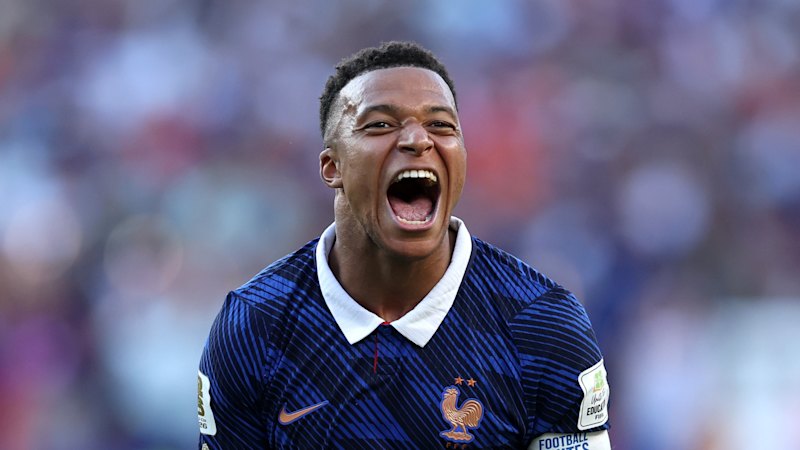
Emmanuel Macron and Kylian Mbappé are running a tired playbook. When the French national team captain takes to the microphone to condemn racism, and the President of the Republic immediately rushes to back him up, the media treats it as a watershed moment of moral clarity. They call it brave. They call it leadership.
It is neither. It is calculated brand management that completely misses the structural reality of modern sports.
The lazy consensus dominating sports media insists that high-profile athlete activism, backed by state validation, is the primary weapon against discrimination. This view is naive. By turning systemic societal fractures into a clean, binary narrative of good celebrities versus bad fans, political and athletic elites are not solving the problem. They are exploiting it to burnish their own credentials while changing absolutely nothing on the ground.
The Illusion of the Activist Athlete
Elite football operates in a vacuum of immense wealth and hyper-curated public relations. When a player of Mbappé’s stature speaks out, it is rarely an unscripted moment of raw defiance. It is a highly managed corporate communication strategy.
Let’s look at the numbers. The global sports market is valued at over $500 billion. At that scale, top-tier athletes are no longer just players; they are multi-national corporations. Mbappé’s move to Real Madrid in 2024, complete with a signing bonus exceeding €100 million and an annual salary of €15 million after tax, places him in a socio-economic bracket that is entirely insulated from the realities of the average citizen.
When an elite athlete condemns racism from a press conference podium, they risk nothing. Nike, Hublot, and Oakley do not drop athletes for opposing bigotry; they build entire marketing campaigns around it.
I have spent years analyzing the commercial structures of European football clubs, watching executive boards navigate public crises. When a racism scandal hits, the immediate response from ownership is not "how do we fix the systemic issues in our academy pipeline or local communities?" The question is always "how do we protect the asset value and sponsor relationships?"
Condemnation is cheap. It costs a club or a player zero Euros to issue a statement. It allows them to control the news cycle, appease corporate partners, and shift the burden of proof onto an abstract, faceless mass of stadium crowds.
The Political Co-Optation Engine
Then comes the state. Macron’s quick intervention to call the abuse "despicable" is a textbook example of political opportunism.
French politics has been fractured for years, marked by bitter debates over immigration, national identity, and economic inequality. The French national team, Les Bleus, has historically been used by politicians as a convenient, fluctuating symbol of French multiculturalism when they win, and a scapegoat when things fall apart.
Remember 1998? The "Black-Blanc-Beur" (Black, White, Arab) team won the World Cup, and politicians claimed racism was solved in France. By 2005, the banlieues were burning. By 2010, after the team's strike in Knysna, South Africa, politicians openly questioned the patriotism and ethnic makeup of the squad.
Macron’s public alignment with Mbappé is not a sudden burst of egalitarian passion. It is a tactical move to draft off the popularity of a national icon. By focusing the conversation on overt, individual acts of racism inside stadiums, the political class successfully diverts attention from structural failures in housing, education, and employment parity in the very suburbs that produce France's footballing talent.
The Flawed Premise of Stadium Bans and Social Media Fines
The standard response to stadium racism is a predictable loop of stadium bans, fines for clubs, and demands for social media platforms to censor users. This approach is fundamentally broken because it treats the symptom as the disease.
Football stadiums do not generate racism; they merely amplify it. A stadium is a highly concentrated crucible of tribalism, alcohol, and anonymity. Expecting to eliminate societal prejudice by policing a ninety-minute window on a Saturday afternoon is like trying to lower the ocean by bailiffing the shore.
Consider the mechanics of current disciplinary measures:
- Financial Fines: UEFA or FIFA fine a national federation €50,000 for fan behavior. To an organization pulling in hundreds of millions in broadcast rights, this is an accounting rounding error, not a deterrent.
- Empty Stadium Closures: This punishes the entire fan base, broadcasters, and local stadium workers for the actions of a vocal minority, fostering deeper resentment rather than education.
- Algorithmic Censorship: Demanding that social media companies scrub offensive comments simply drives the behavior into closed, unmonitored digital spaces where radicalization accelerates.
Imagine a scenario where a tech company invents a flawless, real-time facial recognition and audio tracking system that instantly ejects and permanently bans any fan uttering a discriminatory slur. The stadium becomes pristine. Does the racism vanish? No. The individual walks out of the turnstiles and carries that exact same animosity back into their workplace, their neighborhood, and the voting booth.
By pretending the stadium is the battlefield, football executives get to claim victory while the actual societal rot continues unabated.
The Complicity of the Media Monoculture
Sports journalism has largely abandoned objective critique in favor of moral narrative building. The coverage of the Macron-Mbappé dynamic proves that access journalism requires feeding the celebrity ecosystem.
Reporters do not ask the hard questions. They do not ask Mbappé how his commercial partnerships with brands that rely on low-wage labor in developing nations align with his human rights advocacy. They do not ask Macron why his government pushes restrictive immigration policies while he simultaneously uses Black and Arab football players as the public face of French excellence.
Instead, the media prints the platitudes. They create a moral binary that satisfies the algorithm, generates clicks, and keeps everyone happy—except for the people actually facing discrimination on a daily basis without a PR team to defend them.
The Downside of Disruption
Taking a contrarian view on this topic carries risks. It is incredibly easy for critics to mischaracterize systemic skepticism as apathy toward racism itself.
Let’s be unequivocal: targeted abuse directed at players because of their race is vile. The psychological toll on athletes is real. But pointing out that the current remedies are superficial performance art is not the same as dismissing the problem.
The danger of our current trajectory is that performance art creates complacency. When society checks the box because a famous athlete made a speech and a politician tweeted their support, the collective will to do the hard, boring work of structural reform evaporates. We mistake awareness for progress.
What Real Reform Looks Like
If the current model of celebrity condemnation and political backing is an ineffective loop, how do you actually disrupt the cycle? You have to shift the focus from moral posturing to economic and structural accountability.
1. Divert Fine Revenue Directly to Community Pipelines
National federations should not absorb fines into their general operating budgets. Every Euro collected from stadium infractions should be legally mandated to fund independent, grassroots legal aid and economic development programs in the specific communities where stadium abusers reside. If fans know their bad behavior directly funds the empowerment of the groups they target, the tribal dynamic changes completely.
2. Force True Representation in Corporate Governance
While the pitch in Ligue 1 is diverse, the boardrooms of the clubs, the French Football Federation (FFF), and the executive suites of major sponsors remain overwhelmingly white and aristocratic. Stop asking players to speak on the pitch. Demand that clubs hit hard targets for diversity in executive leadership, ownership structures, and sporting director roles. Power is conceded through governance, not press conferences.
3. Enact Player-Led Economic Strikes
If players truly want to force structural change, they must move past statements. They must leverage their actual power: capital. A collective refusal by top-tier players to participate in broadcast interviews or sponsor activations—directly impacting the television revenue that keeps the sport alive—would do more to force federations and governments into systemic action in 24 hours than a decade of hashtags and presidential endorsements.
The constant cycle of outrage, condemnation, and political validation is an elite feedback loop that serves everyone except the victim. Mbappé will keep scoring goals, Macron will keep seeking votes, and the media will keep writing the same headlines. Until the financial and structural mechanisms of the sport are dismantled and rebuilt, everything else is just background noise.


