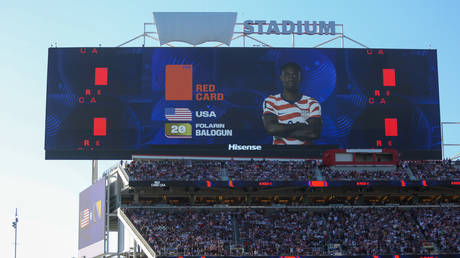
The collective gasp from soccer traditionalists when reports surfaced that Donald Trump pressured FIFA to review Folarin Balogun’s World Cup suspension was entirely predictable. The media instantly rolled out the standard playbook. They wrung their hands over the sanctity of the game. They cited FIFA statutes regarding government interference. They lamented the degradation of sports by geopolitical egos.
It is a comforting narrative for purists. It is also completely wrong. You might also find this connected article interesting: The Tactical Breakdown of Norway Knocking Brazil Out of the World Cup.
The outrage machine missed the real story because it clings to a foundational myth: that international soccer operates in a pristine vacuum, untouched by global power dynamics. The sports press loves to pretend FIFA is a neutral high court of athletic justice. It behaves as if the field is a sacred space where global politics dissolve.
Step out of the fantasy. FIFA is not a sports organization. It is a sovereign corporate entity that wields more diplomatic leverage than half the nations on earth. Pretending a U.S. president pulling strings behind the scenes is an unprecedented violation of the sport’s integrity ignores a century of football history. As highlighted in detailed articles by Sky Sports, the results are worth noting.
Political interference is not a bug in international soccer. It is the core operating mechanism.
The Myth of the Independent Federation
Every time a government official opens their mouth about a red card or a tournament ban, the compliance dorks at FIFA headquarters threaten suspension. They point to their treasured statutes, specifically the rules demanding that member associations manage their affairs independently without influence from third parties.
This is a administrative fiction designed to protect a monopoly.
FIFA demands total autonomy from national laws while simultaneously demanding national tax exemptions, billions in public infrastructure spending, and specialized visa fast-tracks for its executives. When a host country builds stadiums using public funds, that is called a partnership. When a head of state questions a highly debatable disciplinary decision that benches a multi-million-dollar asset during a home World Cup, it is suddenly a crisis of ethics.
Consider the reality of what actually happens when a star player like Balogun gets sidelined. A suspension is not just a sporting penalty. In the context of a modern World Cup, it is the state-sanctioned devaluation of a national entertainment product. The United States Soccer Federation invests millions in talent development, marketing, and hosting rights. Broadcasters wager billions on viewership. To expect a global superpower to sit quietly while a opaque Swiss committee alters the competitive landscape of a tournament on its own soil is naive.
The lazy consensus screams that sports and politics must never mix. The historical reality shows they have never been separate.
How the Game is Actually Played
If you think this backchannel pressure is a unique aberration of the current American political climate, you have not been paying attention to international sports diplomacy.
For decades, European and South American heads of state have integrated football into their foreign policy. When systemic corruption threatened to derail major tournaments in the past, prime ministers and presidents routinely stepped in to negotiate immunity, funding, and security structures. Dictators and democratic leaders alike have used national team success as a metric of state health since the 1930s.
Imagine a scenario where a corporate CEO finds their top-performing regional manager barred from operating by an external regulator under sketchy circumstances. The CEO does not write a polite letter to the regulator’s customer service inbox. They call their contacts in government to apply regulatory counter-pressure.
That is exactly what a presidential intervention represents. It is a recognition that FIFA responds only to raw leverage.
The international soccer apparatus understands power, capital, and public pressure. It does not operate on abstract notions of fairness. When the U.S. Department of Justice busted the FIFA executive committee in 2015, it was not done through sports tribunals. It was done via federal indictments, wiretaps, and asset seizures. The United States proved then that the only way to shift FIFA's trajectory is through direct, aggressive institutional force.
Using executive influence to question a player suspension is just the logical continuation of that relationship.
The Strategy Behind the Balogun Leverage
Let’s look at the actual sporting asset in question. Folarin Balogun represents the modern era of the dual-national recruitment battle. Securing his commitment to the U.S. men's national team was a multi-year corporate acquisition strategy requiring pitches from executives, apparel brands, and federations.
When a referee’s decision or a disciplinary committee’s retroactive ban removes an elite striker from the pitch, the damage radiates outward. It harms television ratings. It reduces sponsor engagement. It cripples the host nation's competitive viability.
The standard operating procedure for a soccer federation facing an unfair ban is to file a formal appeal through FIFA’s internal channels. This is an exercise in futility. The appeal is reviewed by the same institutional machine that issued the penalty. The success rate of these formal avenues is dismal because the system is designed to protect its own officials.
By elevating the issue to the executive branch of government, the calculus changes instantly. It forces the bureaucrats in Zurich to realize that their disciplinary decisions carry real-world geopolitical friction. It reminds them that the country hosting their premier, revenue-generating tournament possesses the keys to the kingdom regarding visas, tax statuses, and corporate sponsorship pipelines.
Is it fair to smaller nations who cannot mobilize a nuclear-armed state apparatus to appeal a red card? No. But international football has never been fair. The illusion of a level playing field exists only on the grass. Off the pitch, power dictates the rules.
The Playbook for Modern Sports Governance
Federations around the globe need to stop playing by the outdated rulebook written by mid-century European administrators. The organizations that win in the current sports economy are the ones that treat their national teams as vital state assets worthy of federal protection.
If you are a sports executive running a national governing body, your strategy shouldn't involve hiding from political infrastructure. It should involve integrating with it.
- Stop apologizing for political alignment. If a government asset can help protect your players from arbitrary institutional overreach, you utilize that asset.
- Weaponize host status. When you hold the keys to the infrastructure of a global tournament, you possess the leverage. Use it before the tournament begins, not just when things go wrong.
- Dismantle the independent federation myth. Treat your organization like a public-private partnership because that is what it actually is.
The real downside to this approach is obvious: it invites instability. If every nation began using its state department to contest refereeing decisions, international sport would devolve into a bureaucratic nightmare of endless litigation and diplomatic standoffs. It would make tournament management incredibly messy.
But messiness is preferable to the current status quo, where an unaccountable committee can alter the competitive balance of a tournament with zero external oversight.
The reports of political pressure regarding Balogun should not be viewed as a scandal. They should be viewed as a blueprint. It is a stark reminder that the game is bigger than the governing body that claims to own it. When the stakes are high enough, the old rules of administrative autonomy disappear, and the real power players take the field. Treat the sport like the multi-billion-dollar geopolitical industry it is, or get left behind by those who do.