Pope Leo XIV just landed in Spain, and he isn't pulling any punches.
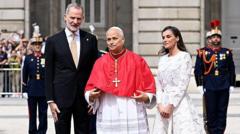
Stepping off the plane in Madrid to start a week-long tour, the Chicago-born pontiff immediately took aim at the toxic culture dividing modern politics. Speaking at the Royal Palace alongside King Felipe VI, the Pope threw down a gauntlet to global leaders. He told them to stop using "sterile simplifications" and polarization just to score cheap political points.
This isn't your standard, rehearsed papal greeting. It's a highly calculated, deeply opinionated opening salvo.
People are searching for the real motive behind this trip because it represents a massive shift in how the Vatican interacts with European power structures. This is the first time a pope has set foot in Spain since 2011, and it's Leo’s very first trip to an EU country outside Italy since he was elected last year.
He didn't choose Spain by accident. He chose it because the country is currently the ultimate ideological battleground for the biggest crises facing the West: immigration, the threat of global war, and the ethics of a rapidly accelerating tech culture.
The Collision with Global Populism
If you want to understand why this speech matters, you have to look at who it targets. Pope Leo has been locked in a fierce, public war of words with US President Donald Trump over the American administration's hardline anti-immigration policies and escalating military posture regarding Iran. Trump recently blasted the Pope on social media, calling him "weak on crime" and "terrible for foreign policy."
Leo's response? He told reporters on the flight from Rome that he has no fear of the Trump administration. He proved it the second his feet hit Spanish soil.
By praising Spain’s current national direction, the Pope is intentionally backing a massive political experiment. Under Socialist Prime Minister Pedro Sánchez, Spain recently launched an amnesty program to grant legal status to roughly 500,000 undocumented immigrants. While the rest of Europe and the United States are building walls, tightening borders, and riding a wave of right-wing nationalism, Spain is doing the exact opposite.
The Pope isn't just dropping by for a chat. He's using his massive global platform to validate Spain's open-door policy as a moral blueprint for the rest of the Western world. He explicitly called on leaders to listen to a world crying "from its depths for peace" instead of fanning the flames of division.
Shifting Focus to the Margins
You can judge a papal trip by its itinerary, and Leo’s schedule shows exactly where his priorities lie. He isn't spending his time locked away in elite theological conferences. He's going straight to the streets.
On his very first afternoon in Madrid, the Pope bypassed the typical political functions to visit a Church-run shelter for the homeless. He sat down and listened to people like Khadry, a migrant from Senegal who handed the Pope a replica of his newly minted Spanish residency card. Khadry talked about the sheer terror of arriving in a country with absolutely nothing, and how legal status gave him a job, a life, and a sense of human dignity.
That's the core message Leo is pushing. He’s taking the abstract, often venomous political debate around immigration and forcing people to look at the human faces behind the statistics.
Later this week, the tour moves to the Canary Islands, specifically Tenerife and the port of Arguineguín in Gran Canaria. For years, Arguineguín has been notoriously dubbed the "pier of shame" due to the brutal, overcrowded conditions faced by West African migrants who survive the perilous Atlantic crossing. More than 3,000 people died trying to make that exact journey last year alone.
By traveling to these islands, Leo is fulfilling a deathbed wish of his predecessor, Pope Francis, who desperately wanted to minister to those specific migrants but died before he could make the trip. Leo will even switch from Spanish to French during his time in Tenerife so he can speak directly with the arrivals from Francophone Africa without an army of translators blocking the connection.
Confronting the Demons at Home
It would be easy to view this trip as a pure political victory lap for Spain’s progressive government, but the Pope is making sure the Spanish establishment faces its own ugly truths.
The Vatican confirmed that Leo will hold a private meeting with survivors of clergy sexual abuse. The Spanish Catholic hierarchy has spent decades dragging its feet, dodging accountability, and covering up crimes. A damning 2023 human rights ombudsman report estimated that hundreds of thousands of Spaniards had been victims of abuse by Church personnel over the preceding decades.
King Felipe VI openly acknowledged this reckoning during his welcoming remarks, praising the Pope’s "clarity and firmness" as essential for the healing process. But for the victims, words aren't enough. Local survivor groups are already protesting the trip's lack of transparency, demanding that the Vatican commit to legally binding recognition, lifelong psychological funding, and real financial compensation. By forcing this meeting onto the schedule, Leo is signaling that the Church cannot preach morality to global politicians while ignoring the rot inside its own walls.
The Battle for Young Minds
There’s a weird, fascinating cultural clash happening on the ground in Madrid right now. The Pope’s arrival happens to coincide with a massive 10-date stadium run by Puerto Rican superstar Bad Bunny.
On his flight into the country, Leo joked with reporters about competing with the reggaeton icon for the attention of Spanish youth. It highlights a very real challenge for the Vatican. While recent data shows a surprising mini-resurgence of Catholicism among young Spaniards—jumping to 28.8% in 2025 from a dismal 17.6% in 2010—the vast majority of the younger generation is completely disconnected from institutional religion.
Youth Catholic Identification in Spain (Historical Trend)
========================================================
2010: 17.6% █░░░░░░░░░
2025: 28.8% ███░░░░░░░
(Context: Late 1970s overall population sat at roughly 90%)
Leo addresses this generational divide by attacking the tools they use every day. In his opening speeches, he explicitly blamed modern technology and social media algorithms for destroying critical thinking and accelerating social polarization. He argued that digital spaces create echo chambers that make people crave "sterile simplifications" instead of engaging with the messy, beautiful complexity of real human history.
He pointed back to medieval Spain—specifically the School of Translators in Toledo, where Christians, Muslims, and Jews worked side-by-side to translate ancient Arabic texts into Latin and Hebrew—as proof that a society's prosperity relies entirely on a culture of encounter, not confrontation.
Completing the Structural Journey
After navigating the political minefield of Madrid, the Pope will head to Barcelona to celebrate the centenary of the death of legendary architect Antoni Gaudí. He’ll celebrate Mass inside the Sagrada Familia and officially inaugurate the 564-foot-tall Tower of Jesus Christ, making it the tallest church structure on the planet.
It’s a moment of profound historical symmetry. The cornerstone of that very basilica was laid in 1882 under the pontificate of Pope Leo XIII. Now, well over a century later, another Pope Leo arrives to open its central spire.
But don't let the architectural marvels fool you. This entire itinerary is structured to deliver a unified message. From the halls of parliament to the migrant housing facilities in the Atlantic, the Pope is trying to yank Western society back from what he sees as a moral cliff.
If you want to track the real impact of this historic visit over the coming days, stop watching the red carpets and start watching these three specific arenas:
- The Parliamentary Address: Look closely at how far-right factions like the Vox party react when Leo becomes the first pope in history to address the Spanish parliament. Watch for walkouts or protests against his migration stance.
- The Abuse Reparations: Watch whether the Vatican issues concrete, legally binding policy updates regarding financial compensation for Spanish abuse survivors after the Pope's private meeting.
- The Canary Islands Policy Shift: Pay attention to whether Leo's presence at the port of Arguineguín forces the wider European Union to assist Spain with the financial and logistical reality of migrant processing, or if they leave the archipelago to handle the influx alone.