When a Texas homeowner files a roof claim after a violent hailstorm and gets denied because an insurer blames years-old weather, they are rarely dealing with an isolated clerical mistake. They are colliding with a deliberate, systemic underwriting strategy known across the property insurance industry as the pre-existing damage exclusion—a mechanism that shifts the burden of proof onto policyholders while insurers collect full premiums on roofs they quietly consider uninsurable.
Look at how a typical dispute unfolds in North Texas or along the Gulf Coast. A severe convective storm rolls through, dropping quarter-sized hail and peeling back shingles. The homeowner calls their carrier—State Farm, Allstate, or a regional underwriter—expecting the policy they have paid thousands of dollars a year to maintain will cover the replacement. Instead, an independent adjuster or a third-party engineering firm arrives, photographs minor granule loss or oxidized bruising, and attributes the bulk of the destruction to an unverified storm from three or four years prior. Because the policyholder cannot prove the exact meteorological date every shingle cracked, the carrier denies the full replacement, offering either zero payout or a token check for a handful of individual shingle repairs that violate local building codes.
This is not accidental. It is math.
How the Pre-Existing Damage Mechanism Actually Works
To understand why these denials have surged across Texas, you have to strip away the consumer-facing marketing and read the policy language that governs residential property contracts. Most standard HO-3 homeowners policies cover sudden and accidental direct physical loss. They explicitly exclude wear and tear, deterioration, latent defects, and damage that occurred outside the active policy period.
On paper, that sounds fair. An insurance company should not have to buy you a new roof just because yours reached the end of its twenty-year lifespan.
In practice, however, carriers weaponize the ambiguity of forensic meteorology and shingle degradation. Hail damage on asphalt composition shingles does not always announce itself with a hole punched through the decking. Often, hail fractures the fiberglass mat beneath the asphalt layer. That fracture might not leak immediately. Over the subsequent months, thermal expansion, UV radiation, and wind uplift widen the crack until a subsequent storm tears the weakened shingle loose.
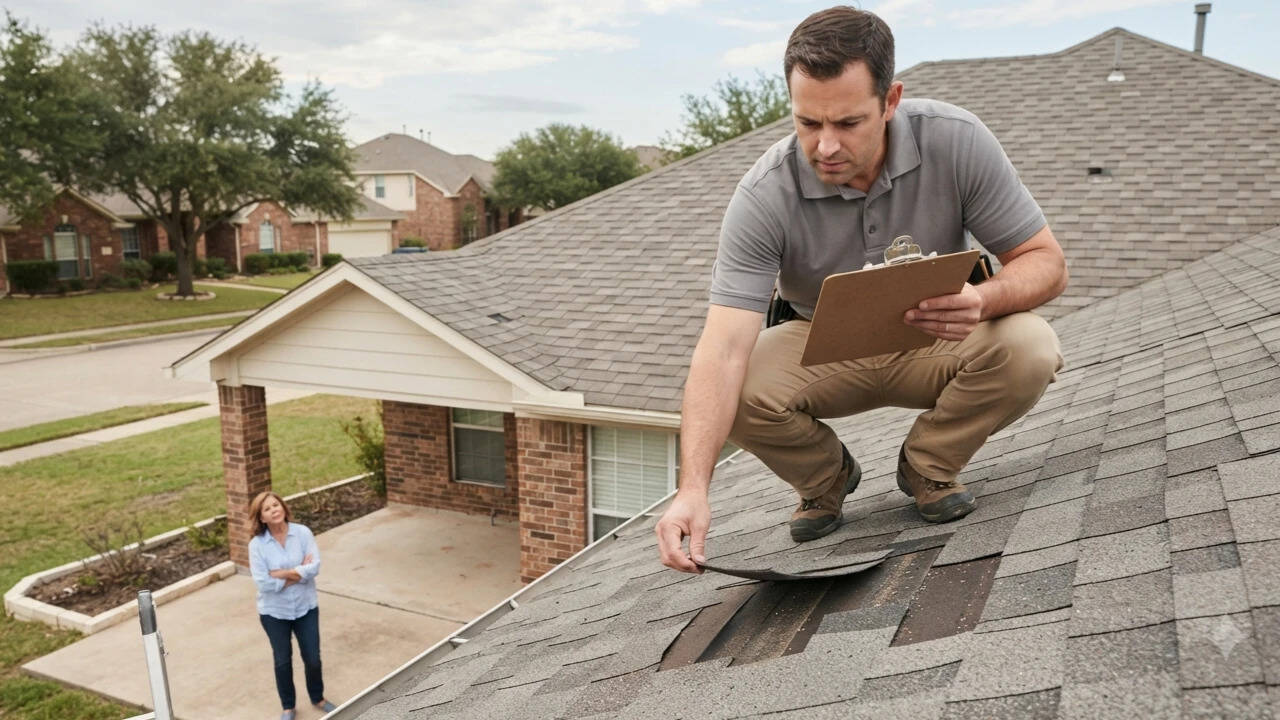
When the homeowner finally notices water spots on their ceiling and files a claim, the carrier's engineering consultant steps onto the roof with a distinct financial incentive. If that engineer concludes the underlying mat fracture happened during an earlier storm—perhaps before the homeowner switched carriers, or during a policy year with a higher deductible, or simply outside the contractual notice window—the insurer walks away clean.
Consider a hypothetical scenario to see how cleanly the trap snaps shut. Imagine a homeowner in Collin County buys a house in 2021. The pre-purchase home inspector notes the roof is eight years old and in serviceable condition, with no active leaks. State Farm binds the policy, inspects the exterior from the street or via aerial imagery, and gladly accepts annual premiums for three years. In 2024, a major spring hailstorm batters the neighborhood. Half the houses on the block get new roofs. Our hypothetical homeowner files a claim, only to be told by the carrier's engineer that the damage actually dates back to a documented hail event in 2020—a year before the buyer even owned the home. Because the damage predates the policy inception, the claim is denied. Yet the carrier never flagged that 2020 damage when it underwrote the policy in 2021, nor did it discount the premiums to reflect a compromised roof.
Heads, the insurer wins. Tails, the policyholder loses.
The Economics Behind Texas Claim Denials
Texas is the epicenter of this friction because of basic geography and actuarial pressure. Positioned at the southern end of Tornado Alley and bordering the warm waters of the Gulf of Mexico, the state absorbs more billion-dollar weather disasters than anywhere else in the United States. Severe convective storms—thunderstorms producing hail, straight-line winds, and tornadoes—have become the primary driver of property catastrophe losses nationwide, rivaling coastal hurricanes in cumulative annual payouts.
For decades, carriers treated roof replacements in Texas as a predictable cost of doing business, baking occasional hail events into regional rate filings. That model broke down over the last several years due to three converging forces:
- Reinsurance spikes: Primary insurers like State Farm buy their own insurance—called reinsurance—to protect against catastrophic years. Global reinsurers dramatically raised attachment points and pricing, forcing primary carriers to absorb far more localized storm losses on their own balance sheets.
- Material and labor inflation: The cost of asphalt shingles, synthetic underlayment, OSB decking, and skilled roofing labor climbed sharply, turning a routine $14,000 roof replacement into a $28,000 liability.
- Deductible suppression: As carriers pushed wind and hail deductibles from flat $1,000 fees to 1% or 2% of a home's insured value, homeowners became far more hesitant to file minor claims. Ironically, waiting until a larger storm hit gave insurers the exact chronological gap they needed to argue the damage was cumulative and pre-existing.
Faced with massive underwriting losses in the Texas residential market, carriers had two choices. They could seek massive, politically unpopular rate hikes through the Texas Department of Insurance, or they could tighten claims adjudication guidelines behind closed doors. Most chose both.
When an insurer tightens adjudication, frontline desk adjusters lose the authority to approve full roof replacements on borderline inspections. Instead, files get routed to specialized large-loss units or third-party engineering firms—entities whose ongoing corporate survival depends on keeping major carriers satisfied with their loss-ratio outcomes.
The Role of Engineering Firms and Aerial Surveillance
If you spend enough time reviewing Texas property litigation dockets, the same names appear repeatedly in the expert witness disclosures. A small ecosystem of forensic engineering firms generates thousands of reports a year for major insurers. While these firms employ licensed professional engineers, the structural bias of their business model is hard to ignore. A roofer gets paid if a roof gets replaced; a carrier-retained engineer gets repeat business if their reports consistently distinguish "uncompensated wear and tear" or "prior storm damage" from covered peril losses.
Compounding this is the quiet revolution in aerial underwriting and historical weather tracking. Today, when you file a claim, the desk adjuster does not just look at photos from your yard. They pull up proprietary forensic hail swath maps—tools like CoreLogic or Verisk—that track radar-indicated hail down to the individual parcel over the past decade.
If a radar algorithm indicates that 0.75-inch hail fell within half a mile of your address three years ago, that data point becomes a weapon in your claim file. The adjuster pairs that historical radar blip with high-resolution aerial imagery collected by fixed-wing aircraft or satellites. Suddenly, the carrier is arguing that your roof was compromised years ago, even if no human being ever set foot on your shingles back then to verify whether the hail actually caused functional damage.
There is a glaring asymmetry in how this technology is deployed. Insurers have access to the exact same historical hail maps and aerial imagery before they issue or renew your policy. They know if a neighborhood was hit by hail in 2021. They have the photos. Yet they rarely send a certified mail notice saying, "We noticed potential hail bruising on your roof from last Tuesday's storm; please repair it within 60 days or we will exclude your roof from future coverage." Instead, they collect the full premium—calculated on the replacement cost value of an intact roof—and hold the historical weather data in reserve until you actually need to use the policy.
Why Texas Law Tilts the Playing Field
Homeowners who lose these battles often assume they can simply hire a lawyer and force the carrier to pay up. That path became drastically harder in 2017, when the Texas Legislature passed House Bill 1774, codified into Chapter 542A of the Texas Insurance Code.
Backed heavily by the insurance lobby under the banner of curbing "hailstorm lawsuit abuse," the law fundamentally altered the financial calculus of suing an insurer in Texas. Before 2017, if a carrier wrongfully delayed or denied a claim, the Texas Prompt Payment of Claims Act slapped them with an 18% annual statutory penalty interest plus mandatory attorney's fees. That penalty gave homeowners real leverage; insurers knew that dragging out a legitimate claim in court would cost them double or triple the original repair bill.
HB 1774 gutted that penalty for weather-related claims, slashing the statutory interest rate to a floating formula tied to market rates—often cutting it in half—and creating strict pre-suit notice requirements and attorney fee limitations.
The unintended—or entirely intended—consequence was an immediate shift in claims behavior. With the financial sting of wrongful denial blunted, carriers realized they could deny marginal or disputed roof claims with far less legal exposure. If nine out of ten denied homeowners simply give up, pay out of pocket, or patch their roofs with credit cards, the carrier saves tens of thousands of dollars per household. Even if the tenth homeowner sues and wins two years later, the insurer often ends up paying roughly what it owed in the first place, minus the time value of money it held onto during litigation.
The Concurrent Causation Trap
Texas courts also enforce a strict legal doctrine known as concurrent causation. Under Texas law, when a loss is caused by both a covered peril (a recent hailstorm) and a non-covered peril (pre-existing wear, tear, or an earlier uncompensated storm), the burden falls entirely on the policyholder to segregate the damage.
Read that again. The insurance company does not have to prove what percentage of your roof was ruined by the old storm versus the new storm. Once the carrier raises the plausible defense of pre-existing damage, you must prove, with reasonable certainty, precisely which shingles were damaged on the date of loss you claimed and which ones were already damaged before.
On an asphalt roof exposed to Texas sun and wind, separating 2023 hail bruising from 2026 hail bruising is a forensic impossibility. Even honest, experienced roofing contractors struggle to differentiate them with scientific precision. Under the concurrent causation doctrine, that impossibility hands the victory to the insurance company by default. If the policyholder cannot mathematically separate the old damage from the new damage, the court can throw out the entire claim.
The Shift to Actual Cash Value Endorsements
Even when homeowners clear the pre-existing damage hurdle, many discover too late that their policy no longer pays what they thought it did. Quietly tucked into renewal packets over the past few years are Roof Surface Payment Schedules or mandatory Actual Cash Value (ACV) endorsements.
Under a traditional Replacement Cost Value (RCV) policy, if a storm destroys your 12-year-old roof, the carrier pays the full cost to install a brand-new roof of like kind and quality, minus your deductible. Under an ACV schedule, the carrier depreciates your roof based on its age and material type.
If you have a 12-year-old standard three-tab or architectural shingle roof, an insurer's payment schedule might dictate that the roof has depreciated by 60% or 70%. On a $25,000 roof replacement, the insurer calculates the actual cash value at $8,000. Then they subtract your 2% deductible—say, $7,000 on a $350,000 home. You are left with a check for $1,000 to pay for a $25,000 roof.
Carriers frequently combine these two tactics. First, they invoke pre-existing damage to deny half the roof slopes. Then, for the remaining slopes they agree to cover, they apply an ACV payment schedule and a percentage deductible that reduces the net payout to nearly zero. The homeowner walks away with a denied or gutted claim, a permanent mark on their Comprehensive Loss Underwriting Exchange (CLUE) report, and a non-renewal notice six months later because their roof is now officially documented as damaged.
How Homeowners Can Protect Themselves Before the Next Storm
Because the legal and regulatory environment in Texas favors carriers on disputed roof claims, waiting until hail hits your driveway to figure out your coverage is a losing strategy. You have to build your evidentiary paper trail while the sky is clear.
1. Audit your declarations page for roof endorsements.
Do not just look at your dwelling coverage limit and your deductible. Flip to the endorsements list and look for terms like Actual Cash Value Loss Settlement, Roof Surfacing Loss Settlement, or Cosmetic Damage Exclusion. A cosmetic damage exclusion means that if hail dents your metal roof or strips granules off your shingles without causing an immediate leak, the carrier owes you nothing—even though your roof's functional lifespan just dropped by a decade. If your policy has converted to ACV on the roof, shop around immediately with an independent broker who writes across multiple regional and national carriers.
2. Create a baseline inspection file.
Every two years, and immediately after any major storm passes through your zip code—even if you do not plan to file a claim—hire a reputable, licensed local roofer to perform a documented health check. Pay them $150 or $200 for a formal report with time-stamped, high-resolution photographs of every slope, ridge cap, flashing detail, and soft metal vent. Keep that report in a cloud folder. If a storm hits next spring and State Farm or another carrier claims your damage happened four years ago, a dated photo report showing an intact, undamaged roof from eight months prior destroys their concurrent causation defense before it reaches a courtroom.
3. Understand the peril of the "free inspection" inquiry.
Many homeowners call their insurance company's claims hotline just to ask if they should have an adjuster come look at their roof after a storm. That phone call creates a formal claim record in the industry-wide CLUE database, even if the adjuster finds no damage and pays $0. Two zero-dollar inquiries in three years can trigger an automatic non-renewal or place you in a high-risk surcharge tier. Always have an independent, vetted roofing contractor inspect the roof first to verify whether the damage actually exceeds your deductible before you ever dial your insurer's claims number.
4. Demand the engineer's full file and invoke appraisal strategically.
If you file a legitimate claim and the carrier denies it based on pre-existing damage, do not accept a verbal summary from a desk adjuster. Request the complete, unredacted engineering report, all field photographs, and the specific meteorological data they relied upon. Look closely at whether the policy contains an appraisal clause. Appraisal is a binding alternative dispute resolution mechanism built into most Texas policies where you hire an independent appraiser, the insurer hires one, and the two select an impartial umpire to determine the amount of loss. While appraisal strictly decides the dollar amount of damage rather than coverage disputes, forcing a carrier into appraisal often exposes weak engineering conclusions and compels a settlement when the carrier realizes its bluff is being called.
Insurance companies operate on precision data, historical weather modeling, and strict contractual leverage. Until homeowners start documenting their roofs with the same forensic rigor carriers use to deny them, the pre-existing damage exclusion will remain the most profitable escape hatch in Texas property insurance.