The metal chair in an interrogation room has a specific temperature. It is never warm. It absorbs the heat from your body and gives nothing back, a stubborn reminder of where you are and who owns the air you are breathing. For years, Luis Manuel Otero Alcántara treated that coldness as a workspace. He is an artist, which means he looks at a blank, hostile environment and sees a canvas.
But there comes a moment when the canvas is taken away entirely, replaced by four concrete walls in the maximum-security prison of Guanajay.
When a state decides to silence a voice, it rarely uses a sudden hammer blow. It prefers a slow, grinding erosion. They offer you choices that are not choices at all. They offer you the open sky, but only if that sky belongs to another country. They offer you your freedom, but the price of that freedom is the loss of your home. It is the ultimate paradox of the modern dissident: to save your life, you must agree to stop living the life you fought for.
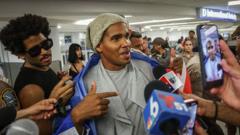
The news filtered out in the quiet, clinical language of international press releases. A Cuban dissident, a leader of the San Isidro Movement, had left Havana. He had arrived in the United States. To the casual observer scanning a headline on a morning commute, it sounds like a resolution. A man was in prison, and now he is safe. The story ends.
Except it does not. That is where the real story begins.
The Streets of San Isidro
To understand the weight of an exile, you have to understand the dirt of the street left behind. San Isidro is not the Cuba of the tourist brochures. There are no polished vintage cars gleaming under manicured palm trees. It is a neighborhood of crumbling plaster, of salt air eating away at colonial facades, of laundry strung across narrow alleyways like colorful flags of defiance.
It is loud. It breathes.
Luis Manuel did not create his art in a secluded studio behind locked doors. He built it on the sidewalks. He used trash. He used scrap metal. He used his own body. When the Cuban government passed Decree 349, a law requiring artists to obtain prior approval from the ministry of culture before presenting their work, it was an attempt to turn creativity into a bureaucratic checklist.
For an artist who grew up with the rhythm of the streets in his veins, that was a death sentence.
Consider what happens when you tell a community they cannot speak without permission. At first, there is silence. A heavy, cautious quiet settles over the neighborhood. But then comes a whisper, followed by a song, followed by a crowd. The San Isidro Movement became a focal point because it was raw. It did not speak the language of traditional politics. It spoke the language of hip-hop, of performance art, of hunger strikes, and of raw, unfiltered human expression.
They used a song. Patria y Vida. Homeland and Life. It was a direct inversion of the old revolutionary slogan, Patria o Muerte—Homeland or Death. For sixty years, the choice presented to the Cuban people had been binary, rigid, and fatalistic. The movement suggested a third option. They suggested that living for your country was infinitely more valuable than dying for a regime.
The state watched. The state waited.
The Cost of a July Afternoon
The turning point did not happen in a gallery. It happened in the scorching heat of July 11, 2021. Thousands of ordinary Cubans took to the streets in unprecedented protests, driven by a combination of economic desperation, lack of medicine, and a suffocating desire for basic liberties.
Luis Manuel never made it to the main demonstration. He was arrested before he could join the crowds, picked up near his home, and moved into the shadow of the penal system.
Prison is designed to strip away the specific traits that make an individual human. You are given a number. You are given a uniform. The vibrant colors of San Isidro—the bright yellows of the crumbling walls, the deep blues of the Caribbean, the chaotic mosaic of street life—were replaced by a monotonous, institutional gray.
He spent nearly three years in that gray.
During those years, the world outside kept moving. News cycles turned. Other crises erupted across the globe. For a political prisoner, the greatest fear is not the physical discomfort or the occasional cruelty of a guard. The greatest fear is oblivion. The terrifying realization that the world might simply forget you are sitting in the dark.
He went on hunger strikes. He went on thirst strikes. He used the only weapon he had left: his own physical existence. When you refuse to eat, you are making a terrifying gamble. You are betting that your life still holds enough symbolic value to force the hands of men who hold all the keys.
It is a slow, agonizing process. Your vision blurs. Your joints ache with a deep, persistent throb. Your mind plays tricks on you, conjuring the smell of fresh coffee or the sound of waves crashing against the Malecón. You become a ghost long before your heart stops beating.
The government did not want a martyr. Martyrs are dangerous. They are permanent. They inspire poetry and monuments. A living exile, however, is a different story. An exile is safely across an ocean, separated from their base by miles of water and the invisible walls of a new culture.
The Flight into the Unknown
The transition happens fast when it finally comes. One day you are looking at the concrete walls of Guanajay, and the next you are being escorted to an airport. The air outside the prison smells different. It smells of fuel, of tarmac, of a strange, terrifying freedom.
There is no triumphant parade. There is no crowd cheering at the gates. There is only a boarding pass and a suitcase filled with fragments of a life left behind.
When the plane leaves the runway in Havana, you look out the window. The island grows smaller. The green fields, the familiar coastline, the rooftops of the city where you learned to walk and create—it all shrinks into a line on the horizon. Then, nothing but blue.
Arriving in the United States is a sensory assault. The lights are too bright. The signs are in a language that, even if you speak it, does not feel like your own. The abundance is disorienting. In Havana, finding a loaf of bread or a tube of paint is an exercise in endurance, a daily battle against scarcity. In an American supermarket, the sheer variety of choices can induce a strange kind of vertigo.
People ask how you feel. They expect joy. They expect a profound sense of relief.
But the truth is far more complicated. Exile is a form of grief. It is the mourning of a life that is still happening somewhere else without you. You are safe, yes. Your skin is intact. You can sleep through the night without worrying about a boot kicking open your front door.
But you are also fractured. A piece of you remains anchored in the cracked asphalt of San Isidro.
The New Canvas
Now comes the hardest part of the journey. What does an artist do when the source of their friction is removed?
Luis Manuel’s art was forged in the fire of resistance. It was defined by its relationship to Cuba, by its direct conversation with the people who lived down the street. In exile, the context changes entirely. The danger is no longer prison; the danger is irrelevance. The danger is becoming a historical footnote, a symbol used by politicians for a few weeks before the news cycle moves on to the next tragedy.
He must reinvent his vocabulary. He must find a way to make the pain of displacement as vivid and urgent as the anger of oppression.
It is easy to look at this story as a defeat for the movement. The regime succeeded in clearing the chessboard of one of its most troublesome pieces. The streets of Havana remain quiet for now, monitored by a pervasive security apparatus that notes every gathering and every unusual conversation.
But that is a short-term view. History suggests that ideas are remarkably resistant to border controls. They do not require a passport to travel. The songs written in the backrooms of San Isidro are still sung in secret. The digital videos recorded on cheap smartphones are still shared from hand to hand via USB drives.
The plane ride to Miami did not erase the past three years. It merely shifted the coordinates of the struggle.
The cold metal chair of the interrogation room is thousands of miles away now. In its place is a new studio, a clean floor, and a fresh supply of paint. The air is warm, but the hand holding the brush still remembers the chill of Guanajay. The work continues, different in form but identical in purpose, proving that while you can remove a man from his country, you cannot easily scrub the country from the man.