The morning air in Nairobi usually tastes of roasting coffee beans and diesel exhaust. It is a predictable, comforting chaos. But on a Tuesday that felt entirely different, the air tasted of nothing but cold iron and anxiety.
Juma, a twenty-four-year-old accounting graduate whose name has been changed for his own safety, stood near the edge of Uhuru Park. He wasn't holding a weapon. He didn't have a rock in his hand. He held a cardboard sign, a smartphone with a cracked screen, and a pocketful of ambition that his country’s economy seemed determined to starve. His boots were laced tight, a lesson learned from previous weeks: when the tear gas canisters hiss against the asphalt, you do not want to trip over your own feet.
Across the boulevard, the state had painted a very different picture.
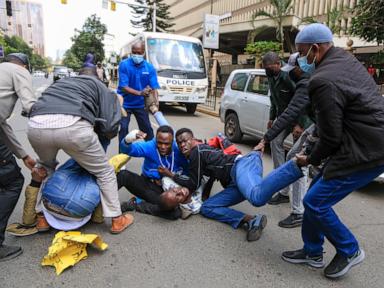
Row after row of anti-riot vehicles sat idling, their heavy engines vibrating through the soles of Juma’s shoes. Officers clad in dark body armor stood shoulder-to-shoulder, helmets reflecting the harsh equatorial sun. They weren't just a police force that morning. They were a human wall, erected to prove that while the citizens might own the streets in theory, the government controlled them in practice.
A similar silence hung over Dar es Salaam, hundreds of miles to the south. There, the heavy hand of the state took a quieter but equally paralyzing form. Red berets patrolled the intersections. Key opposition figures found police cars parked outside their gates before they could even brush their teeth. Two nations, tied together by the Swahili language and a shared colonial past, had arrived at the exact same crossroads on the exact same morning. They chose the strategy of absolute saturation.
To understand why a government deploys thousands of heavily armed men against its own youth, you have to look past the dry headlines about regional security. You have to look at the ledger books.
For months, the friction in East Africa had been building over something as mundane yet volatile as tax policy and cost-of-living adjustments. Imagine running a household where your income drops by half, but the grocery store demands double the price at the register, all while the landlord insists you pay for repairs on a house that is actively leaking. That is the economic reality gripping millions of young Kenyans and Tanzanians.
When the Kenyan government introduced a controversial finance bill aimed at raising taxes on basic commodities like bread and diapers, it wasn't just a policy debate. It was a spark dropped into a dry forest. The youth, organizing under decentralized banners on social media, filled the streets. The initial response from the state was chaos. But chaos is unpredictable, and governments hate unpredictability more than anything else.
The shift in strategy was mechanical. It was about overwhelming presence.
Consider what happens next when a state decides to suppress dissent not with dialogue, but with mass. By placing a dozen officers on every corner before a single protester can arrive, the terrain changes. The protest is defeated before it begins, choked out by the sheer impossibility of gathering. It is a tactical smothering.
But this tactic comes with an invisible invoice.
The cost isn't just measured in the millions of shillings spent on fuel, overtime pay, and riot gear. The true deficit is found in the erosion of trust. When a young citizen looks at a police officer and sees an occupying force rather than a protector, a fundamental contract is broken. That contract cannot be mended by a press conference or a revised budget proposal.
Juma watched a tear gas canister arc through the sky, trailing a white plume. It landed with a dull thud, scattering a group of vendors who had nothing to do with the politics of the day. He ran. Everyone ran. The collective thud of sneakers on concrete sounded like a panicked heartbeat.
The state will tell you the deployment was a success. They will point to the empty streets, the intact storefronts, and the uninterrupted flow of traffic as evidence of order restored. They will say that the economy cannot thrive in a state of anarchy, and they are not entirely wrong about the need for stability. Businesses need predictability to survive.
But there is a vast difference between peace and a pause.
What happened in the capitals of East Africa wasn't the resolution of a crisis; it was the postponement of one. You can clear a street with water cannons and batons. You can silence a public square by filling it with shields. But the hunger that brought those people to the pavement remains. The frustration doesn't evaporate under the pressure of a fire hose; it merely condenses, growing heavier, waiting for the next crack in the wall to seep through.
As the sun dipped below the horizon, leaving a bruised purple smudge across the Nairobi sky, the armored vehicles began to roll back to their barracks. The soldiers stretched their legs. Juma sat on a concrete curb three miles away, coughing up the last remnants of the chemical sting in his lungs. His sign was gone, trampled into the mud during the retreat.
The streets belonged to the government again, quiet and pristine. But beneath the silence, the city was vibrating.