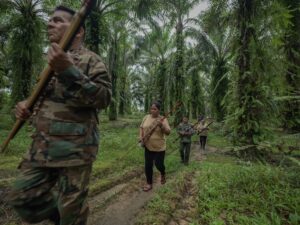
The dirt on his boots was still wet when they came for him.
It was the rich, dark soil of the Amazon basin, heavy with the scent of decaying leaves and recent rain—the kind of earth that clings to you, reminding you where you belong. For years, he had knelt in that soil to plant saplings, to map migration paths of endangered birds, to measure the slow, breathing pulse of a forest older than nations. He was not a politician. He carried no weapon heavier than a wooden walking stick and a battered notebook filled with charcoal sketches of canopy leaves.
Yet, in the quiet hours before dawn, his life was extinguished with the cold efficiency of a ledger entry.
Across the globe, this is the soundtrack of our modern gold rush. It is not the sound of pickaxes striking stone or the roar of heavy machinery clearing ancient timber, though those noises are constant companions. It is the sudden snap of a twig, the muffled shout, the empty chair at a wooden kitchen table where a community leader used to sit.
We talk about resources as abstract lines on corporate balance sheets. We track lithium, timber, gold, oil, and fresh water in quarterly reports and stock tickers. But every single barrel of crude oil extracted from pristine indigenous lands, every ton of ore pulled from the belly of a sacred mountain, has a human receipt. And someone is always being handed the bill.
Consider what happens when a map drawn in a glass-walled boardroom in a distant metropolis collides with the reality of a village that has lived under the same banyan tree for six generations.
To the corporation, the land is empty. It is a spatial void waiting to be optimized. To the people whose ancestors are buried beneath the topsoil, the land is an archive, a pantry, a church, and an identity. When a logging concession is granted or a hydroelectric dam is approved, the conflict is not merely financial. It is existential.
Statistics tell a staggering story, though numbers rarely bleed. According to documentation compiled by global monitoring groups like Global Witness, hundreds of land and environmental defenders are killed every year simply for saying no. They are indigenous leaders, local schoolteachers, mothers protecting their children's water supply, and young biologists tracking illegal poaching. They are ordinary people thrust into extraordinary defiance because the alternative—silence—means the destruction of everything they love.
Most of these murders share a chilling common denominator: impunity.
Imagine standing in a courtroom where the judge owns stock in the very company that bulldozed your community garden. Imagine filing a police report for threats received, only to find your name at the top of a hit list by sunset. This is the daily reality in the remote frontiers of extraction, from the lush rainforests of Central and South America to the mineral-rich hills of Southeast Asia and the vast expanses of the Congo Basin.
The power struggle is structural. On one side stands capital, backed by legal teams, private security forces, and often the tacit complicity of state apparatuses desperate for foreign investment and tax revenue. On the other side stands a community armed with little more than collective memory, ancestral titles that colonial governments refuse to recognize, and a stubborn refusal to vanish quietly.
Why do they fight when the odds are so overwhelmingly stacked against them?
Because compromise is rarely an option when your home is being erased. When the river turns the color of rust from upstream mining runoff, you cannot simply move to the next tap. When the forest that shielded your village from seasonal mudslides is clear-cut, the monsoon becomes an immediate existential threat. Environmental defense is, at its core, self-defense.
We often make the mistake of viewing these defenders as tragic victims of circumstance. That framing strips them of their agency. They are strategists, archivists, and guardians. They understand the cascading effects of ecological collapse far better than any distant bureaucrat pouring over satellite imagery. They know that when the headwaters of a river are poisoned, the fish die, the crops fail, the youth migrate to urban slums, and an entire culture dissolves into history books.
When we consume products manufactured with conflict minerals or cheap timber, we are downstream from these struggles. We live in societies insulated from the visceral violence required to fuel our daily conveniences. The plastic casing of a smartphone, the electricity charging a laptop, the asphalt on our highways—they all carry invisible supply chains that run straight through contested territories where blood has soaked into the dirt.
The tension between global demand and local survival is accelerating. As the transition to green energy increases the global hunger for transition minerals like cobalt, nickel, and copper, the pressure on fragile ecosystems intensifies. The irony is bitter. The very metals required to build wind turbines and electric vehicle batteries are often mined in remote regions through methods that displace indigenous populations and silence those who protest environmental degradation.
We are racing to save the global climate while trampling the people who have protected local ecosystems most effectively for centuries. Studies consistently show that indigenous lands retain biodiversity at rates equal to or exceeding government-protected parks. The most effective conservationists on Earth are not sitting in climate summits wearing suits; they are walking forest trails in worn-out boots, listening to the canopy.
And yet, the machine rolls on.
When a defender falls, a chilling effect ripples through the community. Fear is an efficient tool of displacement. If you kill one leader who organizes blockades against illegal logging trucks, ten others hesitate before speaking out at the next town meeting. The corporations and criminal syndicates operating in these lawless frontiers know this calculus well. Violence is not an unfortunate byproduct of resource extraction; it is frequently a calculated business strategy designed to clear the path of resistance.
Yet, human resilience is remarkably stubborn.
In communities across the globe, new leaders step forward to take the place of the fallen. They pick up the tattered notebooks, memorize the property boundaries, and organize night patrols. They train their youth in digital cartography and international human rights law, combining ancestral wisdom with modern legal tools. They refuse to let their history be paved over by concrete and indifference.
The fight over the world's resources is ultimately a battle over what we value. Do we measure progress by the gross domestic product of nations and the quarterly profits of multinational conglomerates, or do we measure it by our capacity to preserve the living systems that sustain us all?
The soil out in the basin is still wet. The rain continues to fall, washing away footprints, but the memory of those who stood their ground remains rooted deep beneath the surface, waiting for the rest of the world to wake up and listen.