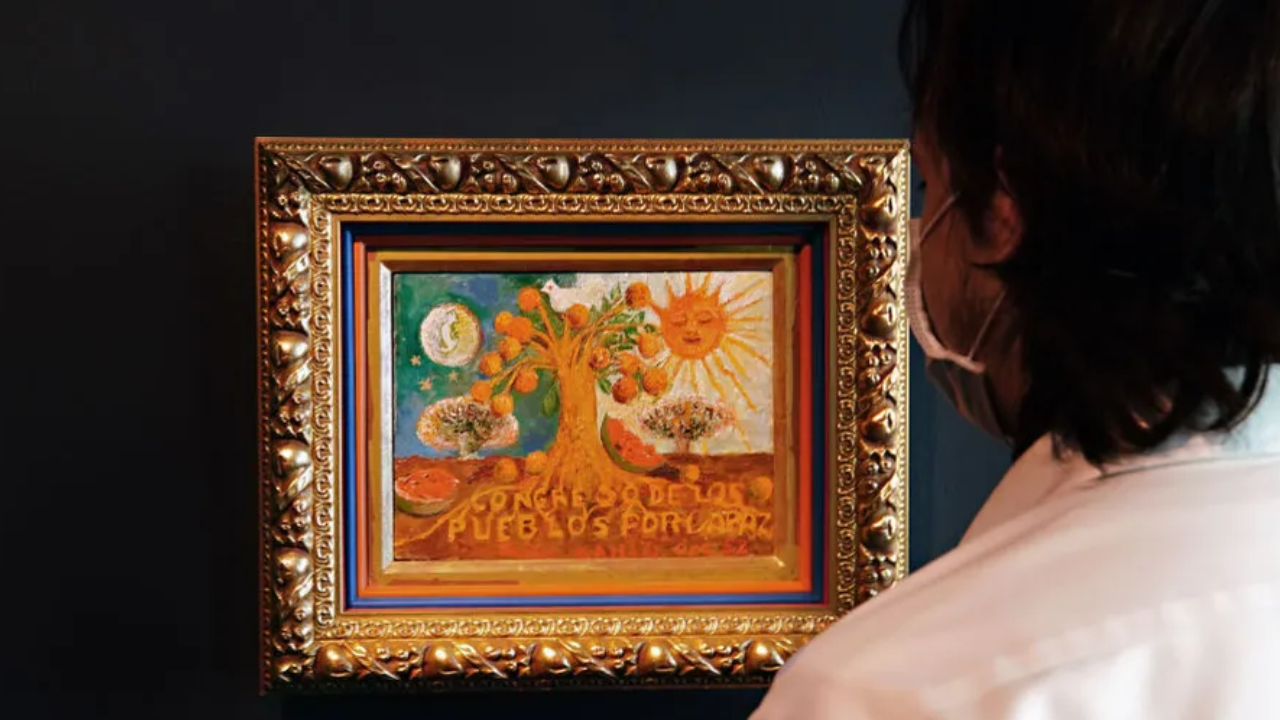
When Christie’s pulled a Frida Kahlo painting from its auction block after questions surfaced regarding a 1953 return to Mexico, the market witnessed a textbook collision between private liquidity and sovereign cultural patrimony law. High-value art transactions do not fail merely because an object is counterfeit; they fail when the chain of legal exportability breaks under retrospective regulatory scrutiny. In the ultra-high-net-worth art market, a provenance gap or a contested cross-border transit history transforms a trophy asset into an illiquid liability overnight.
The withdrawal of a major work by Frida Kahlo—an artist whose entire corpus is protected under Mexican federal law as an artistic monument—demonstrates the severe structural asymmetry between international auction houses and national heritage ministries. While auction houses operate on compressed transactional timelines driven by seasonal sales calendars, cultural heritage enforcement operates on infinite time horizons without statutes of limitations on sovereign claims. When a painting’s physical timeline reveals a return to Mexican soil in 1953, every subsequent international transfer becomes subject to the strict export prohibitions enacted decades later.
The Three Pillars of Sovereign Patrimony Risk
To understand why a single year in a painting’s exhibition or ownership history can halt a multi-million-dollar sale, analysts must evaluate three interlocking mechanisms that govern cross-border cultural property.
Retroactive Monumental Declaration
Under Mexico’s Federal Law on Archaeological, Artistic and Historic Monuments and Zones (enacted in 1972) and the subsequent 1984 presidential decree declaring Frida Kahlo’s entire body of work an Artistic Monument of the Nation, the Mexican state asserted permanent jurisdiction over the export of her paintings. Unlike standard commercial goods, where export legality is judged solely by the customs rules in force at the moment of shipment, monumental declarations impose strict controls over any protected object located within national territory after the decree takes effect. If a work entered Mexico in 1953 and remained there past the enactment of modern patrimony statutes, any subsequent removal without an explicit presidential or ministerial export permit renders the object illicitly exported under Mexican law.The Physical Re-Entry Trap
Art market participants frequently assume that if an artwork left its country of origin prior to the enactment of restrictive patrimony laws, it remains permanently "grandfathered" into the international free market. This assumption collapses the moment the object re-enters the source nation. A documented 1953 return to Mexico—whether for Kahlo’s landmark solo exhibition at the Galería de Arte Contemporáneo in Mexico City or for personal retention—resets the jurisdictional clock. Once the canvas crosses back into Mexican territory, it becomes subject to the territorial sovereignty of the Mexican state. Establishing that the painting exited Mexico again prior to 1972 or 1984 requires indisputable customs manifests, shipping bills of lading, or contemporaneous foreign exhibition records. Absent that proof, auction houses face the presumption of unlawful export.Title Warranty and Rescission Exposure
Major auction houses operate under strict Conditions of Sale that include a limited warranty of title and authenticity. Under the Uniform Commercial Code (UCC) in jurisdictions like New York, a seller warrants that the title conveyed is good and its transfer rightful. If a foreign government asserts a plausible claim of illegal export or sovereign ownership, the buyer can demand full rescission of the sale—forcing the auction house to refund the hammer price plus buyer’s premium while attempting to claw back funds already disbursed to the consignor. Pulling the lot prior to the hammer falling is a calculated risk-mitigation maneuver designed to prevent post-sale litigation and reputational damage.
Deconstructing the 1953 Provenance Bottleneck
The year 1953 carries acute historical and legal weight in Frida Kahlo scholarship. In April 1953, photographer Lola Álvarez Bravo organized Kahlo’s first and only solo exhibition in Mexico during her lifetime. Kahlo, gravely ill, famously arrived at the opening in an ambulance and greeted guests from a four-poster bed installed in the gallery. To mount a comprehensive retrospective of an artist whose major works had largely been sold to American collectors—such as Nickolas Muray, Edgar Kaufmann Jr., and Julien Levy—organizers borrowed paintings from abroad and brought them back into Mexico.
This historical event creates an evidentiary bottleneck for modern due diligence teams:
- Inbound vs. Outbound Documentation: Museums and galleries in the mid-twentieth century kept meticulous records of inbound loans for insurance and cataloguing purposes, yet outbound return shipments were frequently handled through informal diplomatic pouches, private couriers, or poorly archived customs brokers. Proving the painting arrived in Mexico in 1953 is often straightforward; proving the exact date and legal mechanism of its departure is substantially harder.
- The Custody Gap (1953–1984): Kahlo died in July 1954, just over a year after the retrospective. During the chaotic period following her death, works held in her studio at La Casa Azul or with close associates in Mexico City occasionally changed hands privately without formal invoices. If a work returned in 1953 and lingered in Mexico until after the 1972 Monument Law took effect, its subsequent appearance on the New York or London market without a National Institute of Fine Arts (INBA) export license constitutes a direct violation of Mexican patrimony statutes.
- Bilateral Enforcement Treaties: The United States and Mexico are bound by the 1970 Treaty of Cooperation Providing for the Recovery and Return of Stolen Archaeological, Historical and Cultural Properties, alongside bilateral Memoranda of Understanding under the Cultural Property Implementation Act (CPIA). While U.S. courts historically distinguished between "stolen" property and "illegally exported" property (the McClain doctrine), modern compliance departments at Christie’s and Sotheby’s refuse to test that boundary in federal court when the Mexican Ministry of Culture signals an objection.
The Cost Function of Pre-Sale Withdrawal vs. Post-Sale Litigation
When an auction house specialist uncovers a contested transit point late in the consignment cycle, leadership evaluates the decision through an expected-value risk framework rather than an aesthetic one.
The immediate financial cost of withdrawing a marquee Kahlo painting is severe. The house forfeits the buyer’s premium (typically ranging from 20% to 26% on tiered hammer prices) and any negotiated seller’s commission. If the house extended an irrevocable bid or a third-party guarantee to secure the consignment, unwinding those financial instruments triggers administrative fees and strains relationships with major collectors who underwrite auction risk. Marketing expenditures—including catalogue printing, global press tours, and private viewing events—become unrecoverable sunk costs.
Yet proceeding with the sale introduces uncapped downside exposure. If the painting sells for eight figures and the Mexican government initiates diplomatic intervention or files a civil forfeiture action, the auction house absorbs massive legal defense fees. Even if the house prevails on technical jurisdictional grounds—arguing, for instance, that U.S. law does not enforce foreign export restrictions absent a clear vesting of state ownership—the asset becomes permanently stigmatized. No major museum will exhibit it due to American Alliance of Museums (AAM) provenance guidelines, and no rival auction house will accept it for future consignment. By withdrawing the work before bidding opens, Christie’s preserves its balance sheet and transfers the burden of proof back onto the consignor.
Operational Failures in Modern Art Due Diligence
Why do provenance anomalies involving well-documented twentieth-century artists still surface days before an auction rather than during initial intake? The answer lies in the structural incentives of the consignment pipeline.
Auction specialists are compensated primarily on origination volume and sell-through rates. During competitive pitches against rival houses for blue-chip consignments, specialists rely heavily on existing catalogue raisonné entries and standard exhibition histories provided by the seller. If a painting appears in the foundational 1988 catalogue raisonné by Helga Prignitz-Poda, Andrea Kettenmann, and Martha Zamora, intake teams often treat the entry as prima facie validation of clean title.
However, mid-century catalogues raisonnés were compiled by art historians focused on attribution and iconography, not customs compliance. An entry noting "Exhibited: Mexico City, 1953" followed by "Private Collection, New York" omits the precise cross-border transit dates required by twenty-first-century anti-money laundering (AML) and cultural patrimony standards. When the catalogue goes public a few weeks before the sale, external watchdogs—including state cultural ministries, independent provenance researchers, and rival dealers—audit the published timeline with adversarial rigor. That external scrutiny routinely uncovers the exact customs gaps that internal intake teams overlooked.
Limitations of Provenance Remediation
Consignors facing a withdrawal due to sovereign export claims possess limited avenues for remediation, none of which offer rapid resolution:
- Retrospective Export Licensing: Approaching Mexico’s Instituto Nacional de Bellas Artes y Literatura (INBAL) for a retroactive export clearance is virtually impossible for a work declared an artistic monument. Mexican patrimony law is designed to retain cultural capital within national borders, not to monetize exit permits for private sellers.
- Affidavit Reconstruction: Attempting to bridge a post-1953 gap using sworn affidavits from heirs or former dealers rarely satisfies institutional compliance officers. Without primary-source documentary evidence—such as stamped customs declarations, dated shipping crates, or contemporaneous photographs showing the painting hanging in a foreign residence prior to 1972—affidavits remain vulnerable to challenge.
- Private Treaty Sales in Permissive Jurisdictions: Moving the asset from New York to a private sale in a jurisdiction with weaker bilateral cultural property enforcement reduces immediate seizure risk, but it severely discounts the asset’s valuation. Institutional buyers and sophisticated family offices price in the permanent lack of liquidity, forcing the seller to accept a substantial haircut below auction estimates.
Strategic Mandate for High-Value Asset Holders and Consignors
The withdrawal of the Kahlo canvas confirms that historical prestige no longer insulates blue-chip artworks from administrative friction. Collectors, estate managers, and art-backed lenders must shift provenance verification from a pre-sale formality to an underwriting prerequisite.
Before executing any consignment agreement, acquisition contract, or collateralized loan facility involving works by artists subject to national patrimony decrees—including Frida Kahlo, Diego Rivera, Remedios Varo, and Joaquín Torres-García—principals must commission an independent customs-timeline audit. This audit must isolate every physical cross-border movement of the object and cross-reference those dates against the exact enactment dates of the source nation’s cultural heritage statutes. Where a pre-decree re-entry into the country of origin appears in the exhibition record, the asset must be treated as encumbered unless primary-source outbound transit proof exists. Acquiring or underwriting such works without verified exit documentation guarantees future illiquidity when the asset inevitably meets public regulatory scrutiny.