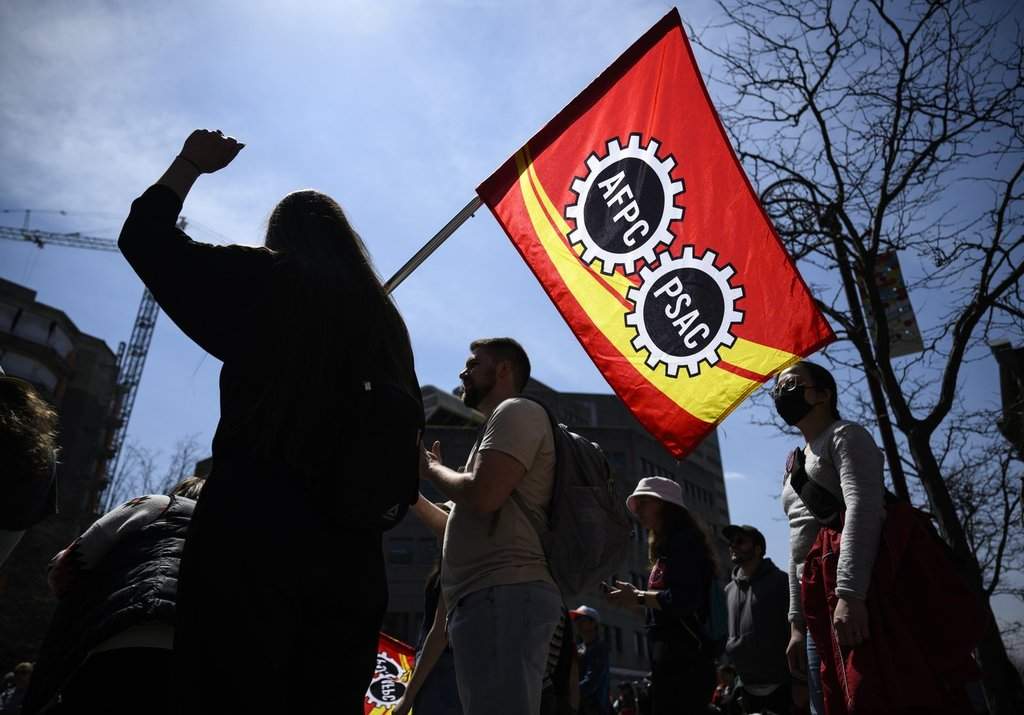
Standard coverage of the Public Service Alliance of Canada (PSAC) strike vote treats the ballot as a simple referendum on whether 120,000 federal employees are angry enough to walk out. That framing misses the structural mechanics of public-sector collective bargaining. When PSAC opened strike voting across the Program and Administrative Services (PA), Technical Services (TC), and Education and Library Science (EB) groups for the window running from November 16, 2026, to January 22, 2027, the union was not merely polling sentiment. It was initiating a timed credibility test designed to alter the Treasury Board's reservation price while managing internal member fatigue from the 12-day walkout in April 2023.
To evaluate whether this mandate shifts leverage at the bargaining table, an analyst must separate headline grievances from institutional incentives. The core blueprint for reading this dispute rests on four mechanisms: the statutory 60-day strike clock that compresses tactical options once votes close, the wage-versus-fiscal-constraint gap driving the impasse, the non-wage structural battles over remote work, artificial intelligence, and Workforce Adjustment (WFA), and the personal opportunity cost borne by workers who substitute salary with strike pay.
Deconstructing the Competitor Narrative and Its Blind Spots
Conventional reporting on PSAC announcements typically follows a predictable script: contract talks stalled after roughly a year and a half, the union calls a government wage offer averaging under 1% per year "insulting", roughly 120,000 workers across diverse roles—from administrative clerks and librarians to fishery officers and wildland firefighters—are eligible to vote, and a successful ballot puts the union in a legal strike position for 60 days. While factually accurate on the surface, that summary leaves three causal links unexamined.
First, standard coverage treats a strike vote as synonymous with a picket line. Under federal public-sector labour rules, a majority vote within a bargaining group authorizes strike action rather than automatically triggering a walkout. Leadership retains discretion over timing, escalation, and tactics—such as targeted or rotating walkouts versus a broad stoppage—within the 60-day window following a successful mandate. Calling a strike too early wastes coercive leverage before mediation exhausts its utility; waiting past the statutory window forfeits the mandate altogether.
Second, surface reporting conflates nominal wage offers with real purchasing power and fiscal trade-offs. Treasury Board's tabled wage trajectory—reported as 2.0% in 2025 followed by 0.5% in 2026, 2027, and 2028—averages under 1% annually across four years. Unions frame this as a real-terms pay cut whenever consumer price growth exceeds nominal increases. The Treasury Board operates under a fiscal restraint mandate aimed at curbing federal operating expenditures and headcount growth, creating a direct clash between household cost-of-living protection and departmental budget caps.
Third, conventional coverage underweights post-2023 rank-and-file skepticism. Three years after the April 2023 strike, workers do not enter a new ballot with a blank slate. Some members view a credible strike threat as the only lever that moves a reluctant employer, while others question whether a prolonged walkout recovers lost wages quickly enough to justify immediate income loss.
The Bargaining Power Equation in Federal Labour Disputes
In bilateral bargaining models such as the Zeuthen–Harsanyi framework, each side's willingness to hold out depends on the perceived cost of disagreement relative to the cost of concession. A strike vote changes the employer's risk calculation only to the extent that the employer believes the union can sustain a disruption without fracturing internally.
Known Facts Versus Educated Hypotheses
Distinguishing verified institutional facts from analytical projections prevents over-reading early signals:
- Known bargaining timeline and scope: Collective agreements in these core groups expired in 2025, impasses were declared in early 2026, mediation has occurred across 2026, and strike voting for roughly 120,000 PA, TC, and EB members spans November 16, 2026, to January 22, 2027.
- Known strike pay floor: Eligible PSAC members working at least 20 hours per week receive $100 per day (up to $500 per week) in general strike pay across most of Canada, with higher territorial rates and potential constituent-body supplements where applicable.
- Known statutory window: Following a successful strike vote, a bargaining agent must declare or authorize a strike within 60 days under federal legislation.
- Educated hypothesis on employer responsiveness: When Treasury Board shows renewed engagement during mediation alongside a strike vote rollout, it likely reflects a calibrated effort to test whether targeted concessions can avert a mandate—or a high-turnout "yes" result—rather than an immediate surrender on core fiscal targets.
- Educated hypothesis on vote turnout: Turnout and margin of approval will likely vary sharply between groups facing immediate restructuring or return-to-office friction and groups with higher operational continuity pressures.
Why Voting Windows Shape Tactical Leverage
Stretching strike voting from mid-November through January 22 serves two operational purposes. In-person information and voting sessions across regions allow locals to verify member contact details, complete mandatory briefings, and route ballots through electronic voting systems using personal credentials rather than employer networks. At the same time, a multi-month voting window keeps pressure active across late-year budget and mediation cycles without forcing an immediate binary cliff before all bargaining units have weighed in.
The trade-off is momentum management. Long voting windows risk uneven early participation if members delay registering or attending sessions until the final weeks before the January 22 noon deadline. A union leadership team optimizes this process by pairing early mediation pressure with late-window turnout drives so the final mandate reflects broad participation rather than a narrow, easily dismissed minority of eligible voters.
Four Structural Fault Lines Driving the Impasse
A contract dispute of this scale rarely turns on a single percentage point. Four structural fault lines define where positions harden.
1. Real Wage Erosion Versus Aggregate Payroll Restraint
Compensation sits at the center of the dispute because it is quantifiable, universal across classifications, and permanent in the wage base. From a worker's household ledger, a sub-1% annualized average increase over four years feels like falling behind whenever groceries, rent, or mortgages climb faster. From the Treasury Board's ledger, every percentage point across more than a hundred thousand salaries compounds across multi-year budgets and pension liabilities. When inflation expectations and fiscal restraint pull in opposite directions, wage talks deadlock until either macroeconomic assumptions shift or non-wage trade-offs bridge the gap.
2. Workforce Adjustment and Job Security Anxiety
Job security becomes acute when departments signal downsizing, restructuring, or Early Retirement Incentives alongside tightening budgets. When thousands of members receive Workforce Adjustment notices or face uncertainty over term conversions and contracting out, bargaining shifts from purely distributive wage gains to defensive risk reduction. Workers under restructuring pressure often place higher value on seniority protections, alternation mechanisms, and retraining support than on marginal wage adjustments that may not offset job displacement risk.
3. Hybrid Work Rules and Real Estate Footprints
Remote and hybrid work arrangements have evolved from pandemic stopgaps into contested governance territory. Unions seek enforceable collective-agreement language and objective assessments rather than unilateral management directives, while employers weigh office occupancy mandates, supervision norms, and public-facing service expectations. Meanwhile, shifting office attendance triggers tangible facilities spending—such as reconfiguring or acquiring workspace—making physical footprint management an economic variable rather than a purely cultural debate.
4. Artificial Intelligence Guardrails and Algorithmic Oversight
As federal departments adopt automated tools, analytics, and digital workflows, unions are pushing for contractual guardrails around hiring, discipline, workplace monitoring, and human oversight. Employers generally resist locking rapidly evolving technology governance into rigid collective-agreement clauses that could slow operational modernization. Even where both sides agree in principle that humans should remain accountable for high-stakes decisions, drafting enforceable definitions of "surveillance" or "automated decision-making" creates sharp friction at the table.
Worker Economics and the Cost of Escalation
A strike is a classic collective-action test with asymmetric costs. For a federal employee earning a typical public-service salary, moving from regular pay to $100 per day—capped at $500 per week for full-time general rates—represents a substantial immediate income drop. Fixed monthly obligations such as rent, child care, and debt service do not pause during a walkout.
Consider a simplified household illustration rather than a statistical average. A full-time employee netting, say, $950 per week in regular take-home pay who receives $500 per week in strike pay faces a $450 weekly cash-flow gap. Even if a negotiated settlement later adds an extra half-percent or full percentage point to annual base pay, recouping several hundred dollars per week of foregone net income takes time—especially if a walkout drags past two weeks. That math explains why seasoned members weigh not just what the union demands, but how a strike would be executed.
Tactically, unions have alternatives between passive compliance and a full-scale general walkout:
- Work-to-rule actions restrict performance strictly to contractual duties, creating administrative friction at low direct wage cost to members.
- Targeted or rotating strikes concentrate disruption on specific functions, regions, or bottlenecks while spreading strike-fund drawdowns and income loss across time.
- Full strikes maximize immediate public and operational shock but carry the heaviest financial strain on members and union strike reserves.
No tactic is a silver bullet. Broad stoppages can trigger back-to-work legislation or public pushback if essential services or citizen-facing backlogs stall, whereas narrow actions may lack enough bite to force a major Treasury Board mandate shift.
Strategic Play for Stakeholders Watching the Vote
Treat the November-to-January ballot window as a structured leverage signal rather than a verdict on whether picket lines will form tomorrow. Track three concrete indicators between now and January 22: registration and turnout momentum across the PA, TC, and EB groups, movement in mediated talks on concrete language around WFA protections and hybrid work rather than general statements of goodwill, and the 60-day authorization clock once results are certified. If a strong mandate emerges without a breakthrough in mediation, expect targeted escalation threats aimed at high-visibility operational choke points before any all-out walkout is staged—and plan budgets, service contingencies, and negotiation timelines around that window rather than assuming an instant resolution.