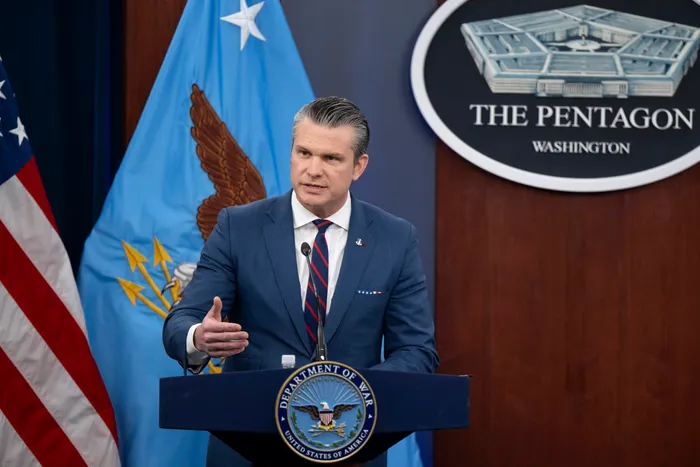
The air inside the Pentagon is different. It smells of floor wax, recycled oxygen, and the heavy, invisible weight of a thousand decisions that could end the world. When Pete Hegseth stood before a group of military faithful for a prayer meeting, the silence wasn't just respectful. It was expectant. In that hallowed, high-security space, every word carries the force of a ballistic trajectory.
Then came the verse.
It sounded like thunder. It sounded like judgment. To those familiar with the cinematic grit of the 1990s, it sounded like a hitman named Jules Winnfield.
"The path of the righteous man is beset on all sides by the inequities of the selfish and the tyranny of evil men..."
For a moment, the line between a government office and a Quentin Tarantino set blurred. Social media erupted within hours. The narrative was too perfect to ignore: A future Secretary of Defense, known for his tattoos and his crusading rhetoric, had supposedly stood at a Pentagon lectern and channeled a fictional executioner. It was the ultimate "gotcha" moment for a digital age that thrives on irony and outrage.
But the truth is far stranger than a movie script. It is a story about how we hear what we want to hear, and how a fake Bible verse from a cult classic film became a litmus test for the American soul.
The Ghost of Ezekiel 25:17
The controversy began with a whisper that turned into a digital roar. Reports surfaced claiming Hegseth had recited the famous "Ezekiel 25:17" speech—the one Samuel L. Jackson delivered with terrifying charisma before a hail of bullets. In the film, it’s a terrifying anthem of vengeance. In a prayer meeting, it would be a chilling declaration of intent.
The problem? That verse doesn't actually exist in the Bible. Not in that form.
Tarantino and Jackson took the skeletal remains of the real Ezekiel 25:17 and grafted onto it pieces of other scriptures and a healthy dose of pure, cinematic menace. The real biblical text is a brief, standard prophetic warning about God's vengeance on the Philistines. The movie version is a sprawling, rhythmic masterpiece of intimidation.
When the rumor hit the internet, the reaction was visceral. Critics saw a man auditioning for a role as a holy warrior, using the language of pop-culture violence to sanctify a political agenda. Supporters saw a man of faith being unfairly maligned by a media apparatus that couldn't tell a prayer from a parody.
But as the dust settled and the actual transcripts and accounts emerged, the narrative shifted. Hegseth hadn't quoted the movie. He had quoted the Bible.
The Anatomy of a Modern Myth
Consider the mechanics of the misunderstanding. We live in a world where the copy is often more famous than the original. For a generation raised on Pulp Fiction, those specific words—"the path of the righteous man"—are inextricably linked to a leather jacket and a burger-joint philosophy. When Hegseth spoke of righteousness and the trials of the faithful, the collective consciousness of the internet didn't go to the dusty pages of the Old Testament. It went to Netflix.
This wasn't just a factual error. It was a cultural collision.
The facts, stripped of their digital hysteria, reveal a more nuanced scene. Hegseth was participating in a recurring prayer circle, a gathering of men and women who look for spiritual grounding amidst the machinery of war. He spoke of the challenges facing those who serve, the moral weight of leadership, and the "righteous path" in a world that feels increasingly chaotic.
He used the actual Ezekiel 25:17. He used the language of the King James Bible.
The irony is thick enough to choke on. The very people accusing him of being "cinematic" were the ones viewing his life through a cinematic lens. They were the ones who couldn't hear a reference to righteousness without imagining a soundtrack by Dick Dale. We have become so conditioned by the tropes of entertainment that we struggle to recognize the sincerity of traditional faith when it appears in a public square.
The Invisible Stakes
Why does this matter? Why do we care if a politician or a military leader quotes a movie or a prophet?
The answer lies in the stakes of the office. The Pentagon isn't just a building; it is the nervous system of global power. When a man like Hegseth—a combat veteran with a history of provocative commentary—steps into that ecosystem, every syllable is scrutinized for signs of radicalism.
The "Pulp Fiction" rumor was a vessel for a deeper fear. It was the fear that the boundary between policy and performance has finally dissolved. People weren't just worried that he liked a movie; they were worried that he saw himself in the movie. They feared a leader who views the world as a battlefield between the "righteous" and the "evil," with no room for the gray areas where diplomacy lives.
By debunking the rumor, we don't necessarily erase the tension. We just move it back to the realm of reality. The real Hegseth, with his actual views on military justice, the role of women in combat, and the "woke" transformation of the armed forces, is far more complex than a Tarantino caricature.
The truth is that Hegseth didn't need to quote a hitman to be controversial. His actual policy positions and his vision for a stripped-down, traditionalist military are enough to fuel a thousand debates. By focusing on a fake movie quote, the public conversation missed the real story: the shift in the fundamental philosophy of American defense.
The Echo Chamber Effect
Imagine a room where the walls are made of mirrors. You shout a word, and it bounces back to you, distorted by the glass, until it sounds like something else entirely. That is the current state of our political discourse.
The Hegseth incident is a perfect case study in how "alternative facts" aren't always lies—sometimes they are just echoes. Someone heard "Ezekiel," their brain filled in "Samuel L. Jackson," and they tweeted it. Five minutes later, it was a headline. An hour later, it was a "truth."
It takes an incredible amount of energy to stop that echo. It requires us to pause, to check the source, and to ask if we are reacting to the person or the projection. In this case, the projection was a violent movie character. The person was a veteran speaking to a group of believers about the burden of their duty.
Those two things can exist in the same space, but they aren't the same thing.
The real danger isn't that a leader might quote a movie. The danger is that we can no longer distinguish between the two. We have become a nation of film critics rather than citizens, looking for "character arcs" and "plot twists" in the lives of the people who hold our lives in their hands.
The Weight of the Word
Hegseth’s presence at that prayer meeting was an act of public faith, a signal to a specific base that the Pentagon is under new management. It was a moment of cultural signaling as much as it was a moment of worship.
When he spoke of the "righteous," he wasn't speaking to the "selfish and the tyranny of evil men" of Hollywood lore. He was speaking to a military culture that feels increasingly alienated from the civilian world it serves. He was promising a return to a specific kind of moral clarity, one that predates the 1990s and even the Pentagon itself.
Whether that clarity is a stabilizing force or a dangerous provocation is the question we should be asking. But we can't ask it if we are busy arguing about whether or not he wants to be Jules Winnfield.
The facts are now clear. The transcript exists. The witnesses have spoken. There was no movie quote. There was no "Pulp Fiction" performance. There was only a man, a Bible, and a room full of people looking for meaning in a building designed for war.
As we move forward, the challenge will be to keep our eyes on the man, not the screen. We must listen to the words he actually says, not the ones we expect him to say based on the tattoos on his arms or the channel he used to work for.
The story of the "Pulp Fiction" verse is a reminder that in the war for reality, the first casualty is often the context. We prefer the exciting lie to the boring truth. we prefer the movie version of the world because the real version is too heavy to carry.
But in the corridors of the Pentagon, there are no directors to yell "cut." There are no scripts to follow. There is only the weight of the decisions and the long, silent walk down the path of the righteous—whatever that path may truly look like.
The silence has returned to the Pentagon prayer room. The wax and the oxygen and the heavy air remain. And outside, the world waits to see what the next chapter holds, hoping that the people in charge know the difference between a prophet and a protagonist.
Reality doesn't have a soundtrack. It only has consequences.