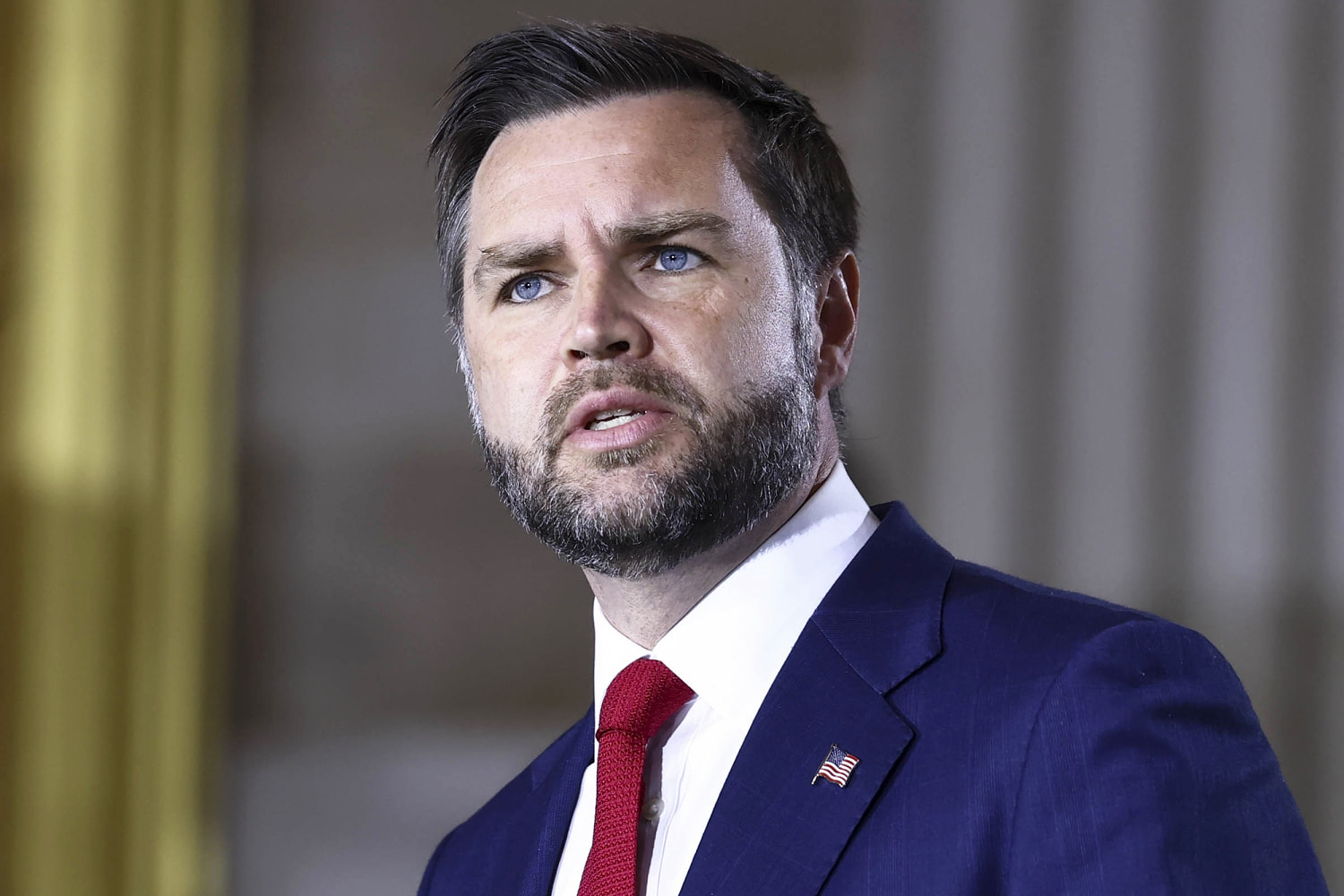
The air inside the recording studio smelled of stale coffee and expensive microphones. Outside, the Ohio humidity pressed against the glass, heavy and indifferent. Inside, JD Vance leaned back into the padding of his chair, adjusting his posture for a conversation that would drift far beyond the usual boundaries of political posturing. He was not talking about inflation or tax brackets. He was talking about the end times. He was talking about the Antichrist, and he was talking about artificial intelligence.
To the casual listener scrolling through a podcast feed on a Tuesday morning, the juxtaposition felt jarring. Eschatology and algorithms rarely share the same breath. Yet, in the quiet architecture of modern conservative thought, these two concepts are beginning to fuse into a single, anxious narrative about the future of human agency. Also making waves recently: The Concrete Horizon And The Voice Waiting In The Margins.
Consider what happens when you strip away the partisan shouting matches. You are left with a fundamental human terror: the sensation that we are building things we can no longer control.
History is littered with men who looked at their own inventions and saw the face of the apocalypse. When the printing press arrived, some theologians worried it was a conduit for unmitigated heresy. When the atomic bomb split the atom in the New Mexico desert, J. Robert Oppenheimer famously reached for Hindu scripture, muttering about being the destroyer of worlds. Now, the silicon chip wears the priestly vestments of prophecy. Further insights into this topic are detailed by NBC News.
During that faith podcast appearance, Vance did not sound like a standard-issue technocrat praising the efficiencies of large language models. He sounded like a man peering over the edge of a precipice, wondering if the descent has already begun. He touched on theological frameworks where technology is not merely a neutral tool, but an active participant in spiritual warfare. When silicon begins to think, mimic, and generate soul-like facsimiles of human art and emotion, where does the soul go?
It is easy to mock this. The secular commentariat often rolls its eyes at any politician who invokes ancient religious archetypes to discuss modern software. But mockery is a cheap defense mechanism against deep discomfort.
We have built a digital ecosystem that rewards our worst impulses, feeds our dopamine receptors, and isolates us behind glowing rectangles. That is not a prophecy; it is a daily lived reality. When a prominent political figure links that reality to the Antichrist, he is giving archaic language to a very modern dread. He is translating the cold mechanics of data centers and server farms into a language of good and evil.
Let us be honest about why this resonates. People are tired. They feel the ground shifting beneath their feet. Jobs are changing, communities are hollowing out, and the cultural consensus that held the late twentieth century together has fractured into a million bitter shards. Into that vacuum steps artificial intelligence—a force promising boundless utopia while quietly eroding the value of human labor and thought.
When Vance talks about the end times in connection with technology, he is tapping into a deep, subterranean vein of American anxiety. It is the fear that our cleverness has outstripped our wisdom.
Think about the way we interact with generative AI right now. We feed it our journals, our artwork, our corporate memos, and our deepest curiosities. In return, it whispers back to us in a voice that sounds eerily, unsettlingly human. It does not hate us, and it does not love us. It simply computes. And that utter lack of a soul—wrapped in a convincing imitation of a soul—is precisely what rattles the theological imagination. What is the ultimate deception, after all, but something that looks and sounds alive, yet possesses no grace, no redemption, and no spirit?
This is where the political and the spiritual collide with startling force. The decisions we make over the next decade regarding regulation, deployment, and ethical boundaries for artificial intelligence will not just shape our economy. They will shape our humanity.
If we treat technology solely as a productivity metric, we miss the human cost. We miss the quiet desperation of the worker whose vocation is rendered obsolete by a script running on a server in Oregon. We miss the profound disorientation of a culture that can no longer distinguish between a photograph of a real moment and a pixel-perfect fabrication.
Vance’s foray into these dark waters reminds us that policy is never just about numbers. It is about what we worship. Whether you view the future through the lens of Christian eschatology or secular techno-pessimism, the destination is the same: a nervous reckoning with our own creations.
The microphones in that studio have long since been turned off. The podcast audio has been parsed, clipped, shared, and argued over across social media algorithms designed to maximize outrage. But the shadow of the question remains. We are racing toward a horizon built of code and silicon, and as we look ahead into the gathering dusk, we are left to wonder if the ghost in the machine is waiting to serve us—or waiting to consume us.