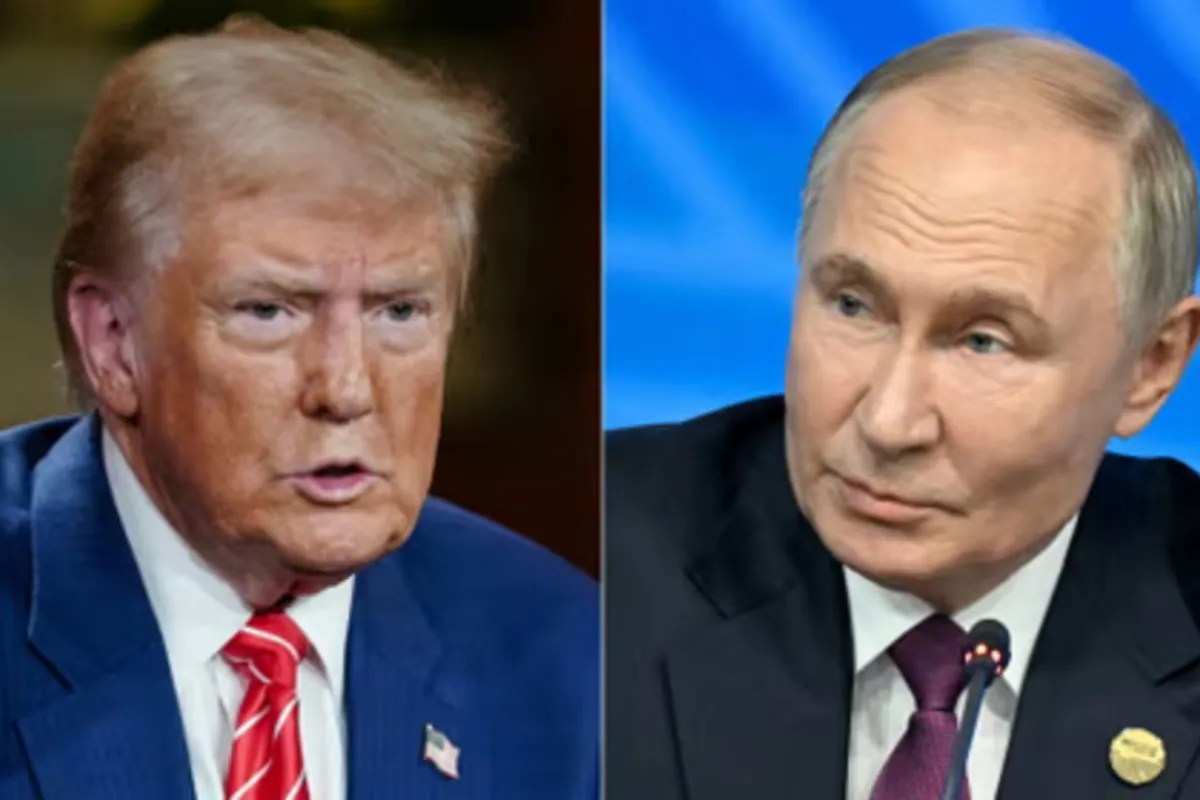
Vladimir Putin is sending a calculated message to Mar-a-Lago, and it has nothing to do with standard diplomatic pleasantries. By publicly acknowledging Washington’s weapon pipelines while warning that prolonged Western assistance will only extend the battlefield, the Kremlin is laying a deliberate trap for the incoming American administration. This is not a outburst of wartime frustration. It is a cold, preemptive strike against Donald Trump’s stated ambition to end the war in twenty-four hours. Moscow is signaling that peace will only happen on Russian terms, effectively neutralizing the leverage Washington thinks it holds.
For months, the political rhetoric in Washington has centered on the idea that American financial and military assistance is a valve that can be turned to dictate terms. The conventional wisdom suggests that by threatening to cut off Kyiv, or conversely, promising to flood Ukraine with advanced hardware, the United States can force both sides to the negotiating table. For a different perspective, consider: this related article.
This calculus is dangerously flawed. The Kremlin’s latest posture demonstrates that Russia has already factored protracted American involvement into its multi-year attrition strategy.
The Myth of the Twenty Four Hour Peace Deal
The illusion that a complex geopolitical conflict can be resolved through a single weekend summit ignores the institutional momentum of the Russian war economy. Moscow has spent the last few years restructuring its entire domestic infrastructure to sustain a long-term fight. Factory floors that once produced civilian goods now churn out artillery shells around the clock. Defense spending has consumed a massive portion of Russia's GDP, creating an economic ecosystem that actually relies on the continuation of hostilities to maintain employment and capital flow. Similar insight on this matter has been shared by USA Today.
Trump’s campaign promise to halt the conflict instantly ran into this wall of economic reality. Putin’s public statements are designed to show that a mere threat of increased American supply does not terrify the Kremlin. Russia has adjusted its logistical lines, secured alternative supply routes for sanctioned components, and deepened its defense ties with sovereign partners outside the Western financial orbit.
Why Washington Miscalculates Kremlin Endurance
Western analysts frequently look at Russian casualties and economic sanctions to predict an imminent breaking point. This framework applies democratic vulnerabilities to an autocratic system. The Kremlin does not face an upcoming election cycle tied to battlefield performance. It does not have to answer to a hostile corporate lobby upset about import restrictions.
- Resource Independence: Russia remains entirely self-sufficient in food, energy, and raw materials required for basic munitions.
- Sanction Adaptation: The shadow fleet of tankers continues to move crude oil, bypassing the Western price cap mechanisms with help from non-aligned global hubs.
- Societal Conditioning: Domestic media has successfully framed the war not as a campaign against Ukraine, but as an existential defensive measures against encirclement by Washington.
When Putin notes that American weapons prolong the war, he is not pleading for them to stop. He is setting the psychological groundwork for his own public. He is telling the Russian population that their economic sacrifices are necessary because they are fighting the full weight of the American military-industrial complex, not just a neighboring state.
The Leverage Trap Facing the New Administration
Consider how negotiation leverage actually functions in high-stakes diplomacy. If the White House approaches Moscow and threatens to increase arms shipments to Ukraine unless Russia agrees to a ceasefire, Putin can simply point to his current rate of advance. The Russian military has shown a willingness to accept high costs to secure incremental territorial gains. A threat of more American weapons does not change the fundamental math on the ground overnight; it takes months for hardware to be authorized, shipped, trained upon, and integrated into frontline units.
Conversely, if the White House threatens Ukraine with a total aid cutoff to force Kyiv into ceding territory, Washington destroys its own credibility with European allies. It would signal to NATO members that American security guarantees are subject to the personal whims of whoever occupies the Oval Office. Putin recognizes this dilemma perfectly. He knows that the United States cannot easily walk away without triggering a systemic collapse of Western alliance structures, nor can it escalate arms deliveries without risking the direct confrontation that Washington has spent years trying to avoid.
The Real Intent Behind the Public Messaging
The messaging directed at Trump is an attempt to dictate the baseline of future talks before anyone even sits down at a table. By emphasizing that Western weapons merely lengthen the timeline rather than alter the ultimate outcome, Putin is telling the world that Russia's victory is an inevitability.
"The Kremlin's strategy relies on convincing Western taxpayers that their investment is a sunk cost. If the public believes that billions in aid only buys a delay rather than a solution, the political will to sustain that aid erodes from within."
This psychological warfare is highly effective. It feeds directly into the isolationist sentiment growing within the American electorate. It allows domestic critics of the war to argue that continuing to fund Kyiv is an exercise in futility, playing directly into Moscow's long-term objectives.
The Logistics of a Protracted War of Attrition
To understand why the Kremlin feels confident enough to dismiss American pressure, one must look at the physical reality of the battle lines. War at this scale is a matter of industrial throughput.
| Country / Bloc | Annual Artillery Production Estimate | Primary Industrial Constraint |
|---|---|---|
| Russia | Millions of shells via state-mandated shifts | Advanced CNC machine tool imports |
| United States | Incremental increases via private defense contractors | Regulatory approvals and workforce shortages |
| European Union | Fragmented production across sovereign nations | Lack of centralized procurement authority |
The raw numbers reveal that despite massive economic superiority on paper, the Western alliance has struggled to convert its financial wealth into immediate, physical military output. Bureaucratic hurdles, supply chain bottlenecks for specialized chemicals, and a lack of domestic manufacturing capacity have slowed the delivery of critical items like air defense missiles and heavy artillery.
Russia, operating under a command economy framework, has bypassed these limitations by ignoring profitability and worker safety standards. The state orders the factories to produce, and they produce. This allows Moscow to maintain a fire superiority advantage that counteracts the technological superiority of individual Western systems.
The Flawed Logic of Freeze and Cede
Many policy proposals circulating in Washington suggest a frozen conflict along the current lines of control, resembling the Korean Peninsula model. This assumes both sides are willing to accept a permanent pause.
For Ukraine, freezing the conflict without ironclad Western security guarantees—such as full NATO membership or a binding mutual defense treaty—is a non-starter. It would simply give Russia time to reconstitute its forces, retrain its officers, and launch a subsequent campaign a few years down the road. For Russia, a frozen conflict that leaves Ukraine free to integrate economically and militarily with Europe is a failure of their core strategic objective, which was to permanently prevent Ukraine from becoming a Western outpost.
Putin’s communications are designed to puncture the optimism of any advisor who thinks a quick deal can be brokered by simply drawing a new line on a map. The Kremlin wants the territory, but it also wants veto power over Ukraine’s future geopolitical alignment.
The European Fragmentation Factor
Moscow's messaging also targets the fractures within the European coalition. The continent is divided between frontline states that view Russian expansion as an immediate existential threat, and Western European nations more insulated by geography and eager to restore historical trade relations.
By asserting that American policy is the sole engine driving the continuation of the war, Putin attempts to isolate Washington from its European partners. If European capitals begin to believe that the war is being artificially prolonged by American geopolitical maneuvering rather than Russian aggression, the unified front of sanctions and diplomatic isolation begins to crumble.
We are already seeing the cracks. Several central European nations have openly broken with the Brussels consensus, calling for an immediate end to aid and a restoration of energy ties with Moscow. Putin's rhetoric provides these factions with the exact political cover they need, allowing them to frame their position not as pro-Russian, but as pro-peace.
The incoming American administration faces a reality that cannot be managed by corporate negotiation techniques or bluster. The Kremlin is dug in, both literally in the trenches of the Donbas and metaphorically in its geopolitical stance. To believe that Russia can be easily incentivized or intimidated into a quick settlement is to misunderstand the nature of the regime in Moscow and the structural realities of the conflict it initiated. Putin has made his opening move before the inauguration has even occurred, laying down a marker that indicates any future negotiations will be met with a brick wall of Russian defiance unless Washington is prepared to offer concessions that would fundamentally reshape the security architecture of the Western world.