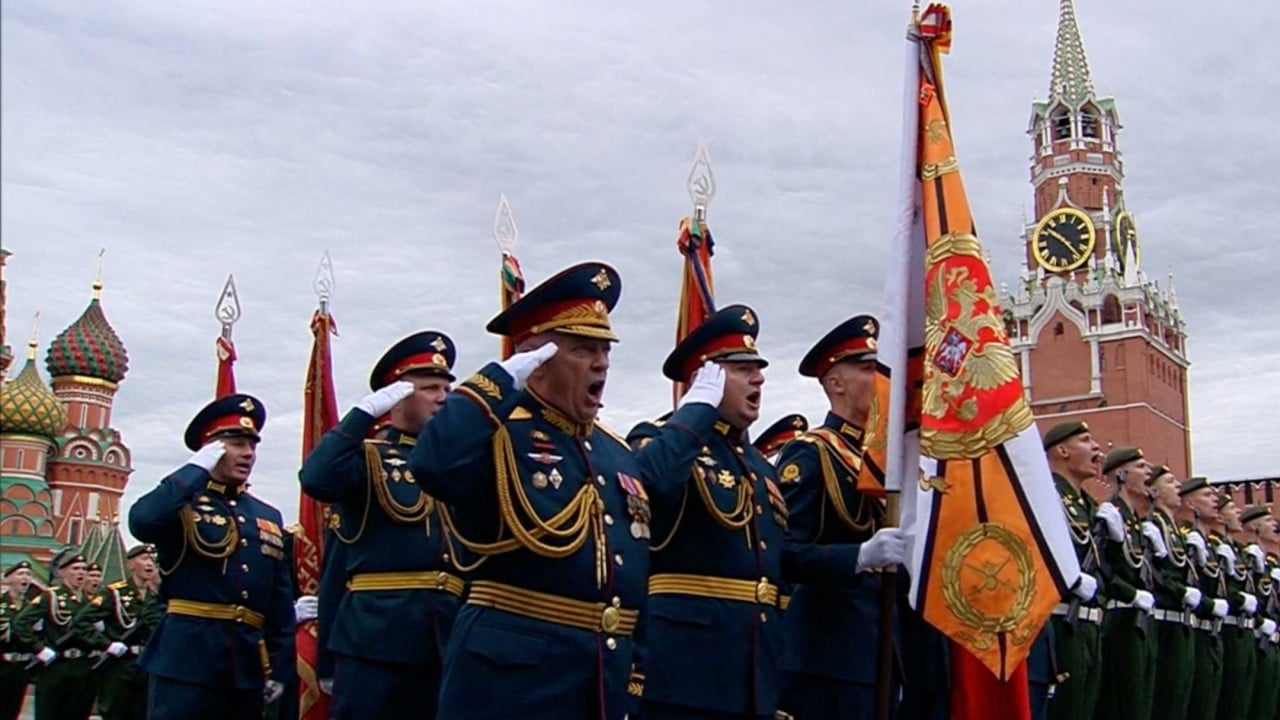
The Red Square parade on May 9 has moved beyond its historical roots as a commemoration of the defeat of Nazi Germany. Today, Vladimir Putin utilized the high-octane pageantry of the 81st anniversary of the Soviet victory to frame Russia’s current invasion of Ukraine as an existential struggle against a "globalist" West. This is no longer a holiday. It is a recruitment drive and a psychological fortification of a nation being prepared for a conflict that the Kremlin now signals could last for years. By positioning NATO’s support for Kyiv as a direct continuation of 1940s fascism, Putin is attempting to bridge the gap between historical trauma and modern geopolitical ambition.
The Weaponization of Historical Memory
For decades, Victory Day served as a somber moment of reflection for the 27 million Soviet citizens lost in World War II. Under Putin, that grief has been re-engineered into a tool of state mobilization. The rhetoric flowing from the Kremlin podium does not merely reference the past; it attempts to overwrite the present.
When Putin speaks of "Western elites" provoking global conflicts, he is speaking to a domestic audience that has been conditioned to see Russia as a perpetual fortress. The logic is circular and effective. If the West is inherently "anti-Russian," then any action taken by the Russian state—no matter how aggressive—is by definition a defensive necessity. This narrative creates a closed loop of justification that leaves little room for internal dissent or external diplomacy.
The presence of advanced military hardware, though scaled back compared to pre-war years, serves a specific psychological function. It is a physical manifestation of sovereignty. Even as the Russian economy pivots toward a total war footing, the sight of intercontinental ballistic missiles rolling across the cobbles of Red Square provides a sense of security to a population grappling with international isolation.
The NATO Narrative as a Shield
The core of Putin’s speech rested on the claim that NATO is actively seeking to dismantle the Russian Federation. This is not a new accusation, but the intensity has reached a fever pitch. By framing the Ukraine conflict as a proxy war initiated by Washington, the Kremlin shifts the blame for the mounting casualties and economic strain away from its own strategic choices.
Investigating the mechanics of this propaganda reveals a calculated effort to dehumanize the opposition. By labeling the Ukrainian government as "neo-Nazis," the Kremlin taps into the deepest emotional reservoir of the Russian psyche. It makes the war not a matter of border disputes or treaty obligations, but a moral crusade. To the average viewer in Novosibirsk or Yekaterinburg, the nuance of international law fades behind the black-and-white imagery of 1945.
A Military in Transition
The 2026 parade reflects a military that is being forced to adapt. While the spectacle remains, the gaps are visible to those who know where to look. The heavy reliance on older equipment or specific units highlights the toll the "special military operation" has taken on the Russian conventional forces. Yet, the Kremlin uses these gaps to emphasize a different kind of strength—resilience.
Russia's defense industry is now operating on three shifts. Factories that once produced civilian goods are churning out shells and drones. This economic pivot is the most dangerous development for European security because it creates a self-sustaining cycle of militarization. Once an economy is fully geared for war, peace becomes an economic risk. The workers in the Ural mountains whose livelihoods now depend on tank production are a new political constituency that Putin must satisfy.
The International Audience of One
While the speech was directed inward, it also served as a signal to the "Global South." Putin’s critiques of Western hegemony resonate in capitals that feel sidelined by the current international order. By casting Russia as the leader of a resistance movement against "colonial" structures, the Kremlin seeks to ensure that it is never truly isolated.
China, India, and various nations across Africa and the Middle East are watching these displays not for their historical accuracy, but for signs of Russian stability. If Putin looks in control, the trade deals for oil, gas, and grain continue. The parade is a theater of competence designed to prove that the sanctions have failed to break the Russian state's back.
The Cost of the Long War
The reality behind the polished boots and synchronized marching is a demographic and economic strain that is rarely mentioned on state television. Russia is facing a labor shortage as hundreds of thousands of men are either at the front or have fled the country. Inflation is a persistent shadow.
The strategy is clear: outlast the West's attention span. Putin is betting that the political will in Washington and Brussels will crumble before the Russian people’s capacity for endurance is exhausted. This is a gamble on the inherent instability of democratic systems. He sees the electoral cycles of the West as a weakness to be exploited, while his own centralized power allows him to ignore the immediate costs of his policies.
Tactical Shifts on the Ground
Observers noted the specific units featured in this year's parade. Many are veterans of the most intense fighting in the Donbas. Their inclusion is a message to the soldiers currently in the trenches: your sacrifice is the foundation of the new Russian state. This attempts to create a warrior caste that is loyal to the person of the president rather than the institutions of the state.
The hardware on display also hints at Russia's shifting procurement priorities. There is a marked increase in electronic warfare systems and autonomous platforms. The lessons of the last two years of combat are being integrated into the military's public identity. They are no longer pretending this is a quick operation. They are showing a force that has learned, bled, and stayed in the fight.
The Shattered Post-War Consensus
The most profound takeaway from the Victory Day rhetoric is the finality with which the Kremlin has rejected the post-1945 international order. For decades, the "Never Again" sentiment was a shared language between East and West. That language is dead.
Putin has reclaimed the victory of 1945 as an exclusively Russian achievement, stripping away the contributions of the other Soviet republics, including Ukraine. This historical revisionism is the bedrock of his territorial claims. If the victory belongs to Russia alone, then the lands liberated during that victory are seen as Russian by right.
This is a dangerous departure from the diplomacy of the late 20th century. It replaces the concept of sovereign borders with the concept of "spheres of influence" determined by military might. The parade is the annual celebration of this worldview.
The Logic of Total Mobilization
We are seeing the birth of a "Parade State." In this model, every aspect of civilian life—education, media, and commerce—is subordinated to the needs of the military. Schools have introduced "Lessons of Importance" that mirror the rhetoric heard on Red Square. The youth are being prepared not for a globalized economy, but for a life of national service and potential combat.
The danger of this transition is that it leaves no off-ramp. If the state is defined by its struggle against an external enemy, then the removal of that enemy threatens the state's very reason for being. This suggests that even if a ceasefire were reached in Ukraine, the hostility toward the West would be maintained to keep the internal gears of the Russian state turning.
The tanks moving past the Kremlin walls are not just relics or symbols. They are the primary tools of a leadership that has decided its legacy will be defined by the forceful restoration of an empire, regardless of the blood or treasure required to build it. The message to the world is that Russia is no longer interested in joining the international community on any terms but its own.
Europe must now grapple with a neighbor that has successfully integrated a permanent state of war into its national identity. The fireworks over Moscow at the end of the day were not a celebration of peace, but a pyrotechnic signal of intent. The long war is here, and the Kremlin has made it clear that it is prepared to wait.