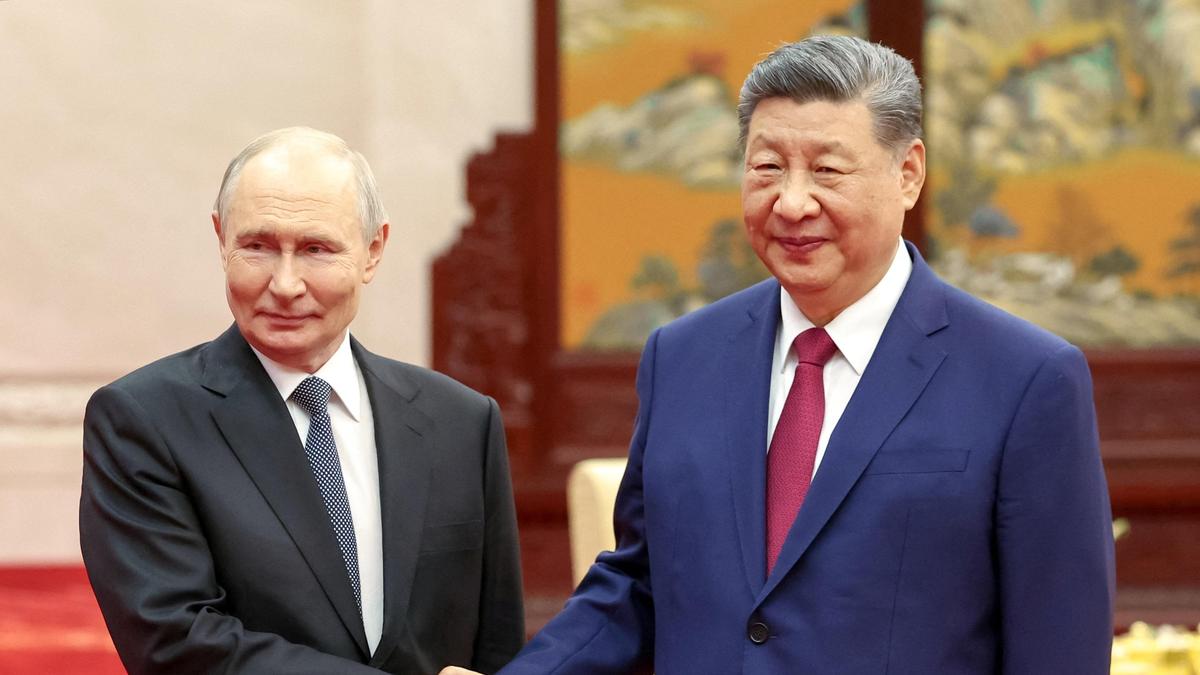
The red carpet in Beijing barely had time to cool down. Just four days after hosting US President Donald Trump for a high-stakes, gold-plated summit, Chinese President Xi Jinping rolled out the military honor guard yet again. This time, the guest of honor was Russian President Vladimir Putin, making his 25th official visit to China.
On the surface, it looked like business as usual for the world's most powerful autocratic duo. They drank tea in the Great Hall of the People, signed a pile of bilateral agreements, and took turns blasting Western foreign policy. Putin dropped an old Chinese proverb about how missing his friend for a day feels like three autumns. Xi talked about an unyielding relationship.
Don't let the cozy rhetoric fool you. Underneath the choreographed smiles and the joint declarations against the law of the jungle, the power dynamic between Moscow and Beijing has shifted dramatically. What was once billed as a no-limits partnership has transformed into a highly transactional arrangement. China holds all the cards, and Russia is increasingly feeling the squeeze of being the junior partner.
The Illusion of Equal Footing
Publicly, Putin and Xi want you to think they're standing shoulder-to-shoulder against Washington. They love the optics. By hosting the leaders of the world's two largest nuclear powers in the span of a single week, Beijing successfully broadcasted its status as the absolute center of global diplomacy.
But look closer at what actually happened during these meetings.
When Trump was in town, Beijing confirmed a massive purchase of 200 Boeing jets and pushed hard to manage trade stability. Xi told Trump that the US and China should be partners, not rivals. Why? Because China’s economy relies heavily on maintaining access to Western consumers. Global trade stability is oxygen for the Chinese Communist Party.
Then Putin showed up, expecting a massive payoff for his loyalty. Instead, he got tea, sympathy, and a lot of vague promises.
The biggest indicator of this imbalance is what didn't happen during the summit. For years, Russia has been desperately pushing for a final agreement on the Power of Siberia 2 natural gas pipeline. Moscow needs this project to double its fossil gas exports to China and make up for the European revenue it lost after invading Ukraine. Yet, the joint statement came and went without a signatures on the pipeline contract.
Beijing is intentionally dragging its feet. They know Putin has nowhere else to turn, so they're squeezing him for the lowest possible gas prices. It's a brutal reality check for the Kremlin.
High Tech vs Crabs and Honey
The economic asymmetry between the two neighbors isn't just about pipelines. It's about a widening technological chasm that's starting to rattle the Russian elite.
During an exchange at a bilateral trade event, Yuri Trutnev, Putin's special envoy to Russia's Far East, openly admitted his frustration. He noted that while Chinese exhibitors brought advanced drones and automated robotics to the table, the Russian side had little more to show off than honey and crabs.
That single observation captures the state of the relationship. Due to crippling Western economic sanctions, Russia's domestic industry is hollowed out. They are utterly dependent on China for high-tech components, microchips, and automotive parts to keep their economy running.
- Bilateral trade numbers: Trade between the two reached $228 billion in 2025.
- The catch: This trade is entirely lopsided. Russia sends raw crude oil and gas; China sends back finished, high-value tech.
- The risk: Russian analysts are quietly raising alarms that Moscow is trading its past dependence on European energy markets for a permanent, inescapable dependence on Beijing.
Distrust Under the Surface
While the official state media outlets scream about a multipolar world order, the intelligence agencies in both countries are playing a much darker game.
Western officials note that beneath the public displays of unity, deep-seated paranoia persists within the Russian security services. The Russian Far East is sparsely populated and resource-rich, sitting right next to a highly industrialized nation of 1.4 billion people. The Kremlin views China as a critical lifeline today, but a massive geopolitical threat over the next few decades.
Espionage is a constant friction point. Dozens of individuals inside Russia are quietly investigated or charged with spying for Beijing every year. Normally, the Kremlin buries these cases to avoid ruffling Xi’s feathers. But the fact that these operations continue shows that neither side truly trusts the other.
China is playing a double game, too. Beijing claims total neutrality in the Ukraine conflict. They try to keep Western regulators happy by allowing Chinese private firms to sell parts to both Russia and Ukraine, extracting financial benefits from the chaos while refusing to fully back Putin's war aims.
What Happens Next
If you want to see where this relationship is going, watch the upcoming Asia-Pacific Economic Cooperation summit this November in southern China. Both Trump and Putin are expected to attend, which will force Beijing into another delicate balancing act.
For businesses and geopolitical analysts watching this space, the takeaway is clear. Stop viewing the Russia-China alliance as a solid monolithic bloc. It's an alliance of convenience born out of shared grievances against the West, but it has distinct structural limits.
If you are evaluating international supply chains or global market risks, treat Russia as a subsidiary economic market of China, not an independent actor. Keep an eye on the specific pricing metrics of Russian oil exports to independent Chinese refineries. When Beijing finally decides to sign the Power of Siberia 2 pipeline deal, that will be the real signal that they've extracted every single concession they wanted from a weakened Moscow. Until then, expect more tea ceremonies, more proverbs, and very little actual charity from Beijing.