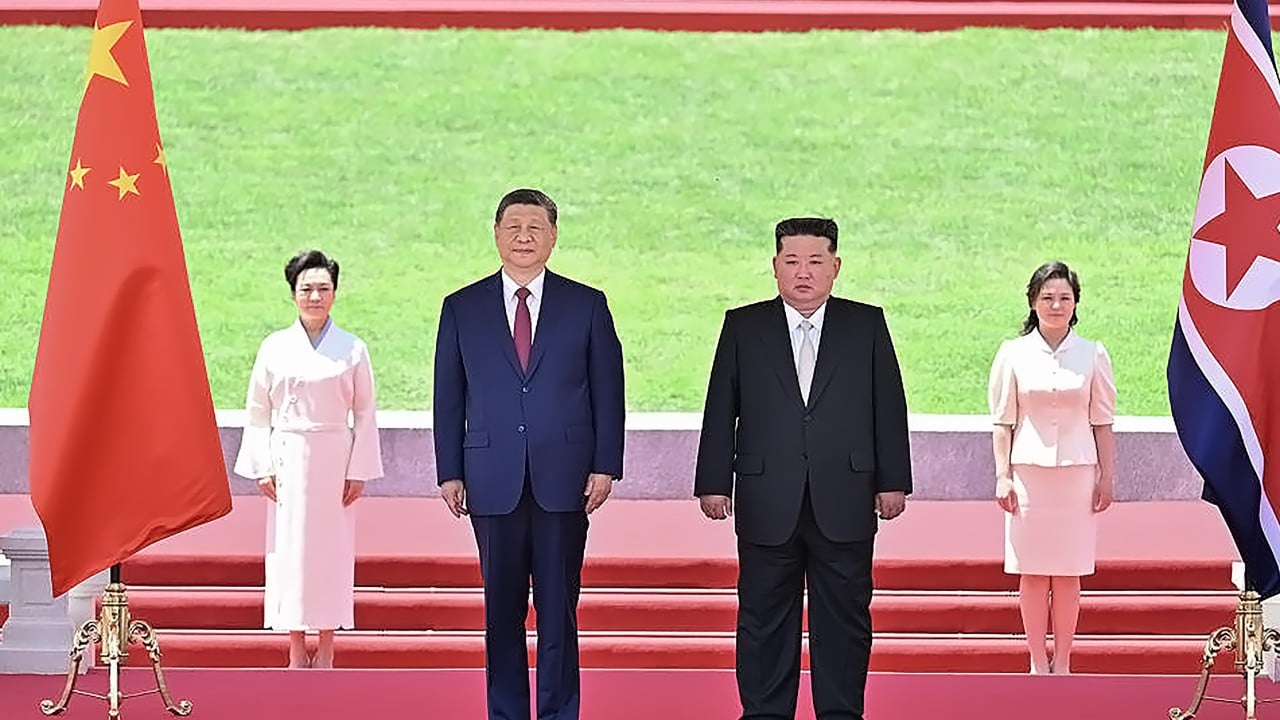
Mainstream media outlets love a good parade. When Xi Jinping rolls into Pyongyang to the sound of booming cannons, synchronized crowds, and the fluttering of synchronized flags, the foreign policy establishment falls over itself to declare a terrifying new era of authoritarian alignment. They see the pomp and ceremony and read it as a flawless demonstration of geopolitical muscle.
They are getting played.
The lazy consensus among talking heads is that these meticulously choreographed summits represent a monolithic bloc ready to upend the global order. They stare at the red carpets and miss the frayed edges underneath. The truth is far less comfortable for both Beijing and Pyongyang. This lavish theater is not a victory lap. It is a desperate, highly managed smoke screen masking profound systemic vulnerabilities, deep-rooted mutual distrust, and economic architecture that is fundamentally broken.
When you look past the synchronized smiles, you do not see a robust alliance. You see two jittery neighbors trapped in a transactional marriage of convenience, terrified of what happens if the other stumbles.
The Illusion of the Ironclad Alliance
Western analysis routinely treats the relationship between China and North Korea as a seamless strategic partnership. Having monitored East Asian trade flows and diplomatic double-speak for over fifteen years, I can tell you that this interpretation is laughably superficial.
In diplomacy, the extravagance of the welcome is often inversely proportional to the actual trust between the parties.
China does not view North Korea as a cherished ally. It views North Korea as a volatile, nuclear-armed buffer state that happens to sit on its border. The leadership in Beijing does not wake up in the morning wanting to bankroll Kim Jong Un’s regime. They do it because the alternative—a collapsed state, millions of refugees streaming across the Yalu River, and American troops stationed on the Chinese border—is a strategic nightmare.
Consider the actual economic data rather than the state-media press releases. While the media hypes up "renewed economic cooperation" every time a Chinese delegation visits, Beijing consistently calibrates its economic support to a strict survival level.
[China-North Korea Trade Reality]
Beijing's Strategy: Cap Support at Survival Threshold
Economic Aid = Enough to prevent total regime collapse
Economic Aid ≠ Enough to allow North Korean independence or aggressive expansion
Result: Deliberate economic dependency, not mutual growth
Beijing provides just enough oil and grain to keep the lights on and prevent a humanitarian catastrophe that would destabilize the region. It explicitly denies Pyongyang the kind of investment that would lead to genuine economic independence or major military expansion. It is a leash, not a partnership.
Dismantling the Premise of Pyongyangs Economic Value
People Also Ask: How much does China benefit economically from its alliance with North Korea?
The Brutal Answer: Economically, China benefits almost zero. North Korea is a black hole for Chinese capital. The trade balance is staggeringly lopsided, and the North Korean market is too impoverished to serve as a meaningful consumer base for Chinese goods. China tolerates the financial drain solely for geopolitical insulation.
The narrative that China is leveraging North Korea for economic gain collapses under the slightest scrutiny. North Korea’s chief exports to China have historically been coal, iron ore, and seafood—commodities that China can easily source elsewhere without the massive geopolitical headache.
Furthermore, doing business with Pyongyang is a bureaucratic and financial minefield. I have spoken with Chinese provincial trade officials in Liaoning who privately complain about the sheer impossibility of enforcing contracts with North Korean state enterprises. Defaulting on debt is practically a hobby for Pyongyang's ministries. When a North Korean entity decides not to pay for Chinese machinery or trucks, the Chinese business owners have zero legal recourse.
Beijing tolerates these losses not out of solidarity, but as a tax. It is the price they pay to maintain a geopolitical shield. To call this an "alliance" stretches the definition of the word to its breaking point.
The Nuclear Friction the Media Ignores
The most glaring flaw in the "united front" narrative is the issue of nuclear weapons. Mainstream reporting often implies that China quietly approves of North Korea’s nuclear provocations as a way to keep the United States and its allies off balance.
This is fundamentally wrong.
Pyongyang’s nuclear ambitions are a direct threat to China’s long-term security architecture. Every time Kim Jong Un launches an Intercontinental Ballistic Missile (ICBM) or conducts a nuclear test, it gives the United States a flawless justification to build up its military presence in East Asia.
- Advanced Missile Defense: It justifies the deployment of THAAD (Terminal High Altitude Area Defense) systems in South Korea, which possess radar capabilities that can peer deep into Chinese territory.
- Trilateral Security Cooperation: It forces Japan and South Korea to set aside historical grievances and forge tighter, unprecedented military intelligence-sharing agreements with Washington.
- Naval Build-up: It brings American aircraft carrier strike groups right to China's maritime doorstep.
Kim’s nuclear program does not project Chinese power; it actively compromises it. The red carpet in Pyongyang is an exercise in damage control. Xi Jinping travels to North Korea to remind the young leader who pays the bills, attempting to rein in behavior that actively harms Beijing's broader global ambitions.
The Cost of the Contrarian View
To be fair, viewing this relationship as inherently weak has its own analytical risks. If you assume the relationship is purely theatrical, you risk underestimating their capacity for short-term tactical coordination.
When pressed by external sanctions, both regimes can and do cooperate on cyber warfare, illicit financial networks, and ship-to-ship oil transfers that bypass international monitoring. They are highly proficient at exploiting the cracks in Western enforcement mechanisms.
But we must distinguish between tactical opportunism and long-term strategic alignment. A shared enemy is not the same thing as a shared vision. The moment the external pressure drops, the inherent contradictions and historical animosities between Beijing and Pyongyang bubble right back to the surface.
Stop Misreading the Theater
The next time you see footage of goose-stepping soldiers and massive card stunts honoring a visiting foreign leader, change the channel. Or better yet, look at what is not being filmed.
Look at the empty shipping containers at the Dandong border post. Look at the strict quotas Beijing places on North Korean laborers entering its northern provinces. Look at China’s frantic diplomatic efforts to manage relations with Seoul and Tokyo behind closed doors.
The pomp and ceremony are designed specifically for Western consumption. It is a theatrical performance meant to project an image of absolute stability and unbreakable unity to a Western audience that is easily spooked by big parades.
Stop buying the ticket. Stop watching the show. Start measuring the actual economic variables, the structural security friction, and the deep undercurrents of mistrust that define the real relationship. The red carpet isn't a sign of a rising axis; it is a bandage on a chronic, festering wound.