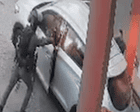
A security camera catches a moment that standard military press releases can't easily scrub away. In the Qalandiya refugee camp, north of Jerusalem, an Israeli Border Police officer steps up to a stopped car. There's a brief verbal exchange. Then, without warning, the Israeli officer shown throwing stun grenade into car during West Bank raid pulls a flashbang from his belt, yanks the pin, and tosses it straight into the passenger cabin.
He doesn't just throw it. He slams the door shut and leans his weight against it to trap the occupants inside while the device detonates.
Smoke pours from the seams. Two passengers in the back manage to scramble out of the opposite side, ducking for cover. The officer then draws his rifle and fires toward them as they run. This footage, released by the Israeli human rights organization B'Tselem, captured an incident from July 5, 2026, that completely upends the usual institutional defense narratives. It's no longer a matter of conflicting testimonies. The entire sequence is on tape.
What the Footage Reveals About Standard Operating Procedures
Official responses from military and paramilitary organizations usually rely on the ambiguity of the fog of war. When a confrontation happens in a volatile area like the Qalandiya camp, standard statements point to immediate operational threats or hostile crowds. The video breaks that pattern completely.
- The vehicle was stationary: There was no sudden acceleration or attempt to ram the officers.
- The escalation was immediate: The officer went from shouting to deploying an explosive device within seconds.
- Entrapment was intentional: Forcing the car door closed demonstrates a deliberate choice to maximize the physical impact of the blast inside an enclosed space.
The Israel Police, who oversee the Border Police unit, reacted quickly after the B'Tselem footage began circulating on social media. They issued a statement acknowledging that the officer acted "not in accordance with procedure" and confirmed that the Justice Ministry’s Department of Internal Police Investigations (Machash) has taken over the case. The officer has since been suspended pending a full investigation.
The Physical Reality of an Enclosed Flashbang Blast
Military officials often describe stun grenades as nonlethal tools designed purely for disorientation. They use a mix of magnesium and ammonium perchlorate to create a blinding flash and a deafening report of around 170 decibels. In an open street, they cause temporary blindness, loss of balance, and acute tinnitus.
Inside a compact car cabin, the dynamics change entirely.
An explosion in an enclosed metal space amplifies the pressure wave. The sound level spikes, risking permanent eardrum rupture. The intense heat from the pyrotechnic flash can instantly ignite upholstery, plastics, or clothing, creating toxic smoke in seconds. The driver in this specific incident managed to escape without severe injuries, but that outcome is a matter of luck rather than tactical precision. Using a flashbang as an improvised cabin-clearance tool while blocking the exit violates every established manual on riot control and urban policing.
The Context of the Qalandiya Raid
This encounter didn't happen in a vacuum. It occurred during a broader, highly volatile Israeli military operation inside the Qalandiya camp. According to the Palestinian Health Ministry, during that same raid, Israeli forces shot and killed 16-year-old Walid Abu Sneineh and wounded three other Palestinians. Two of the wounded were children hit in their lower limbs.
The friction in the West Bank has reached boiling point over the summer of 2026. Incidents are compounding daily. Just hours after the Qalandiya raid, Palestinian medical sources reported that an overnight attack by Israeli settlers in the South Hebron Hills village of Umm al-Khair left six Palestinians injured after physical altercations broke out along the border of the Carmel settlement.
The sheer volume of these clashes creates an environment where local field commanders and low-ranking officers operate under immense stress, but also under a perceived sense of impunity.
The Accountability Gap in West Bank Operations
The suspension of the Border Police officer is a necessary first step, but history suggests that formal charges are exceptionally rare. Human rights groups like B'Tselem and international observers point out a systemic pattern where internal investigations rarely lead to prosecution.
Data from the United Nations shows that since 2020, over 1,100 Palestinian civilians have been killed by Israeli soldiers or settlers across the West Bank. A significant portion of those casualties involves minors. Yet, the number of successful indictments against security personnel remains close to zero.
Yuli Novak, executive director of B'Tselem, argues that the issue runs deeper than individual misconduct. When field personnel regularly see violent abuse or excessive force met with reprimands rather than criminal prosecution, the boundaries of acceptable behavior naturally erode. The Qalandiya video is unique because the evidence is too blatant for the system to ignore entirely, forcing an immediate suspension where other incidents are simply swept into months of bureaucratic review.
Next Steps for Tracking the Investigation
If you want to follow how this case develops and whether it marks a genuine shift in military accountability, watch these specific indicators:
- Monitor Machash statements: Look for updates from the Israeli Justice Ministry regarding whether this case moves from a disciplinary suspension to formal criminal charges.
- Track the civil rights litigation: Human rights organizations frequently file follow-up petitions with the Israeli High Court of Justice if internal police investigations stall without an indictment.
- Observe operational shifts: Watch whether the Border Police issue updated tactical directives regarding the use of less-lethal munitions during vehicle checkpoints and urban raids in the West Bank.