The rain in Manila does not fall so much as it arrives all at once, turning asphalt into dark mirrors and testing the patience of every diesel engine stuck along EDSA. Inside a fluorescent-lit operations center near Camp Aguinaldo, however, the weather is tracked not by the sound of thunder against glass, but by shifting amber polygons on a wall of digital monitors.
Watch the eyes of the watch officer on duty during typhoon season. He is not looking at weapons systems. He is looking at bridge weight limits in Cagayan, fuel reserves in Palawan, and the exact minute a low-pressure system east of Samar will cross the threshold from a tropical storm into a catastrophe.
For decades, the outside world has viewed the Philippines through a binary lens. Either it is the battered archipelago absorbing twenty typhoons a year, or it is the frontline flashpoint in the South China Sea, where gray-hulled coast guard vessels play lethal games of chicken over submerged reefs. Analysts write papers about deterrence. Generals talk about interoperability. Politicians trade speeches about sovereignty.
Yet if you sit down with the people who actually manage emergencies across the Indo-Pacific, a quieter, far more urgent truth emerges. The real test of an alliance is not whether four nations can fire missiles on the same radio frequency. The test is whether they can keep the lights on, the ports open, and the sea lanes breathing when a crisis hits at three in the morning.
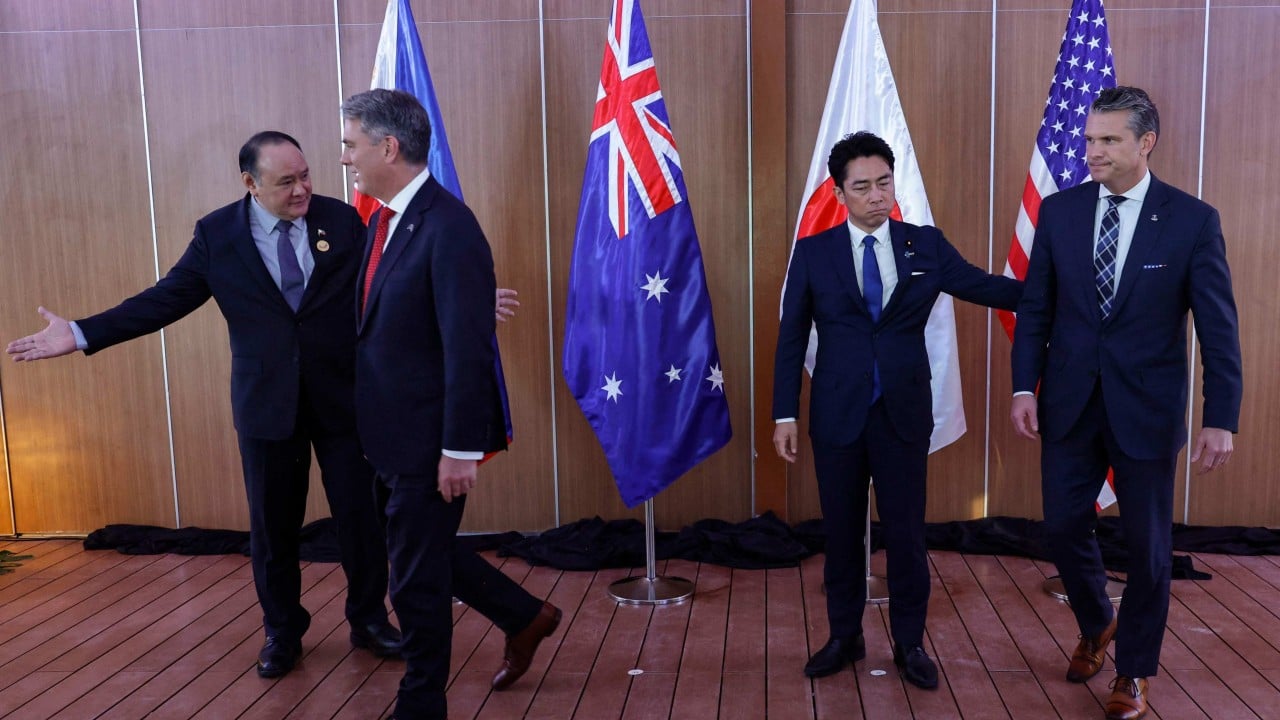
This is the beating heart behind Manila’s quiet campaign to host a permanent coordination hub for the Squad—the informal security grouping uniting Australia, Japan, the Philippines, and the United States.
To understand why this matters, you have to strip away the geopolitical jargon. Forget the acronyms. Picture instead a hypothetical scenario that keeps defense planners awake from Tokyo to Canberra.
Call her Elena. She is a logistics coordinator at a mid-sized port in northern Luzon. In our scenario, it is late October. A Super Typhoon is churning toward the Babuyan Channel, threatening to sever power grids and wash out coastal highways. At the exact same moment, a cluster of foreign maritime militia vessels drops anchor near a disputed shoal, jamming local radio frequencies and blocking civilian resupply boats heading toward a remote island outpost.
Elena does not care about white papers on Indo-Pacific security architecture. She cares about whether the cargo ship carrying water purification units and backup transformers will get through before the storm surge hits, and whose coast guard cutter is close enough to escort it without triggering an accidental war.
Without a shared nervous system, four friendly nations responding to Elena’s crisis end up tripping over their own boots. One navy sends surveillance drones using software the other cannot read. A Japanese humanitarian aircraft waits twelve hours for diplomatic clearance that an Australian liaison officer thought the Americans had already secured. Information travels through embassies, across time zones, translated three times over before reaching the captain on the bridge.
Delay. Friction. Confusion. In the space between those three words, ships sink and towns go dark.
The Architecture of Trust
When the defense chiefs of Australia, Japan, the Philippines, and the United States first began meeting regularly in 2023 and 2024, the press quickly dubbed them the Squad—a punchy, journalistic shorthand meant to echo the older, broader Quad grouping that includes India. The nickname stuck, even if diplomats winced at its comic-book swagger.
What started as a series of joint maritime patrols and multilateral exercises like Balikatan has rapidly outgrown its original shell. War games, by design, have a start date and an end date. Ships steam out of Subic Bay, practice maneuvers in formation, fire live rounds at towed targets, take photographs for the evening news, and sail home. When the exercise ends, the temporary headquarters is dismantled. The servers are packed into crates. The liaison officers fly back to Honolulu, Yokosuka, and Canberra.
Manila’s bid to establish a standing command and coordination hub is an admission that the era of episodic cooperation is over. You cannot schedule a crisis for the third week of April.
Consider what happens when a temporary handshake becomes a permanent desk. In a standing coordination center, an Australian intelligence analyst sits six feet away from a Philippine Navy commander. Across the aisle, a Japanese Maritime Self-Defense Force planner shares coffee with a U.S. Indo-Pacific Command logistics officer. They do not need formal diplomatic cables to ask a question. They just turn their chairs.
This proximity changes the chemistry of decision-making. Anyone who has ever worked inside a joint operations room knows that trust is not built in summit banquets; it is built during the boring, caffeinated hours at two in the morning when someone catches a typo in a fuel manifest before a helicopter takes off. Over months of shared shifts, national habits soften into a common operational language.
Critics, both inside the Philippines and across Southeast Asia, look at this emerging hub with understandable unease. The memory of foreign bases—specifically the long, complicated American presence at Clark and Subic Bay that ended in 1991—still carries deep emotional weight in Manila. For many Filipinos, sovereignty is not an abstract legal concept; it is a hard-won dignity that feels fragile whenever foreign uniforms appear on local soil.
At the same time, neighbors within ASEAN worry about polarization. In Jakarta, Kuala Lumpur, and Singapore, diplomats tread a careful tightrope between Washington and Beijing, terrified of being forced to choose sides in a superpower rivalry that could shatter regional trade. To a skeptical observer in Southeast Asia, a four-nation command hub in Manila looks suspiciously like the embryo of an Asian NATO.
Those fears deserve honesty, not dismissal. Pretending that a coordination center has nothing to do with deterring Chinese assertiveness in the West Philippine Sea would be disingenuous. Every maritime patrol conducted by the four nations sends an unmistakable signal to Beijing that coercive tactics around Second Thomas Shoal or Scarborough Shoal will not go unwitnessed.
Yet focusing exclusively on military containment misses half the blueprint.
Where War Games Meet the Storm
If you trace the geography of the Western Pacific, you quickly realize that the fault lines of geopolitics and the fault lines of nature sit right on top of each other. The Luzon Strait—that narrow stretch of deep water separating the northern Philippines from Taiwan—is simultaneously one of the world’s most vital shipping arteries, a critical underwater fiber-optic cable corridor, and a bowling alley for the strongest tropical cyclones on Earth.
Every year, the Philippine Atmospheric, Geophysical and Astronomical Services Administration tracks roughly twenty tropical cyclones entering the Philippine Area of Responsibility. Eight or nine make landfall. When Typhoon Haiyan tore through the Visayas in 2013, killing more than six thousand people and flattening Tacloban, it was not a traditional military alliance that saved tens of thousands of survivors in the critical first seventy-two hours. It was a massive, improvised multinational logistics surge led by American aircraft carriers, Japanese Self-Defense Force medical teams, and Australian heavy-lift planes working alongside Philippine responders.
Back then, the coordination had to be cobbled together on the fly while bodies were still being pulled from the rubble.
Manila’s vision for a Squad hub directly fuses those two worlds—high-end maritime security and rapid crisis response—into a single operational spine. In the language of defense planners, this is called grey-zone and disaster convergence. In plain English, it means recognizing that the exact same ships, radars, satellite feeds, and supply chains used to monitor illegal fishing fleets or naval blockades are the ones needed to rescue stranded villagers after an earthquake.
Think of it like building a fire station on an earthquake fault line. You hope the building never has to withstand a magnitude-eight tremor, and you hope the trucks never have to fight a chemical fire at the harbor. But if you design the communications grid so the firefighters, the coast guard, and the hospital dispatchers all share the same live map, every single emergency gets answered faster.
By anchoring this hub in Manila rather than Honolulu or Tokyo, the center of gravity shifts toward the actual front line. Geography imposes its own discipline. A planner sitting in Hawaii looks at the South China Sea across five thousand miles of ocean and five time zones. A planner sitting in Manila looks out the window and sees the reality of the archipelago—seven thousand islands, shallow coral reefs, aging port infrastructure, and coastal communities whose livelihoods depend on calm waters.
The Invisible Infrastructure
What does a modern coordination hub actually look like? Forget Hollywood movies with darkened bunkers and glowing holographic globes. Real operational centers are surprisingly mundane rooms filled with humming servers, ergonomic chairs, whiteboards covered in dry-erase markers, and secure fiber-optic lines.
The magic—and the friction—lives in the data pipelines.
Right now, one of the biggest headaches for the four Squad nations is simply getting their machines to talk to one another. The United States operates vast satellite constellations and high-altitude surveillance drones. Japan possesses some of the most sophisticated submarine-hunting aircraft and maritime radar networks in Asia. Australia brings long-range reconnaissance capabilities and deep intelligence ties across the Pacific islands. The Philippines brings sovereign access, local domain awareness, and the indispensable knowledge of its own waters.
Yet historically, classification barriers have kept much of that picture locked in national silos. An American radar might spot a dark vessel—a ship that has turned off its mandatory AIS transponder—slipping into the Philippine exclusive economic zone at midnight. If that data is stamped with a classification label that prevents automatic sharing with non-U.S. personnel, a human officer has to manually scrub the intelligence, write a sanitized summary, and email it through a separate network. By the time the Philippine Coast Guard receives the alert, the ship has vanished into the morning fog.
A permanent hub in Manila is designed to break that bottleneck. It creates a physical and legal container where shared intelligence classification protocols, common maritime domain awareness software, and pre-approved rules of engagement can live side by side.
Consider the ripple effects of that quiet technical fix.
First, it turns episodic deterrence into persistent presence. When Beijing sees four navies conducting a one-week exercise, it simply waits seven days for the ships to leave before resuming pressure on Philippine resupply missions. When those four nations maintain a permanent, twenty-four-hour watch floor sharing real-time satellite and radar feeds, the darkness disappears. Every water-cannon blast, every laser sighting, every illegal dredging operation is recorded, verified across four national intelligence systems, and broadcast to the world within hours. Transparency becomes a shield.
Second, it gives Manila agency. For too long, smaller nations in the Indo-Pacific have felt like pawns moved across a chessboard by larger powers. By hosting the hub on its own soil, under its own roof, the Philippines steps into the role of convener. Manila sets the agenda for how regional emergencies are prioritized, ensuring that a typhoon threatening Batanes or an oil spill off Mindoro commands the exact same urgency as a naval standoff near Taiwan.
The Weight of the Bet
Still, ambition is cheap in diplomacy; execution is where grand strategies go to die.
Building a functioning multinational hub in Manila carries real risks, and anyone pretending otherwise is selling a brochure rather than a strategy. There is the relentless churn of domestic politics in all four democracies. A change of administration in Washington, a fiscal crunch in Tokyo, a shift in parliamentary priorities in Canberra, or a presidential election in Manila in 2028 could suddenly alter the appetite for deep security integration.
There is also the physical vulnerability of the hub itself. Placing a vital regional nerve center in a coastal megacity prone to earthquakes, flooding, and power grid strain requires serious engineering—hardened communications, redundant satellite uplinks, backup generation capable of running for weeks without external fuel deliveries. If the command center goes dark during the very super typhoon it was built to manage, the credibility of the entire enterprise collapses overnight.
And then there is the inescapable shadow to the north. Beijing will inevitably view a permanent Squad hub in Manila as a provocative encirclement, ramping up diplomatic pressure, economic coercion, and grey-zone harassment in response. Filipino fishermen in Zambales and Palawan—men who already face the daily terror of losing their wooden boats to steel-hulled coast guard ships—will bear the immediate brunt of that friction.
That is the human equation sitting beneath every line of the joint communiqués.
When defense ministers sign agreements in air-conditioned conference rooms, they speak of rules-based order and freedom of navigation. When a fisherman in Masinloc unties his boat at dawn, he speaks of whether he will come home with enough catch to pay his daughter’s school fees, and whether a foreign ship will chase him away from reefs his grandfather fished for fifty years.
Manila’s wager is that isolation is far more dangerous than partnership. For years, the Philippines tried quiet bilateral accommodation with Beijing, hoping restraint would buy peace. What it bought instead were artificial islands topped with runways, radar domes, and missile batteries sitting a hundred miles off the Philippine coast.
Silence did not keep the peace. Silence simply meant nobody was watching when the map was redrawn.
Walk back outside that operations center in Quezon City as the afternoon squall finally breaks. Steam rises off the wet pavement. Jeepneys edge forward through the puddles, headlights cutting through the grey mist. Somewhere out beyond the horizon, past the reefs of the West Philippine Sea, patrol boats are rolling in the heavy swell, radios crackling with static.
A room full of screens cannot stop a typhoon from forming in the Pacific, and it cannot wish away the ambitions of a superpower. What it can do is ensure that when the water rises—whether from a storm surge or a deliberate blockade—no one on that watch floor has to reach for a phone book to figure out who is coming to help.