The fluorescent lights in the convention hall hum at a frequency just low enough to give you a headache by noon. Around the polished mahogany tables, men and women in tailored wool suits tap glass screens, adjusting carbon-offset spreadsheets and debating the precise syntax of bracketed text in a draft resolution. Outside, three thousand miles away from this climate-controlled bunker, the rain is late again.
In the mist-choked highlands of the northern Andes, a woman named Elena—a composite, hypothetical figure drawn from the thousands of Indigenous land defenders who have walked these corridors—kneels beside a patch of frailejón, the spongy, velvet-leafed plants that act as the water towers of South America. She doesn't have a spreadsheet. She has the calloused hands of someone who has spent forty years reading the health of a watershed by the smell of the peat and the flight patterns of the mountain tanager.
This is the central, suffocating irony of modern conservation.
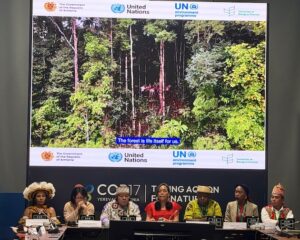
When delegates gather for COP17, the United Nations Biodiversity Conference, the press releases inevitably bloom with warm, congratulatory language. Diplomats applaud traditional ecological knowledge. Panels celebrate Indigenous leaders as the "guardians of the earth." Cameras flash as elders in woven tunics and feathered headdresses shake hands with environment ministers.
Yet, once the photo opportunity ends and the heavy oak doors click shut, those same elders are frequently relegated to the observer gallery—watching through glass while bureaucrats from nations that have already paved over their own wilderness decide how to manage what little remains of the world's wild places.
The Eighty Percent Paradox
To understand why this polite exclusion is a catastrophic error, you have to look at the math. Not the speculative math of financial derivatives, but the hard, empirical accounting of satellite imagery and biodiversity surveys.
Indigenous Peoples make up roughly five to six percent of the global population. That is a sliver of humanity. Yet, according to data compiled by the World Bank and the Intergovernmental Science-Policy Platform on Biodiversity and Ecosystem Services (IPBES), Indigenous communities manage, own, or occupy at least a quarter of the world’s land surface. More staggering still, those territories intersect with approximately forty percent of all terrestrial protected areas and intact ecosystems.
And inside those boundaries sits roughly eighty percent of the planet’s remaining biodiversity.
Pause on that number. Eighty percent.
If the global ecosystem were a burning library, Indigenous communities are the ones standing inside the only wing where the sprinklers actually work. Meanwhile, the international community is standing in the parking lot arguing over who gets to hold the blueprints to the building.
I remember the first time I walked through a primary forest managed by an Indigenous council in the Amazon basin, just days after touring a state-run national park fifty miles downriver. The contrast wasn't subtle; it hit you in the lungs. The state park—patrolled intermittently by underfunded rangers following top-down decrees drafted in a distant capital—was eerily quiet, scarred along its edges by illegal logging tracks and silent of large mammals. Crossing the invisible boundary into the Indigenous territory felt like stepping into a cathedral. The canopy closed overhead like a green vault. Howler monkeys roared from the upper branches; the air smelled thick with rotting leaves, wild cacao, and wet earth.
Nothing about that abundance was accidental. It was the result of centuries of active, hyper-local governance—a living system of agroforestry, seasonal hunting taboos, and controlled burning that western science spent decades dismissing as "primitive" before quietly rebranding it as "regenerative land management."
Applause Without Authority
So why are we still having a debate at COP17 over whether Indigenous leaders deserve a formal, binding seat at the decision-making table?
The friction comes down to a collision of worldviews, disguised as legal technicality. Under the rules of the United Nations Convention on Biological Diversity, only sovereign nation-states are "Parties" to the treaty. Everyone else—scientists, corporations, non-governmental organizations, and Indigenous Peoples—is classified under the umbrella of "observers" or "stakeholders."
Think about what the word stakeholder does. It flattens reality. It places a community whose ancestors have tended a river valley for four hundred generations on the exact same procedural footing as a timber conglomerate lobbying for looser extraction permits or a conservation NGO flying in from Geneva.
During the negotiation of the Kunming-Montreal Global Biodiversity Framework—the landmark agreement aiming to protect thirty percent of the planet's land and oceans by 2030, known as "30x30"—Indigenous delegates fought tooth and nail just to get their rights mentioned in the text. They succeeded in securing explicit references to Indigenous territories and traditional knowledge. On paper, it looked like a breakthrough.
In practice, it left a dangerous loophole.
Because nation-states retain ultimate authority over how 30x30 targets are implemented, several governments have simply drawn lines on a map, declared an area a "strict nature reserve," and evicted the very people who kept it alive. Conservationists have a blunt term for this: fortress conservation. It is the colonial fantasy that nature can only survive if human beings are scrubbed from the landscape entirely—a fantasy that ignores the simple truth that human absence in many ecosystems actually triggers ecological collapse. Without traditional fire management, forests choke on dead underbrush and burn hotter. Without customary harvesting, certain medicinal plants lose the soil disturbance they need to germinate.
Imagine you have spent your entire life keeping a complex, antique clock running smoothly, knowing every quirk of its gears by ear. Then, a committee of strangers bursts into your house, praises your craftsmanship, takes the clock away to put it behind velvet ropes in a museum, and wonders why it stops ticking three weeks later.
That is what happens when COP17 celebrates Indigenous leaders without dismantling the legal walls that keep them out of power.
Follow the Money
If governance is the lock on the door, finance is the key—and right now, almost nobody is handing it over.
At recent climate and biodiversity summits, wealthy nations and philanthropic foundations have pledged billions of dollars toward forest protection and Indigenous-led conservation. The headlines were triumphant. Finally, the money was flowing to the front lines.
Except it wasn't.
When researchers tracked the actual disbursement of the landmark $1.7 billion pledge made at COP26 to support Indigenous Peoples and local communities, they uncovered a sobering bottleneck. Less than ten percent of those funds ever reached Indigenous-led organizations directly. The vast majority was swallowed by middlemen—massive international NGOs, multilateral development banks, and government ministries that took hefty administrative cuts and required complex, English-language grant applications that a village council in rural Borneo or the Peruvian Amazon could never reasonably complete.
To understand how absurd this is, picture a rural volunteer fire department watching a wildfire crest the ridge behind their town. An aid agency arrives with a truck full of hoses, but refuses to hand them over until the firefighters fill out a forty-page logical framework matrix, secure an international fiscal sponsor, and prove they have a certified accounting department. By the time the paperwork clears, the town is ash.
The administrative burden isn't just an annoyance; it is a quiet form of gatekeeping. When conservation funding demands corporate-style bureaucracy, it systematically starves the nimble, grassroots patrols that actually stop illegal miners and poachers on the ground. Worse, it forces Indigenous leaders to spend their days hunched over laptops in regional capitals instead of walking their territories and passing knowledge to the next generation.
What Inclusion Actually Looks Like
The confusion at the heart of global environmental politics stems from a failure of imagination. Diplomats often fear that granting Indigenous Peoples real decision-making authority at COP17 will paralyze negotiations or undermine national sovereignty.
We don't have to guess whether shared governance works, though. We already have proof.
Look at the Great Bear Rainforest along the coast of British Columbia. For decades, it was a war zone of blockades, arrests, and bitter lawsuits between First Nations, logging companies, and the provincial government. The turning point didn't come from another symbolic panel or a non-binding declaration. It came when the government finally recognized First Nations not as "consultees," but as co-equal decision-makers with real veto power over land-use plans.
Together, they drafted an ecosystem-based management framework that protected eighty-five percent of the old-growth forest while creating a sustainable, Indigenous-led conservation economy. Today, grizzly bears, spirit bears, and wild salmon thrive in watersheds that were slated for clear-cutting twenty years ago.
Or consider the Indigenous Ranger programs across northern Australia. By combining millennia-old ecological knowledge with modern drone mapping and GPS tracking, Indigenous rangers manage over a quarter of Australia's total landmass. They prevent catastrophic late-season wildfires, eradicate invasive species, and monitor endangered wildlife at a fraction of the cost of state-run agencies—while simultaneously transforming employment and health outcomes in remote communities.
In both cases, the breakthrough happened the moment power shifted from consultation to consent.
Consultation means asking someone for their opinion before you do what you already planned to do. Consent means they have the right to say no—and the authority to design the alternative.
The Cost of Delay
There is a temptation, when reading about international treaties and UN acronyms, to treat this as an abstract debate about fairness or historical justice. It is both of those things, certainly. But framing Indigenous inclusion purely as a moral favor misses the blunt, existential reality facing every person on Earth, whether you live in a thatched house beside the Xingu River or a forty-story apartment tower in Chicago.
Biodiversity is not a collection of pretty animals we keep around for nature documentaries. It is the biological infrastructure that makes human civilization possible. It is the soil microbes that grow your wheat, the wild pollinators that fertilize your coffee and apples, the coastal mangroves that absorb the punch of category-five hurricanes, and the intact forests that regulate rainfall patterns across entire continents.
When the Amazon loses too much tree cover, the "flying rivers" of moisture it pumps into the atmosphere dry up, triggering droughts that wither soy crops in Brazil and disrupt weather systems as far away as North America. When boreal peatlands degrade, they release centuries of locked carbon, accelerating warming faster than any fleet of electric vehicles can offset.
We are dismantling the life-support system of the spaceship while we are still inside it. And the people who know how to repair the wiring are standing outside the airlock, knocking on the glass.
The Room Where It Happens
Later this week, inside the COP17 plenary hall, the delegates will eventually reach a consensus on the final text. There will be applause. Someone will bang a wooden gavel. Ministers will step up to microphones to praise the spirit of multilateral cooperation and reaffirm their commitment to living in harmony with nature.
In the back of the room, a handful of Indigenous leaders will pack their notebooks into worn canvas bags, step out past the security checkpoints, and catch red-eye flights back to places where the stakes aren't measured in diplomatic communiqués. They will return to riverbanks tainted with mercury from illegal gold dredges, to forest edges scarred by cattle pastures, to mountain springs running thinner every dry season.
Before Elena—or any of the real women and men she represents—steps onto that plane, she will likely walk past a massive digital display in the convention center lobby, ticking off the remaining species sliding toward extinction while delegates pose for group photos beneath banners celebrating diversity.
The gavel has already fallen. The lights in the hall are dimming. Outside, the rain is still late, and the people who know how to call it back are still waiting for the keys to their own house.