The porch light flickers twice before dying.
It is 6:45 PM on a Tuesday in late October, and the air in Macomb County, Michigan smells like wet oak leaves and the exhaust of a silver Honda Civic idling at the curb. Inside the car, a twenty-four-year-old field organizer named Maya—a composite character drawn from hundreds of real canvassers working the Rust Belt this cycle—stares at a glowing tablet screen. A blue dot pulses over a three-bedroom ranch house with a faded American flag hanging beside the garage.
Maya takes a breath. She steps out into the chill, clutching a clipboard loaded with printed walking lists and glossy door hangers.
If you turn on cable news tonight, you will hear anchors breathless over "the all-out fight for critical battleground states." They will show you red and blue maps glowing like neon signs. They will toss around millions of dollars in television ad buys, recite polling margins of error like sacred scripture, and treat entire states as monolithic chess pieces to be captured or defended.
They get the scale completely backward.
The real war for the presidency, the Senate, and the direction of American life is not fought on television screens in New York studios. It is fought right here, on cracked concrete driveways in places like Macomb County, Lehigh Valley, and Maricopa County. It is decided in thirty-second awkward conversations on front porches, in the subtle hesitation of a neighbor holding a screen door ajar, and in the cold, relentless mathematics of voter turnout.
The Geography of a Coin Flip
To understand why a handful of counties hold the fate of three hundred and thirty million people in their hands, you have to strip away the noise of modern punditry and look at the brutal architecture of the Electoral College.
Because almost every state awards all of its electoral votes to whoever wins the popular vote inside its borders, forty-plus states are essentially spectators before a single ballot is cast. California will go blue. Wyoming will go red. Campaigns do not spend a dime persuading voters in Manhattan or rural Alabama, because the electoral math renders those margins irrelevant.
Instead, the entire national election funnels down into a narrow corridor of roughly seven swing states—Pennsylvania, Michigan, Wisconsin, Georgia, North Carolina, Arizona, and Nevada.
Think of the American electorate as a massive, tug-of-war rope stretched across a continent. On either end, millions of firmly committed partisans pull with everything they have, locking the center knot almost completely in place. That knot hovers over a muddy patch of ground no wider than a few feet. The battleground states are that mud. And the people who live there—the undecided voters, the sporadic voters, the exhausted working-class families—are the ones whose slightest shift in weight drags the entire country one way or the other.
In 2016, the presidency came down to fewer than eighty thousand votes spread across Michigan, Pennsylvania, and Wisconsin. In 2020, the margin in Arizona, Georgia, and Wisconsin was even tighter—roughly forty-four thousand votes combined. That is barely enough people to fill a mid-sized baseball stadium.
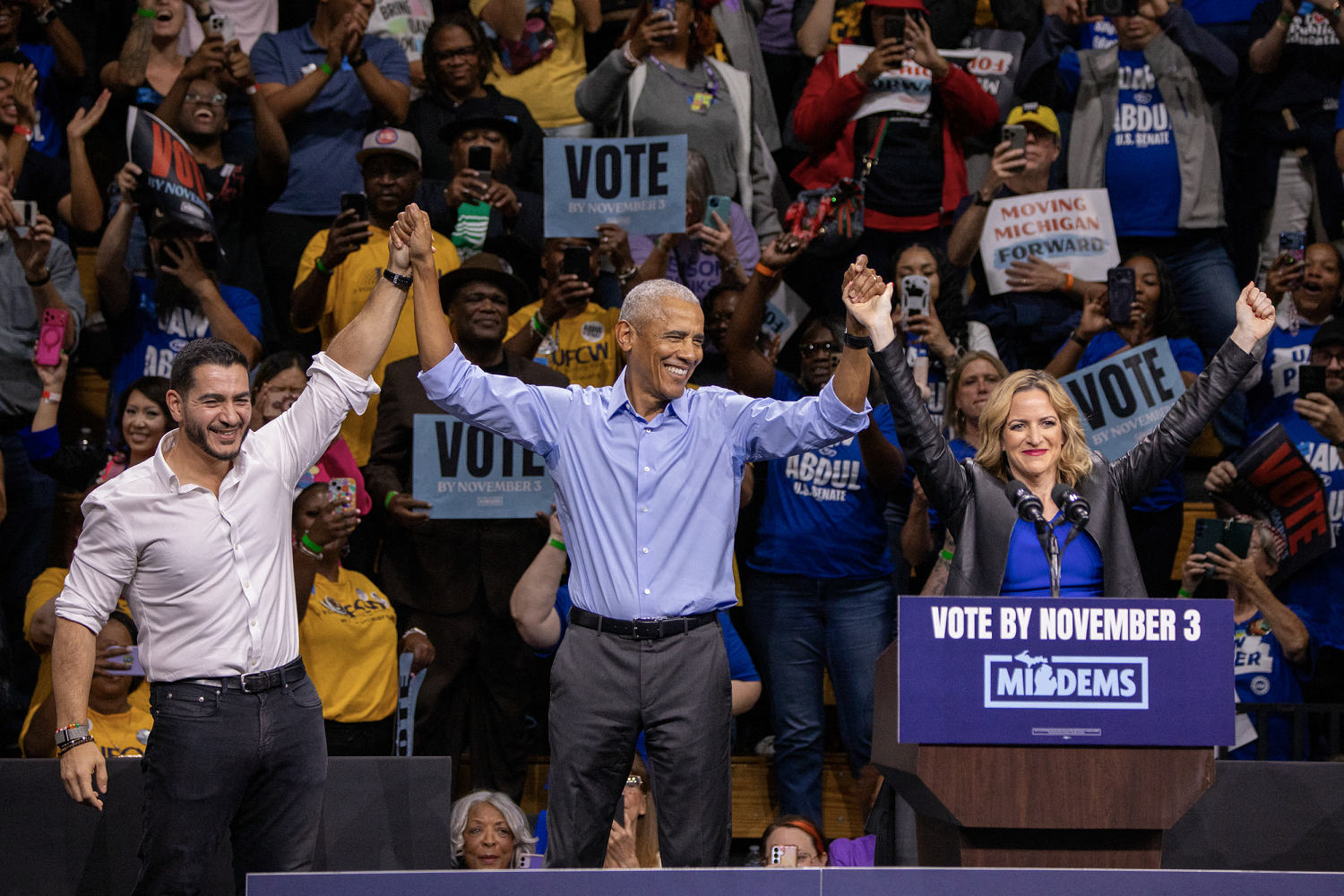
When political operatives talk about an "all-out fight," they are not speaking metaphorically. They are describing a hyper-targeted, industrial-scale effort to find those forty-four thousand people, figure out what keeps them awake at 3:00 AM, and convince them to walk into a school gymnasium on a Tuesday in November.
The Invisible Machine Behind the Curtain
I spent two election cycles working on the ground in swing districts, walking precincts until the soles of my sneakers peeled away from the rubber. If you have never been inside a coordinated campaign field office in October, it is almost impossible to picture the strange mixture of chaos, caffeine, and precision engineering that drives it.
The walls are plastered with butcher paper covered in sharpie tallies. The air smells like stale pizza and damp wool. Every volunteer sitting at a folding table with a headset on is plugged into a massive digital nervous system—voter files built from decades of public records, consumer data, and algorithmic modeling.
Campaigns do not guess who lives behind that door with the flickering porch light. Before Maya ever steps onto the driveway, the database on her tablet has already assigned the homeowner a score from zero to one hundred for partisan support, and another score for turnout likelihood.
Consider what happens when a campaign identifies what strategists call a "low-propensity" voter. Let us imagine a hypothetical man named David, a forty-two-year-old HVAC technician living outside Allentown, Pennsylvania. David voted in 2020, skipped the 2022 midterms, and registered as an independent. He does not watch cable news. He skips YouTube ads within five seconds. He throws political mailers straight into the recycling bin next to the grocery circulars without glancing at the faces printed on them.
To a national media commentator, David is invisible. To a battleground field director, David is pure gold.
Because David ignores traditional media, the only way to reach him is through human friction. A campaign will spend upwards of fifty dollars just to get a live human being to knock on David’s door three times over six weeks. They will match his phone number to peer-to-peer texting platforms. They will serve targeted digital video ads directly to his smart TV while he watches Thursday Night Football.
The goal is rarely to convert a die-hard opponent. Political science research over the last twenty years has repeatedly shown that changing a committed voter’s mind is roughly as effective as trying to push a freight train uphill by hand. Instead, modern battleground warfare relies on two far more reliable levers: mobilization and persuasion at the margins.
Mobilization means making sure your own team actually shows up. Persuasion at the margins means finding people like David—folks who feel squeezed by the cost of groceries, worried about their kids’ schools, and deeply skeptical of both parties—and giving them one concrete reason why staying home will cost them personally.
Why the Noise Feels So Personal
If you live in a battleground state right now, you already know the exhaustion that comes with being the center of the political universe.
Your mailbox overflows with glossy cardstock accusing one candidate of destroying the economy and the other of dismantling democracy. Your phone buzzes every forty minutes with texts from out-of-state area codes begging for five dollars before midnight. You cannot watch a local weather forecast without seeing thirty-second spots filled with ominous black-and-white footage and gravelly voiceovers.
It is easy to feel cynical. Honestly, there were nights during my time organizing when I sat in my car staring at a list of unreturned calls and wondered if any of it mattered at all. The sheer volume of money—billions of dollars poured into media markets from Phoenix to Philadelphia—can make an individual human voice feel like a whisper in a hurricane.
But the data tells a very different story.
Studies conducted by political scientists Alan Gerber and Donald Green proved decades ago—and subsequent cycles have reaffirmed—that a face-to-face conversation at the front door remains the single most effective way to increase voter turnout. One genuine, unscripted interaction can boost the likelihood of someone casting a ballot by roughly eight to ten percentage points. No thirty-second television commercial comes close to that return.
Why? Because human beings are wired for social accountability.
When a stranger stands on your porch in the rain, holding a clipboard, looking you in the eye and asking what you care about, voting stops being an abstract civic duty performed in a vacuum. It becomes a real interaction between two people sharing the same community. Even when voters slam the door—and they do, often—the knock itself breaks through the digital numbness that defines modern life.
The Anatomy of a Thirty-Second Decision
Let us go back to Maya on that porch in Macomb County.
She knocks three times. Silence. She takes a step back, preparing to tuck a piece of literature into the screen door, when the heavy wooden door creaks open. A woman in a faded Detroit Lions sweatshirt stands in the doorway, holding a dish towel. Behind her, a toddler is crying, and the smell of frying onions drifts out into the cold air.
"Sorry to bother you," Maya says, keeping her posture open, stepping back down one stair so she does not crowd the threshold. "I'm volunteering in the neighborhood tonight, just checking in to see if you've got a plan to vote next week."
The woman sighs. She looks tired—the kind of bone-deep fatigue that comes from working a double shift and coming home to make dinner. "Honestly? I don't even know if I'm going. Everything costs twice what it did three years ago, and none of these people in Washington seem to care about folks like us."
Here is the moment where amateur campaigns fail and disciplined ground games win.
An amateur canvasser will launch into a memorized talking point. They will recite statistics about GDP growth, unemployment rates, or legislative achievements. The woman in the Lions sweatshirt will nod politely, say she has to get back to her kid, and close the door. She will stay home on Election Day.
A trained organizer listens first. Maya does not argue with the woman's reality. She validates it.
"I hear you," Maya says quietly. "My mom works retail down the road, and she says the exact same thing every time she comes back from the grocery store."
The woman’s shoulders drop an inch. The wall between them softens. For the next forty seconds, they do not talk about cable news outrage or national talking points. They talk about local property taxes, the cost of childcare, and where the nearest early voting location is open on Saturday morning so she does not have to juggle voting with a Tuesday work shift.
When Maya walks back down the driveway to her silver Honda Civic, she taps two notes into her tablet. She has not magically turned a skeptical voter into a cheering partisan. She has simply removed one layer of friction—and reminded one person that her voice carries the exact same weight as a billionaire donor's.
The Weight of the Uncast Ballot
We often talk about elections as a measure of public opinion, like a giant thermometer taking the temperature of the nation. That is a comforting myth.
Elections are not a measure of what everyone thinks. They are a measure of who showed up.
In almost every major American election, the largest single bloc of citizens is not Democrats, and it is not Republicans. It is non-voters. Millions of eligible adults stay home because they believe their vote is a drop in an ocean—too small to change the tide, too insignificant to justify waiting in line on a rainy Tuesday.
Yet history turns on those exact margins.
Think about the local school board races decided by eleven votes. Think about the state legislative seats in Pennsylvania or Michigan where control of an entire chamber—and with it, laws governing healthcare, wages, infrastructure, and voting rights—hinges on a few hundred ballots cast in a single suburban township.
The fierce, relentless battle unfolding across the swing states right now is ultimately a war against resignation. Every door knock, every phone call, every local volunteer organizing rides to the polls is pushing back against the quiet lie that ordinary people have no power left.
The television ads will fade the Wednesday after the election. The consultants will pack up their laptops, take down the butcher paper from the walls of strip-mall field offices, and move on to the next cycle. The cable news maps will go dark until the next crisis demands our attention.
What remains is the quiet, stubborn reality of the neighborhood itself—the cracked sidewalks, the local schools, the kitchen tables where families tally up their bills at the end of the month. And somewhere on a quiet street in Michigan or Pennsylvania, a porch light flickers on in the dark, waiting for the next knock.