Ten years ago, if you stood on a dusty street corner in a tier-three Indian town—somewhere far from the glass towers of Mumbai’s Bandra-Kurla Complex—you could measure the cost of human ambition in megabytes.
A single gigabyte of mobile data cost roughly 250 rupees. To a young college graduate trying to watch a coding tutorial, or a tailor trying to browse bridal designs from Delhi, that price wasn't a utility bill. It was a wall. You rationed your curiosity. You turned off your mobile data the second a WhatsApp message went through, hoarding kilobytes like scarce rainwater during a dry monsoon. If you found value in this post, you might want to check out: this related article.
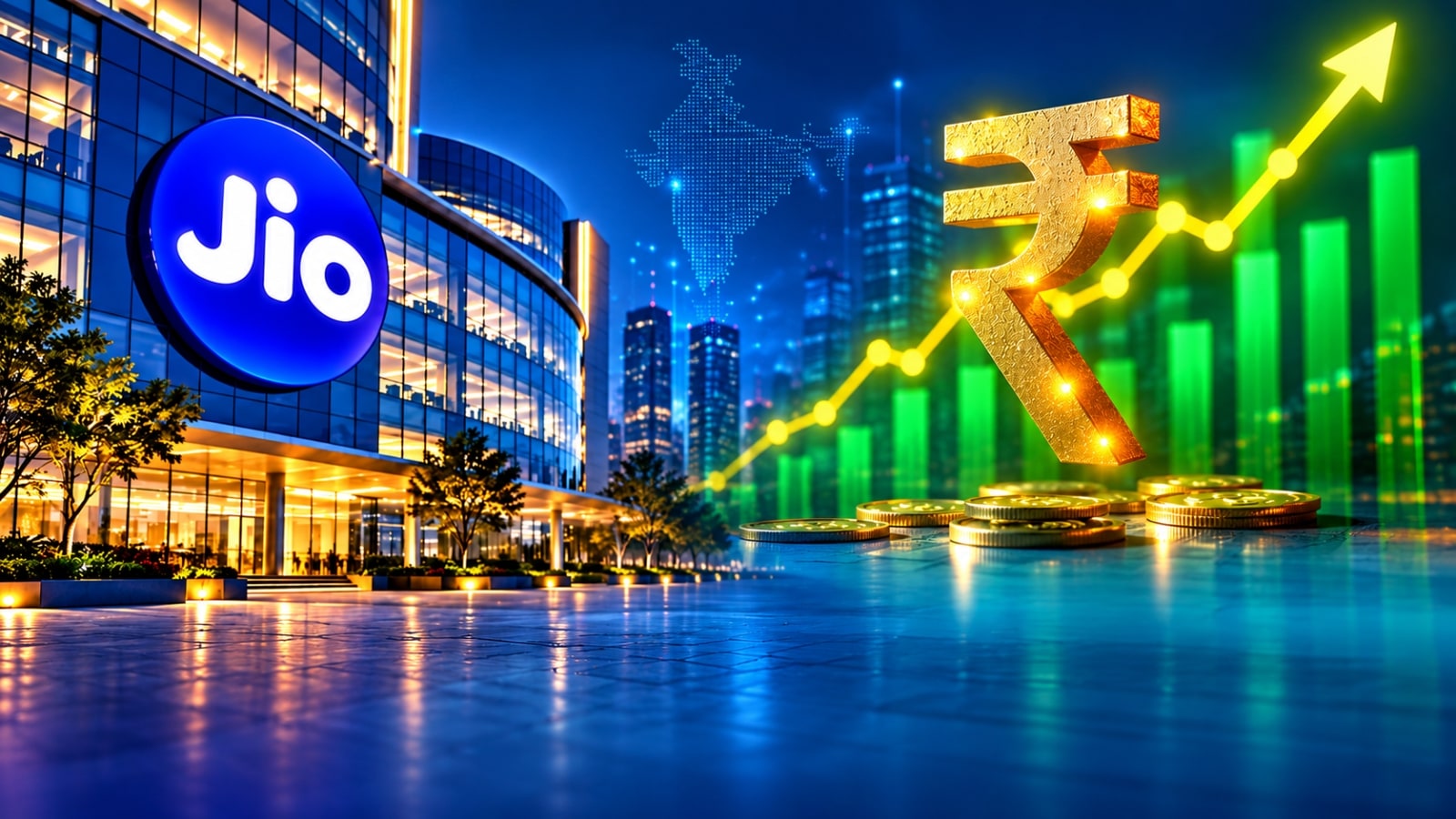
Fast forward to the trading floor on the morning Jio Platforms crossed the $100 billion valuation threshold at its initial public offering.
Bell. Applause. Ticker tape scrolling across high-definition screens in emerald green. For another perspective on this event, see the latest coverage from MarketWatch.
Financial analysts immediately reached for their historical ledgers to frame the headline. Jio Platforms, led by Mukesh Ambani, had just become only the fourth founder-led company in global history to debut above the $100 billion mark, joining a rarefied, almost mythological club alongside Alibaba, Facebook, and Saudi Aramco—or, depending on how strict your definition of state-backed enterprise is, standing shoulder-to-shoulder with the very titans that defined the modern internet age.
Numbers like $100 billion have a strange anesthetic effect on the human brain. They are too large to hold. When we read them in standard financial dispatches, we nod politely, register the prestige, and move on to our morning coffee. We treat a twelve-figure valuation as a trophy won in a boardroom.
It isn't. A $100 billion IPO is never built on a trading floor. It is built in the quiet, invisible moments when a nation’s daily habits permanently mutate.
The Anatomy of an Audacious Bet
To understand why institutional investors from New York to Singapore scrambled for a piece of Jio’s public listing, you have to strip away the spreadsheets and look at the sheer psychological violence of what Reliance Industries did back in September 2016.
I remember sitting in a cramped coworking space in Bengaluru during that launch week, watching engineers refresh their browsers in disbelief. At the time, India was a voice-first market. Telecom giants made their fortunes charging per minute for phone calls and treating mobile internet as a luxury add-on for the urban elite. Data networks were sluggish 2G and patchy 3G pipes, choked by years of underinvestment.
Then Mukesh Ambani walked onto a stage and announced that voice calls would be free forever, and data would be practically given away.
Wall Street and Dalal Street thought he had lost his mind.
Legacy telecom operators scoffed. Analysts predicted massive capital destruction. Reliance had poured over $30 billion—a staggering sum of debt and internal cash—into laying hundreds of thousands of kilometers of fiber-optic cable and erecting cell towers across a subcontinent before earning a single rupee of revenue. In traditional corporate finance, you build a little, charge a lot, and expand slowly. Ambani inverted the model entirely. He built a nationwide 4G digital highway first, priced the toll at zero, and bet that 1.4 billion people would rush onto the road.
They didn't just rush. They stampeded.
Within 170 days, Jio signed up 100 million users—faster than Facebook, faster than WhatsApp, faster than WeChat. Average monthly data consumption per user in India exploded from under 300 megabytes to over 20 gigabytes within a few years. Suddenly, India wasn't data-dark; it was the largest consumer of mobile data on planet Earth.
Meet Priya and the Invisible Economy
Statistics tell you what happened. They rarely tell you who it happened to.
Consider a hypothetical scenario grounded in millions of real trajectories across the country. Imagine a woman named Priya, living in Indore in 2015. She runs a small home-bakery, taking orders through word of mouth and scribbled phone numbers in a spiral notebook. To expand, she needs to see trends, message suppliers instantly, and accept payments without losing half her afternoon walking to a bank branch. In 2015, the digital infrastructure around her is too expensive and too slow to make any of that frictionless.
Now place Priya in the post-Jio era.
Because a smartphone and a 4G connection suddenly cost less than a few cups of tea a week, Priya opens an Instagram storefront. She watches baking tutorials on YouTube in high definition without buffering. When a customer wants to pay, she doesn't wait for cash; she points her phone at a QR code powered by India’s Unified Payments Interface—a public digital rail that only achieved mass adoption because Jio put high-speed internet into the pockets of street vendors and shoppers alike.
Multiply Priya by five hundred million.
This is the secret engine behind the $100 billion valuation. Investors buying into Jio Platforms at its IPO weren't buying a telecom company. Telecom companies are boring, capital-heavy utilities with shrinking margins—think AT&T or Vodafone. You don't pay tech-giant multiples for cell towers.
You pay tech-giant multiples when you realize that the cell towers were merely the Trojan horse.
Why Wall Street Saw a Platform, Not a Pipe
If you peel back the corporate structure of Jio Platforms, you find something far more intricate than wireless spectrum. Over the last decade, Ambani methodically layered software, commerce, entertainment, and enterprise services directly on top of that fiber network.
Think of it like building a city’s entire water supply system for free, and then owning the bottling plants, the irrigation networks, the laundromats, and the fire hydrants that plug into it.
When global tech heavyweights—Meta, Google, Silver Lake, Vista Equity Partners, and sovereign wealth funds from the Middle East—poured over $20 billion into Jio Platforms back in 2020 for minority stakes, they were telegraphing what the public markets have now confirmed. They saw an ecosystem that touches almost every waking hour of an Indian consumer’s digital life:
- Connectivity: Nearly half a billion wireless subscribers and tens of millions of wired home broadband connections.
- Commerce: Deep integration with Reliance Retail, allowing neighborhood kirana stores to digitize their inventory and compete with global e-commerce giants.
- Entertainment and Media: JioCinema and its sprawling media mergers, turning the mobile screen into the primary living-room television for cricket, Bollywood, and regional storytelling.
- Enterprise and AI: Massive sovereign data centers, cloud infrastructure, and indigenous artificial intelligence tools trained in dozens of Indian languages.
Yet, I have to be honest about the tension sitting right beneath this triumph. Whenever a single corporate entity grows this large, a quiet unease settles over economists and everyday citizens alike. It is exhilarating to watch an Indian enterprise stand among the four largest founder-led IPOs in history, proving that world-scale tech wealth doesn't only germinate in Silicon Valley or Shenzhen. At the same time, concentration of power brings real questions. When the same conglomerate provides your internet, streams your cricket match, sells your groceries, and processes your digital payments, where does healthy market efficiency end and uncomfortable gatekeeping begin?
Investors love a moat. Citizens sometimes worry about living inside a walled garden. Both truths can exist in the exact same room.
The Rare Air of the Four Founder-Led Giants
Pause for a second on that historical benchmark: fourth founder-led firm globally to cross $100 billion at IPO.
Why is "founder-led" the phrase that makes seasoned fund managers lean forward in their chairs?
Because hired CEOs optimize for quarters; founders optimize for decades. A professional chief executive answering to a nervous board of directors would have been fired in 2017 after burning tens of billions of dollars on free data while legacy competitors bled red ink. Only a founder with absolute conviction—and controlling equity—could absorb that kind of short-term punishment in pursuit of a ten-year monopoly on attention.
Look at the company Jio keeps in that exclusive quartet:
- Alibaba: Jack Ma built the digital bazaar that wired Chinese commerce, debuting in New York in 2014 at a valuation north of $160 billion.
- Facebook (now Meta): Mark Zuckerberg turned a dorm-room directory into the social graph of the Western world, crossing the $100 billion threshold on its chaotic 2012 Nasdaq debut.
- The Global Tech Outliers: Every other massive listing of the last twenty years was either a state-owned oil behemoth like Saudi Aramco, a decades-old industrial spin-off, or a company whose founders had long since stepped aside.
In each of these founder-led cases, the public listing wasn't the beginning of the story. It was the monetization of an irreversible cultural shift. By the time Facebook went public, people were already checking their feeds before brushing their teeth. By the time Alibaba rang the bell, Singles' Day was already eclipsing Black Friday.
And by the time Jio Platforms crossed $100 billion on the exchanges, the habit of effortless, dirt-cheap connectivity had already become as involuntary as breathing across the Indian subcontinent.
What the Ticker Symbol Doesn't Show
There is a particular sensory memory I still carry from a train ride between Jaipur and Delhi a few years after the telecom revolution began.
Across from me sat an elderly farmer in a faded yellow turban, his hands calloused from decades of working dry soil. In his lap rested a scratched, entry-level smartphone. He wasn't reading financial news. He didn't know what an enterprise multiple was, nor did he care about sovereign wealth allocations or fiber-to-the-home penetration rates.
He was on a crystal-clear video call with his granddaughter, who was studying nursing in another state. Every time she laughed on that tiny screen, the lines around his eyes softened. No dropped packets. No panicked glances at a dwindling data balance. Just a grandfather watching his family’s future unfold in real time, miles away, for pennies a day.
Financial history will record the numbers. It will cite the $100 billion milestone, the institutional oversubscription, the fourth-place ranking among founder-led global debuts, and the wealth unlocked for millions of retail shareholders who held Reliance stock through years of skepticism.
All of those facts are true, and all of them matter.
Still, if you want to understand the real weight of what just happened on the market floor, don't look at the green numbers flashing across the financial terminals in Mumbai. Look at the glow of a five-inch screen illuminating a face on a night train, three hundred miles from the nearest stock exchange, connected to everything.