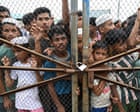
The rain in Cox’s Bazar does not fall so much as it leans against the bamboo walls, heavy and persistent, turning the red clay paths of Kutupalong into channels of slick, rust-colored mud.
Imagine, for a moment, a woman named Jamila—a hypothetical composite drawn from the thousands of Rohingya survivors who fled Rakhine State in the late summer of 2017—sitting on a woven plastic mat inside a shelter no wider than a parking space. She keeps her family’s surviving documents wrapped in three layers of clear polythene, tucked beneath a tin trunk where the damp cannot reach. An expired household registration card. A faded tax receipt from a village that no longer appears on satellite maps. A laminated slip issued by humanitarian workers in Bangladesh.
She has held onto those scraps of paper for years because paper is the only proof that she existed before the smoke rose over the Naf River.
Three thousand miles away, in a wood-paneled chamber at the Peace Palace in The Hague, men and women in dark robes and white neckbands spend hours parsing the exact legal threshold of intent. When the International Court of Justice issues a ruling on the genocide case brought by The Gambia against Myanmar, the language is clinical, measured, and dense with precedent. It speaks of provisional measures, treaty obligations under the 1948 Genocide Convention, and the preservation of evidence.
Then come the reactions from the capitals of the world.
In Brussels, European Union officials step forward to praise the "critical" role of the United Nations' top court, framing the ruling as a vital pillar of international law and accountability. Across the Atlantic, Washington’s response arrives wrapped in the careful syntax of diplomatic caution—acknowledging the gravity of the atrocities, reiterating support for accountability, yet calibrating every syllable against strategic calculations, regional alliances, and the quiet dread of setting a legal precedent that might one day be turned back toward American interests.
Wait.
Read that contrast again, because the gap between European applause and American hesitation is not a minor diplomatic footnote—it is the entire fault line of modern international justice, running straight through the mud floors of Cox’s Bazar and the marble corridors of global power.
The Architecture of a Measured Response
To understand why two Western allies can look at the exact same judicial pronouncement and reach for entirely different dictionaries, you have to strip away the press-release polish and look at what the International Court of Justice actually is.
Think of the ICJ not as a global police force with handcuffs and sirens, but as an architect drawing up the blueprints of a house while a storm is already tearing the roof off. The court settles disputes between states. It does not put generals in prison cells—that belongs to its neighbor across town, the International Criminal Court—nor does it command armies to enforce its orders. What it possesses is moral and legal authority, the power to look a sovereign nation in the eye and declare that its conduct violates the most fundamental rules of human civilization.
When The Gambia, a small West African nation with no direct border with Myanmar, invoked the Genocide Convention in 2019, it triggered a mechanism built specifically for moments like this. Under the convention drafted in the shadow of the Holocaust, any signatory state can haul another signatory before the World Court to prevent and punish genocide, even if its own citizens were not the victims.
For the European Union, backing the court's authority is an instinctive reflex rooted in its own post-war DNA. The EU is itself a legal construct born from the ashes of continental slaughter, an institution that survives only if treaties mean what they say and courts hold weight over raw power. When Brussels describes the ICJ's role as critical, it is defending the very operating system that allows a union of twenty-seven nations to function without tanks on their borders.
Washington operates from a different muscle memory.
Anyone who has spent time watching American foreign policy up close knows the peculiar anxiety that grips the State Department whenever an international tribunal gains momentum. The United States has a long, complicated history with the courts in The Hague. It withdrew from the ICJ's compulsory jurisdiction in the 1980s after Nicaragua sued over covert mining of its harbors. It has never ratified the Rome Statute of the International Criminal Court, even passing legislation authorizing extreme measures to shield American personnel from its reach.
So when the ICJ speaks on Myanmar, American diplomats face a delicate balancing act. On one hand, the U.S. government has formally determined that the Myanmar military’s campaign against the Rohingya constituted genocide and crimes against humanity—a designation Secretary of State Antony Blinken announced at the U.S. Holocaust Memorial Museum in 2022, standing before photographs of burned villages and grieving mothers. On the other hand, endorsing the sweeping jurisdiction of a UN court too enthusiastically invites uncomfortable questions about how those same legal standards apply elsewhere, from the Middle East to Washington's own past interventions.
Caution, in diplomatic parlance, is rarely about indifference. It is almost always about precedent.
What the Numbers Refuse to Let Us Forget
It is easy, watching spokespeople parse adjectives at podiums in Washington and Brussels, to lose sight of the sheer physical scale of what brought Myanmar to the Peace Palace in the first place.
In August 2017, following attacks by Rohingya insurgents on security posts, Myanmar’s military—the Tatmadaw—launched what it called "clearance operations" across northern Rakhine State. What followed was documented by UN investigators, satellite analysts, and journalists with grim precision:
- More than 740,000 Rohingya fled across the border into Bangladesh within months, joining hundreds of thousands already displaced by earlier waves of violence.
- Satellite imagery analyzed by human rights monitors identified at least 392 Rohingya villages partially or completely destroyed by fire, many bulldozed afterward to erase the foundations of homes, mosques, and schools.
- Independent UN fact-finding missions estimated that at least 10,000 people were killed in the initial months alone, though humanitarian workers on the ground have long suspected the true toll lies far higher.
I still remember the first time I looked at high-resolution before-and-after satellite images of a village in Maungdaw township. In the first frame, taken in early August 2017, there was the unmistakable geometry of human life—clusters of thatched roofs tucked beneath dense green canopy, narrow footpaths winding toward a river bend, rectangular plots of farmland stitched together like a quilt. In the second frame, captured six weeks later, the green canopy was gone. The roofs were gone. Even the footpaths had vanished, replaced by a uniform smear of gray ash and scraped earth, as if someone had taken an eraser to a pencil drawing and rubbed until the paper tore.
You do not need a law degree from Leiden or Harvard to recognize the intent behind a bulldozer clearing the ashes of a burned village.
The Invisible Stakes Behind Diplomatic Caution
Yet inside the chambers of statecraft, intent is never just a moral question. It is a geopolitical lever, and every lever has a fulcrum.
Consider what happens next when a major power hesitates to throw its full institutional weight behind a UN court ruling. On the surface, the difference between "welcoming the ruling's accountability efforts" and "praising the court's critical role" looks like semantic hair-splitting—the kind of nuance only treaty lawyers and foreign correspondents notice.
Down on the ground, however, that sliver of daylight widens into a canyon.
Myanmar’s military junta, which seized full power in a 2021 coup that ousted Aung San Suu Kyi’s civilian government, watches international divisions with predatory focus. The generals in Naypyidaw understand that international law has no teeth unless powerful nations agree to bite. When the European Union speaks with clarity about the ICJ's authority while the United States tempers its tone with strategic caution, the junta reads the room not as united condemnation, but as fractured resolve.
And the ripple effects stretch far beyond Southeast Asia.
Think about the signals sent to other capitals watching the proceedings in The Hague:
- Regional neighbors in ASEAN see that Western consensus on international judicial mechanisms remains conditional, reinforcing their own reluctance to confront Naypyidaw forcefully.
- Global South nations, many of whom already suspect that international law is applied selectively—swiftly against weaker states, slowly or never against powerful ones—point to Washington's careful phrasing as proof of a double standard.
- Investigators and evidence collectors working on the ground face an uphill battle to preserve mass grave sites, military communications, and survivor testimonies when the political momentum behind enforcement stalls.
I have sat across from international human rights investigators who carry encrypted hard drives in their backpacks like sacred relics—drives filled with leaked military orders, smartphone videos recorded through cracks in bamboo walls, and sworn affidavits from defectors who risked execution to speak. Their deepest fear is not that the world will fail to discover the truth. The truth is already documented in terabytes of corroborated data.
Their fear is that the truth will be filed neatly in an archive in Geneva or The Hague while the people who suffered it grow old behind barbed-wire fences in Bangladesh.
The Trap of the Long Timeline
There is an honesty required when talking about the International Court of Justice that few politicians are willing to offer in public: this process moves at the speed of glaciers, while human lives burn at the speed of matchsticks.
A full genocide case at the ICJ routinely takes years—sometimes more than a decade—from initial filing to final judgment on the merits. Preliminary objections over jurisdiction eat up years. Written memorials and counter-memorials stretch across thousands of pages. Oral hearings unfold over weeks of dense legal argument, followed by months of closed-door deliberation before a single sentence is read aloud in the Great Hall of Justice.
To a diplomat in Brussels or Washington, a ten-year judicial arc is a manageable horizon, a steady institutional track running parallel to sanctions, humanitarian aid, and regional diplomacy.
To Jamila in Kutupalong—and to the real mothers, fathers, and children whose lives her story reflects—ten years is an entire childhood spent inside a camp where formal secondary education is restricted, legal employment is barred, and monsoon landslides wash away shelters every July. A child born in the camps in September 2017 is already approaching adolescence without ever having seen the mango trees of their parents' village or held a passport from any nation on earth.
When the EU praises the court's critical role, it is affirming that the slow machinery of law must keep turning, no matter how long it takes, because abandoning the track surrenders the future to impunity. When the U.S. reacts cautiously, it is acknowledging—perhaps unintentionally—the limits of what a court in Europe can actually deliver on the banks of the Naf River without broader political and strategic leverage backing it up.
Both instincts carry a grain of uncomfortable truth. That is what makes the moment so maddening.
Why the Words Chosen Today Matter Tomorrow
Strip away the diplomatic choreography, and the tension between Washington and Brussels over the ICJ ruling comes down to a single, enduring question: Is international law a universal standard that binds everyone equally, or a toolkit to be picked up only when convenient?
Europe, bound together by treaties and scarred by its own twentieth-century collapses, has wagered its survival on the first answer. It needs the ICJ to be critical, authoritative, and central, because without the supremacy of law over force, the European project itself loses its moral foundation.
America, accustomed to acting as the indispensable guarantor of global security—and acutely aware that global policing invites legal scrutiny—still clings to the second. Washington wants justice for the Rohingya; its humanitarian funding for the camps in Bangladesh remains among the largest in the world, and its sanctions on Myanmar’s military leaders have squeezed key revenue streams. Yet it remains wary of handing unreserved authority to an international bench it does not control.
History has a habit of judging these moments not by the cleverness of the caveats, but by the courage of the commitment.
Back in Kutupalong, as the afternoon rain finally eases and mist rises off the wet tin roofs, Jamila unfolds her three layers of polythene just enough to check the edges of her faded household card. The ink is smudged at the corners, the paper soft from years of humidity, yet she presses it flat against her knee with the steady, practiced care of someone who knows that memory alone cannot survive the mud. Somewhere far away, men and women in dark robes have written down the name of her people in the permanent record of the world's highest court, while the capitals that hold the power to enforce that record still weigh every word before they speak.