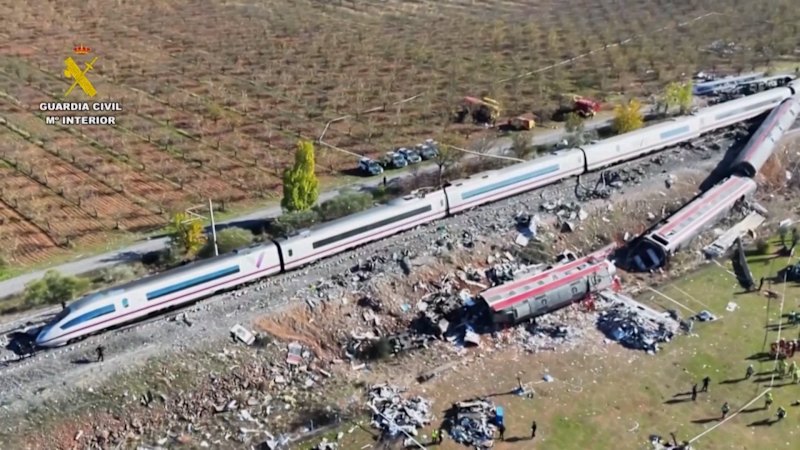
Silence.
That is the first thing survivors always describe when a hundred tons of steel leaves its tracks at two hundred miles an hour, not the screech of tearing metal or the shattering of safety glass, though both come quickly enough, but a sudden, weightless vacuum where the rhythmic hum of the rails simply ceases to exist. Meanwhile, you can explore related developments here: Behind the Royal Dance Floor Lies a Trillion-Dollar Reparations Reckoning.
In the wake of the disaster that has already claimed at least sixty-eight lives—with rescue crews still cutting through twisted aluminum and darkened carriages knowing the number will climb—the headlines have settled into their familiar, clinical rhythm. We read the casualty counts over morning coffee. We scan the diagrams of the track geometry, nod at the statements from transport ministers promising swift inquiries, and absorb the cold data of a tragedy reduced to figures on a glowing screen. Sixty-eight dead. Scores more fighting for breath in regional trauma wards. A high-speed rail line severed in two.
Yet numbers are a sedative. They insulate us from the unbearable weight of a single empty chair at a dinner table, and they obscure the uncomfortable truth that modern high-speed rail travel relies on an invisible, razor-thin bargain between human ambition and the unforgiving laws of physics. To explore the bigger picture, we recommend the detailed article by Reuters.
The Illusion of Effortless Velocity
To understand what happened in those final, catastrophic seconds before impact, step inside a hypothetical carriage just three minutes earlier. Call her Elena, a composite of the dozens of commuters, students, and grandparents who boarded that morning train with nothing more urgent on their minds than a delayed connection or a lukewarm cup of station coffee.
Elena sits by the window, watching the countryside blur into streaks of green and ochre. Inside the pressurized cabin, the air is climate-controlled and whisper-quiet. There is no sensation of violence, no wind tearing at her clothes, no vibration rattling her teeth. Modern engineering has achieved something miraculous here: it has stripped speed of its terror. At nearly three hundred kilometers per hour, a passenger can balance a coin on a tray table or type an email without missing a keystroke.
That tranquility is a carefully constructed illusion.
In reality, every carriage in that train is carrying the kinetic energy of a small artillery barrage. Think of kinetic energy not as a dry textbook formula, though physics defines it cleanly as half an object’s mass multiplied by the square of its velocity, but as a debt that must be paid the instant motion stops. Double the speed of a train, and you do not merely double the energy inside it. You quadruple it. Tripling the speed multiplies that destructive potential by nine. When a train glides to a halt at a station platform, regenerative brakes and friction pads pay that debt slowly, bleeding the energy away as heat and electricity over several kilometers. When a train derails or strikes an obstruction at full cruise, the universe demands immediate payment in full.
For Elena, and for the real men and women whose journeys ended abruptly when the forward cars jackknifed across the ballast, there was no time for panic. Human reaction time—the electrical blink required for the eye to register danger, the brain to interpret it, and the muscles to flinch—takes roughly a quarter of a second. In that quarter of a second, a high-speed train travels more than twenty meters. Before a single passenger could even grasp that the floor beneath their feet was tilting, the laws of momentum had already decided their fate.
Where the Margin Vanishes
I have spent years reporting from the edges of transport disasters, standing beside scorched embankments where yellow police tape flutters in the wind and the smell of diesel and crushed earth lingers for weeks. You learn quickly that major rail crashes almost never stem from a single, cinematic failure. Hollywood loves a lone villain or a dramatic snapped axle. Reality is far more insidious.
Major accidents are born in the quiet accumulation of microscopic compromises.
Consider how a high-speed corridor actually operates. Unlike conventional railways, where drivers rely on their eyes to spot red signals down the track, high-speed trains move too fast for human vision to serve as a safety net. By the time an engineer sees a buckled rail or a stalled maintenance vehicle ahead, the stopping distance—often stretching three to four kilometers—has already doomed the train. Instead, the entire system rests on automated signaling, continuous track sensors, and centralized traffic control software that whispers instructions directly to the locomotive’s onboard computers.
It is an extraordinary ballet of automation, until one sensor drifts out of calibration, one software patch introduces an unforeseen latency, or one maintenance crew works five minutes past a scheduled window without updating a digital ledger.
Look back through the history of modern rail tragedies, from Eschede in Germany in 1998 to Santiago de Compostela in Spain in 2013, and a haunting behavioral pattern emerges. In Eschede, a single fatigued rubber-cushioned wheel rim fractured, snagging a track switch that hurled the rear carriages into a concrete bridge pier, killing one hundred and one people. In Spain, a train entered a curved section of track at twice the posted limit because the automated braking system ended just kilometers before the bend, leaving a distracted human driver alone with physics at the exact moment transition occurred.
In every instance, the system worked flawlessly ninety-nine point nine percent of the time. That very reliability bred a quiet, institutional complacency. When machines run smoothly for millions of kilometers, warning alarms begin to feel like nuisances rather than lifelines. Budget committees question why redundant sensors are necessary when the primary ones never fail. Inspection intervals stretch from weeks to months.
I will admit something that rarely makes it into official safety briefings: the deeper you look into complex infrastructure, the more unsettling it becomes. We want absolute certainty when we buy a ticket. We want to believe that engineering has conquered chance. Yet every engineer who has ever signed off on a high-speed line knows that safety is never an absolute state; it is a continuous, exhausting war against entropy, weather, metal fatigue, and human distraction.
The Longest Hours After Impact
When the dust finally settles over the wreckage, the story shifts from the cold mechanics of velocity to the agonizing endurance of the living.
First responders who arrive at a high-speed derailment face a scene that defies normal rescue doctrine. Unlike an urban building collapse, rail corridors often slice through remote farmland, steep cuttings, or narrow valleys inaccessible to heavy cranes. Firefighters must carry hydraulic spreaders—each weighing upwards of twenty kilograms—across uneven gravel embankments in the dark, working by the harsh glare of portable floodlights while the smell of leaking hydraulic fluid hangs heavy in the night air.
Inside the crumpled shells of the carriages, silence gives way to a different kind of sound: the muffled ringing of dozens of unanswered mobile phones buried beneath debris.
That detail stays with anyone who has ever stood near a triage zone. Every ringing phone is a parent, a spouse, or a child sitting miles away, watching breaking news banners crawl across a television screen, dialing a number that still connects to a tower even though the person who owns it can no longer reach their pocket.
Rescue teams work under an agonizing triage calculus. Cutting through reinforced structural pillars designed to withstand rollover forces takes precious minutes, and every minute spent freeing one trapped survivor is a minute delayed for someone pinned three cars further down the line. Paramedics crawl into spaces barely wide enough for a human torso, administering intravenous fluids and pain relief in pitch darkness while structural engineers monitor the wreckage for shifts that could crush rescuer and victim alike.
And outside the perimeter, at makeshift reception centers set up in nearby hotels and municipal halls, families wait in a purgatory of bureaucratic caution. Authorities cannot release names until forensic teams verify identities—a process slowed when high-energy impacts scatter personal belongings across hundreds of meters of track. For hours, sometimes days, relatives inhabit a cruel limbo where hope and grief occupy the exact same breath.
The Question Nobody Wants to Ask
As recovery crews continue their grim work and the death toll ticks upward from sixty-eight toward whatever final, terrible tally the wreckage yields, the public conversation inevitably turns to accountability. Who was at the controls? Was the track inspected? Did a signal fail?
Those questions matter, and investigators will spend months combing through black box telemetry, metallurgical samples, and dispatch recordings to answer them. Yet focusing solely on individual blame misses the larger reckoning staring us in the face.
High-speed rail remains, statistically, one of the safest modes of mass transit humanity has ever devised. Over the past half-century, bullet trains across Europe and Asia have carried billions of passengers with fatality rates a fraction of those seen on highways. To abandon high-speed rail out of fear would be a catastrophic mistake, pushing travelers back onto congested roads where thousands die every single week without generating a single international headline.
But safety statistics offer zero comfort when a preventable failure tears through a crowded morning train. The real danger is not speed itself; it is our growing habit of treating aging or overstretched infrastructure as invincible simply because it is fast. Across the world, rail networks built decades ago are being pushed to carry heavier loads, tighter timetables, and faster services, often on maintenance budgets that have quietly stagnated while ticket prices and political ribbon-cuttings grab the spotlight.
We celebrate the record-breaking test runs and the sleek aerodynamic noses gleaming in promotional photographs. We rarely celebrate the night-shift track walker checking rail fasteners in freezing rain, or the unglamorous software audit that catches a signaling bug before a train ever leaves the depot.
What Remains on the Ballast
Days from now, the heavy cranes will finish lifting the last severed carriages onto flatbed trucks. Crews will relay the torn sleepers, weld fresh lengths of steel rail into place, and tamp down new crushed granite until the scar across the landscape disappears. Soon enough, another sleek train will glide smoothly over that exact stretch of ground, its passengers glancing up briefly from their phones before returning to their messages, unaware of the coordinates passing beneath their feet.
Out in the tall grass just beyond the perimeter fence, however, away from the freshly laid stone and the hum of restored signals, a single, scuffed leather shoe lies half-buried in the mud, its laces still neatly tied from a morning that began like any other.