The champagne dried sticky on the concrete of London’s Centurion Club back in June 2022, long before the first tee shot ever left the ground.
Dustin Johnson stood on the practice range that week, his hat pulled low against the English drizzle, looking less like a revolutionary and more like a man who had just found an unlocked vault and decided to empty his pockets inside. Around him, speakers pumped bass lines across the pristine Hertfordshire grass—a deliberate, loud middle finger to the hushed, library-like reverence of Augusta National and St. Andrews. Nine-figure signing bonuses were flying through the air like confetti. Private jets sat idling on tarmac thirty minutes away, fueled by the bottomless sovereign wealth of Saudi Arabia’s Public Investment Fund. They promised to blow up a century-old monopoly. They promised "Golf, But Louder." They promised the future.
Four years later, the music has stopped.
Quietly, without the fireworks or the leather-jacketed press conferences that birthed it, LIV Golf is winding down its operations. The news didn't arrive via a triumphant stadium broadcast or a viral social media clip; it arrived through the sterile, fluorescent-lit corridors of legal filings and corporate restructuring notices, where lawyers confirmed what empty grandstands and flatlining television ratings had whispered for months. The great disruption is over.
The Architecture of an Illusion
To understand how an enterprise backed by nearly a trillion dollars could simply evaporate, you have to understand what money can—and cannot—buy in professional sports.
I spent fifteen years covering golf from inside the ropes, walking five miles a day with mud on my cuffs and a notebook soaked by sudden afternoon squalls. You learn quickly out there that golf is not a television show. It is a slow-burn psychological thriller built entirely on accumulated memory. When Rory McIlroy stands over a six-foot putt on the seventy-second hole of a championship, the tension in your chest doesn't come from the size of the winner's check. It comes from the ghost of every putt he missed a decade ago, every collapse in the Georgia pines, every scar earned in front of millions of witnesses over twenty years.
LIV Golf tried to purchase that tension off the rack.
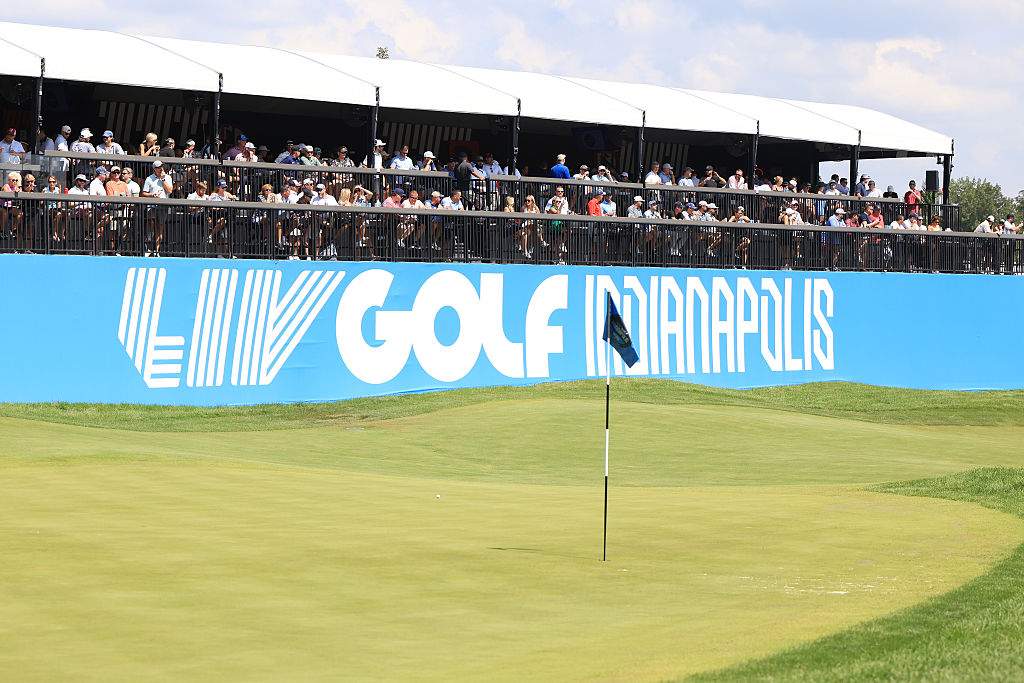
Consider a hypothetical tournament Sunday in the middle of the 2024 season—let’s call it the Invitational at Nowhere-in-Particular. Picture a young caddie named Marcus, a guy who spent six years sleeping in the back of a Honda Civic at Monday qualifiers just to earn a tour bag. Marcus is standing on the eighteenth fairway in 102-degree heat. Fifty-four holes. No cut. Shotgun start. Somewhere three holes behind him, a guy tied for forty-first place is guaranteed $120,000 just for showing up and keeping his shoelaces tied. Ahead of Marcus, three hundred spectators—half of them comped tickets—lean against a hospitality rope, checking their phones while a DJ plays twenty-year-old remix tracks from a scaffolding tower.
Marcus looks at his player. There is no danger of missing a paycheck. There is no relegation cliff looming beneath their spikes. There is no century-old silver trophy waiting on the green, only a Lucite slab and a wire transfer that cleared six months before the first tee shot.
"What's the yardage?" the player asks.
"One-sixty-four," Marcus says, knowing deep in his gut that the number doesn't actually matter.
Without consequence, sport turns into an exhibition. And exhibitions, no matter how brightly lit, are impossible to care about once the novelty wears off.
The Numbers That Wouldn't Budge
Lawyers deal in liabilities, asset transfers, and wind-down timelines, so let’s look at the cold ledger that brought the rebel league to its knees.
Between 2022 and 2025, the Public Investment Fund poured an estimated $3 billion to $4 billion into LIV Golf. That astronomical sum went toward guaranteed player contracts—reportedly $125 million for Dustin Johnson, $150 million for Brooks Koepka, $200 million for Phil Mickelson, and upwards of $300 million for Jon Rahm—alongside $25 million tournament purses and extravagant production costs. In business terms, it was the most aggressive loss-leader strategy in modern athletic history, designed to force the established PGA Tour into a corner.
It worked on paper, right up until the moment real human eyeballs were required to sustain it.
While traditional PGA Tour broadcasts routinely drew two to four million viewers on Sunday afternoons—and spiked past ten million during major championships—LIV Golf’s linear television broadcasts on The CW frequently struggled to clear 200,000 viewers. On streaming platforms, concurrent viewership often hovered in the tens of thousands, beaten handily on any given weekend by reruns of The Big Bang Theory, minor-league cornhole tournaments, and midday local news.
Advertisers noticed. Major blue-chip sponsors—the insurance giants, luxury automakers, and financial institutions that keep professional golf’s ecosystem afloat—refused to touch the product. Without corporate sponsorship, tournament revenue remained near zero. Every single event operated at a catastrophic net loss, sustained entirely by sovereign wire transfers from Riyadh.
Then came the real killer: the Official World Golf Ranking.
The Slow Poison of Irrelevance
If you want to understand the psychological trap LIV players walked into, think of a Michelin-starred chef who accepts ten million dollars to cook exclusively inside a private submarine. The pay is generational. The kitchen is pristine. Nobody criticizes the salt levels. But after three years beneath the waves, nobody on land remembers what your food tastes like, and you are no longer invited to the culinary competitions that define greatness.
Because LIV Golf refused to adopt a seventy-two-hole format, refused to institute a thirty-six-hole cut, and operated as a closed shop with minimal meritocratic turnover, the Official World Golf Ranking board denied the league accreditation.
Slowly, inexorably, the rankings of golf’s biggest stars began to rot.
Jon Rahm, who arrived in late 2023 as the reigning Masters champion and arguably the finest ball-striker on earth, watched his world ranking slide down the leaderboard like sand through an hourglass. Bryson DeChambeau, who briefly recaptured the public imagination with his YouTube channel and a thrilling 2024 U.S. Open victory at Pinehurst, spent the rest of the calendar year playing exhibition golf in front of sparse crowds, starved of the weekly crucible that sharpens a champion’s edge.
Players who had spent their entire lives measuring their self-worth against the names etched onto the Claret Jug and the Wanamaker Trophy suddenly found themselves locked outside the gates of the major championships once their multi-year exemptions expired. You could see it in their interviews—a strange, defensive restlessness. They had won the lottery, yet they were staring through the chain-link fence at the neighborhood pickup game they used to rule.
The Framework Illusion and the Boardroom Endgame
For a brief, surreal moment in June 2023, it looked as though the rebels had pulled off the ultimate heist. PGA Tour Commissioner Jay Monahan appeared on live television alongside PIF Governor Yasir Al-Rumayyan to announce a shocking "framework agreement" to merge their commercial operations.
Golf fans felt betrayed. Players who had turned down nine-figure offers out of loyalty to the Tour—men like Rory McIlroy and Tiger Woods—looked like fools who had brought principles to a knife fight.
But the announcement was an illusion, a truce signed on wet paper during a hurricane.
Months dragged into years. The U.S. Department of Justice opened an antitrust investigation into the proposed alliance. Billions of dollars in private equity flowed into the newly formed PGA Tour Enterprises from the Strategic Sports Group—a consortium of American sports owners including Arthur Blank, Steve Cohen, and Fenway Sports Group—suddenly giving the PGA Tour the war chest it needed to survive without Saudi capital.
Suddenly, the leverage flipped.
The PIF no longer held a gun to golf’s head; it was simply holding a bleeding asset that cost $100 million a month to keep on life support while failing to deliver the soft-power legitimacy Riyadh craved. Why burn billions funding a standalone league nobody watched when the real prize—a seat at the table of global sports ownership—could be negotiated cleanly without the baggage of a failing tour?
What Remains When the Checks Clear
I’ll admit something that used to make me uneasy when this civil war first broke out: for a long time, I wasn’t sure the traditionalists were right.
Golf needed shaking up. For decades, the PGA Tour treated fans like captive customers, charging fifteen dollars for warm domestic beer while stuffing broadcasts with forty minutes of commercials per hour. The slow play was agonizing. The corporate stiffness was suffocating. When LIV arrived promising fast rounds, team camaraderie, and global destinations from Adelaide to Valderrama, a part of me wanted it to force a genuine evolution.
And to be fair, it did—just not in the way its founders intended.
Frightened by the threat of defection, the PGA Tour restructured its entire competitive calendar. It created Signature Events with $20 million purses, guaranteed equity stakes for its players, and finally forced the best golfers in the world to face each other ten times a year outside of the majors. In trying to destroy the PGA Tour, LIV Golf accidentally forced the Tour to become the best version of itself.
Meanwhile, the rebel league itself hollowly collapsed under the weight of its own contradictions. You cannot preach "disruption" while paying athletes upfront regardless of whether they finish first or forty-eighth. Greatness requires desperation. It requires the genuine, terrifying possibility of failure. When you remove the ledge, nobody cares how high the tightrope is strung.
The Last Tee Shot
As the legal teams finalize the dissolution of LIV Golf’s operations, winding down contracts, shuttering regional offices, and folding the remnants of its intellectual property into broader sports-investment structures, the players who took the leap are left standing in an awkward silence.
Some will quietly negotiate pathways back toward traditional tours, paying fines and serving suspensions to regain entry into the arenas that actually matter. Others, enriched beyond the wildest dreams of their great-grandchildren, will simply fade into semi-retirement, their bank accounts overflowing and their legacies permanently asterisked.
Think back to that rainy afternoon at the Centurion Club in 2022, when the smoke machines hissed and the bass rattled the leaves off the English oaks. Back then, the architects of LIV Golf believed they had discovered a shortcut to immortality—that if you simply stacked enough gold bars on the first tee, history would bend its knee and call you king.
Instead, they built a monument to a truth every kid on a municipal driving range learns before they break eighty: you can buy the clubs, you can buy the course, and you can even buy the applause, but the moment the ball leaves the face of the iron, money has no idea where it’s going.