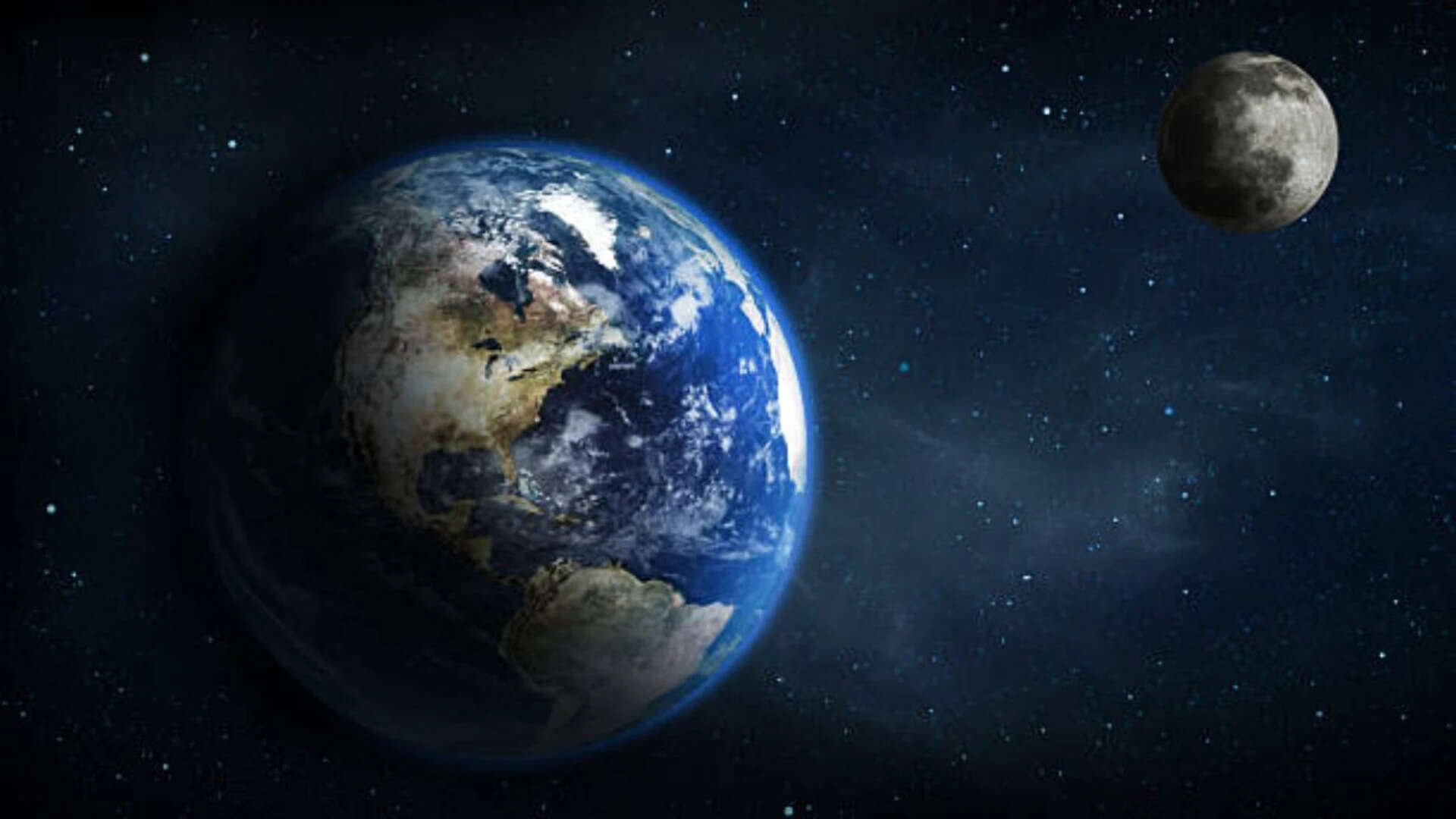
Every year, the Moon slips away from Earth by approximately 3.8 centimeters. That distance matches the rate at which human fingernails grow. While the shift seems imperceptible over a human lifetime, the physics driving this migration represent a massive exchange of kinetic energy that is slowly braking the rotation of Earth and dismantling the delicate gravitational system that stabilizes our global climate.
This retreat is not a theoretical model or an unverified hypothesis. It is an observed physical measurement tracked continuously for over five decades using laser reflectors left on the lunar surface during the Apollo missions. Understanding why the Moon is leaving requires examining the mechanics of ocean tides, the friction of shifting water, and the conservation of angular momentum across four billion years of planetary history.
The Precision Math of a Receding Satellite
In July 1969, astronauts installed a array of retroreflectors in the Sea of Tranquility. Observatories on Earth, including the McDonald Observatory in Texas and the Côte d'Azur Observatory in France, routinely fire high-powered laser pulses at these quartz corner cubes. By calculating the exact round-trip travel time of the photons, astrophysicists can measure the distance to the Moon with millimeter accuracy.
The data reveals a steady retreat. The Moon currently orbits Earth at an average distance of roughly 384,400 kilometers. That distance increases annually by precisely 3.82 centimeters.
This movement is driven by an ongoing energy trade between Earth's rotation and the Moon's orbit. Earth rotates on its axis once every 24 hours, while the Moon takes approximately 27.3 days to orbit Earth in the same direction. Because Earth spins much faster than the Moon orbits, a massive gravitational drag mechanism develops within our oceans.
+-----------------------------------------------------------------------+
|                       THE LUNAR DYNAMICS TIMELINE                     |
+------------------------------------+----------------------------------+
| Era / Epoch                        | Earth-Moon Conditions            |
+------------------------------------+----------------------------------+
| 4.5 Billion Years Ago (Formation)  | Moon distance: ~25,000 km        |
|                                    | Earth Day length: ~6 hours       |
+------------------------------------+----------------------------------+
| 1.4 Billion Years Ago (Proterozoic)| Moon distance: ~340,000 km       |
|                                    | Earth Day length: ~18.7 hours    |
+------------------------------------+----------------------------------+
| Present Day                        | Moon distance: 384,400 km        |
|                                    | Earth Day length: 24 hours       |
|                                    | Lunar recession: 3.82 cm/year    |
+------------------------------------+----------------------------------+
| +600 Million Years (Future)        | Moon distance: +23,000 km        |
|                                    | Total solar eclipses permanently |
|                                    | cease due to angular size drop   |
+------------------------------------+----------------------------------+
How Tidal Friction Steals Earth's Rotational Energy
The Moon's gravity exerts a pull on Earth, creating two tidal bulges in the oceans—one on the side facing the Moon and one on the opposite side. If Earth did not spin, these bulges would align directly with the lunar gravitational axis.
Earth's fast rotation changes the mechanics entirely. The planet spins out from underneath the water, dragging the tidal bulges slightly ahead of the line connecting Earth and the Moon. This asymmetric mass distribution creates a gravitational tug-of-war.
- The Pull on the Bulge: The forward ocean bulge exerts a forward gravitational pull on the Moon, injecting orbital energy into the satellite and flinging it into a wider, higher orbit.
- The Braking Effect: Simultaneously, the Moon pulls back on the lead ocean bulge, acting as a gravitational brake against Earth's surface friction.
- Energy Transfer: The energy lost by Earth's slowing rotation is converted into orbital velocity for the Moon, forcing it to spiral outward.
This braking force lengthens the Earth day by roughly 1.7 milliseconds every century. That number sounds trivial until applied to geological time frames. Four billion years ago, when the Moon was newly formed, it hovered just 25,000 kilometers above the surface—filling the sky like a giant, glowing orb. At that point in early history, an Earth day lasted less than six hours.
The Ancient Geological Record Written in Ocean Sediments
Geologists do not have to rely exclusively on modern laser experiments to track this orbital evolution. The evidence is embedded directly into the planetary crust through geological structures known as tidalites and cyclothems.
Tidalites are layered sedimentary rocks formed in shallow coastal areas where daily ocean tides deposit alternating beds of mud and sand. By analyzing the thickness and pattern of these layers, geologists can calculate the frequency and intensity of ancient tides.
Research on 1.4-billion-year-old rock formations from the Xiamaling Formation in northern China demonstrates that an Earth day during the Proterozoic Eon was roughly 18.7 hours long. The Moon was sitting significantly closer, exerting far stronger gravitational forces than it does today.
Another historical record appears in deep-sea fossil beds containing ancient coral reefs. Daily growth rings in fossil corals from the Devonian Period, roughly 400 million years ago, indicate that a year back then contained approximately 410 days, with each day lasting only 21.9 hours. The earth was spinning significantly faster because the Moon was close enough to drag harder on the oceans.
               [ GRAVITATIONAL DRIFT MECHANICS ]

 Earth Rotation (Fast: 24h)            Moon Orbit (Slow: 27.3d)
       ______                                _____
     /        \                            /       \
    |    E     |  ===> Tidal Bulge ===>   |    M    |
     \ ______ /   Pulled Ahead by Earth    \ _____ /
        ||                                    ||
   Rotational Drag                      Gains Orbital
   Slows Earth Down                     Energy & Recedes
Planetary Stabilizer and the Threat of Atmospheric Chaos
The primary function of the Moon regarding Earth's habitability is not illumination or oceanic tides, but axial stabilization.
Earth rotates on an axis tilted at approximately 23.5 degrees relative to its orbital plane around the Sun. This tilt creates the modern seasonal cycle. Without the massive gravitational anchor of the Moon, Earth’s axial tilt would not remain stable.
Solar system dynamics show that planets without large, nearby satellites experience chaotic axial wobbles due to the gravitational influence of neighboring gas giants like Jupiter and Saturn. Mars, for instance, lacks a substantial moon. Its small satellites, Phobos and Deimos, are captured asteroids that offer negligible gravitational mass. As a result, the tilt of Mars fluctuates wildly between 10 degrees and 60 degrees over million-year cycles.
If Earth experienced similar tilt variations, planetary climate stability would collapse:
- At extreme 60-degree tilts: The poles would receive intense, direct sunlight during summer months, melting global ice caps completely, followed by total solar darkness during winter, freezing entire oceans over.
- At minimal 0-degree tilts: The seasonal gradient would vanish. Weather systems would stall, oceans would stratify, and vast equatorial belts would overheat while high latitudes froze permanently.
The Moon acts as a gravitational flywheel. Its immense mass suppresses these chaotic resonances, keeping Earth’s obliquity restricted within a tiny band of 2.4 degrees over a 41,000-year cycle. As the Moon drifts further away, its gravitational influence decreases, slowly weakening its ability to keep Earth's axis locked in place.
The End of Solar Totality and the Ocean Crisis
The retreat of the Moon will trigger several unmistakable physical thresholds over the next few hundred million years.
The most immediate visual casualty will be the total solar eclipse. Right now, by a striking cosmic coincidence, the Sun is roughly 400 times wider than the Moon, but it is also roughly 400 times further away. This alignment makes their apparent angular sizes in the sky virtually identical, allowing the Moon to cover the solar disk completely during a total eclipse.
As the Moon continues to recede at 3.8 centimeters per year, its apparent diameter in the sky steadily shrinks. In roughly 600 million years, the Moon will be too far away to cover the Sun. Total solar eclipses will cease entirely, replaced by ring-shaped annular eclipses.
+-----------------------------------------------------------------------+
|                      FUTURE PLANETARY IMPACT MATRIX                   |
+-------------------+---------------------------------------------------+
| Impact Domain     | Long-Term Consequence                             |
+-------------------+---------------------------------------------------+
| Ocean Ecology     | Declining tidal ranges reduce marine nutrient     |
|                   | mixing in coastal bays and intertidal zones.      |
+-------------------+---------------------------------------------------+
| Day Length        | Rotational slowing extends daylight hours,        |
|                   | altering atmospheric heating and weather patterns.|
+-------------------+---------------------------------------------------+
| Axial Stability   | Decreased lunar gravity increases long-term tilt  |
|                   | variance, threatening global climate cycles.      |
+-------------------+---------------------------------------------------+
| Solar Eclipses    | Angular size drops below solar disk size in       |
|                   | ~600M years, making total eclipses impossible.    |
+-------------------+---------------------------------------------------+
Far more dangerous than losing an astronomical spectacle is the slow death of ocean mixing. Tides drive huge volumes of coastal water through estuaries, shallow seas, and continental shelves. This movement mixes nutrients, distributes heat, and oxygenates coastal waters.
A receding Moon generates weaker gravitational tugs, leading to diminished tidal ranges. Over vast spans of time, reduced tides will shrink tidal flats and intertidal habitats, threatening the marine species that rely on these transition zones for feeding and reproduction.
The Ultimate Fate of the Earth-Moon System
A common misconception is that the Moon will eventually break free of Earth's gravity and drift off into deep space. The laws of celestial mechanics dictate a different outcome.
As the Moon moves outward, the energy exchange between the two bodies continues to slow Earth's rotation while increasing the Moon's orbital period. Eventually, if left undisturbed, Earth's rotation would slow until a single day equaled the time it takes for the Moon to complete one orbit.
At that juncture—roughly 50 billion years in the future—Earth and Moon would become tidally locked to one another, just as the Moon is already tidally locked to Earth today. The Moon would hover over a single fixed spot on Earth's hemisphere, visible only from one side of the planet, and the outward migration would stop entirely.
That scenario will never actually occur.
Long before the Earth-Moon system can reach total tidal locking, our Sun will complete its main-sequence lifespan. In approximately five billion years, the Sun will expand into a red giant, swelling outward far past the orbit of Venus and likely engulfing both Earth and its departing companion.
The laser retroreflectors sitting in the dust of the Sea of Tranquility continue to track the millimeter-by-millimeter shift. The Moon is leaving, and with every centimeter of distance gained, it leaves behind a planet with longer days, weaker tides, and a slowly changing climate future.

/https://i.s3.glbimg.com/v1/AUTH_e84042ef78cb4708aeebdf1c68c6cbd6/internal_photos/bs/2026/g/B/3vpkvHQKizRKAfzDxjXA/vini-jr-antes-e-depois.jpg)