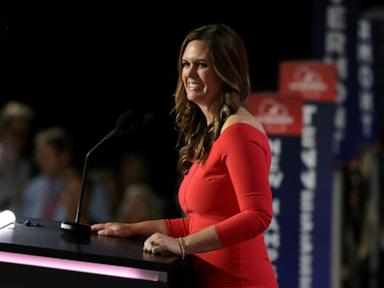
Republican donors and political operatives are actively encouraging Arkansas Governor Sarah Huckabee Sanders to enter the 2028 presidential race, viewing her as a battle-tested conservative executive who survived a difficult midterm cycle. While Sanders publicly insists she is focused on governing Arkansas, she has notably declined to rule out a White House bid—even while promoting a new book and making high-profile national media appearances.
The whispers started almost before the final ballots of the 2026 midterm elections were counted. On November 13, 2026, anonymous sources told ABC News that major financial backers and grassroots supporters were quietly urging the 43-year-old governor to consider a run for the Oval Office. Two days later, sitting on the set of CNN’s State of the Union to promote her new book, Unapologetic, Sanders executed the classic Washington two-step. She deflected direct questions about her ambitions by saying she is focused on her job in Little Rock, yet left the door wide open by remarking that her father—former presidential candidate Mike Huckabee—probably wouldn't wish the grueling experience of a White House campaign on her.
That is not a no. In political speak, it is a test balloon.
To understand why donors are suddenly looking toward Little Rock, you have to look at the broader wreckage of the 2026 midterms. Republicans suffered significant losses across key battlegrounds, triggering an immediate, anxious post-mortem inside the party's donor class. Checkbooks are closing on old orthodoxies, and financiers are hunting for a 2028 standard-bearer who carries conservative credibility without the baggage of recent electoral defeats.
The Post-Midterm Vacuum
Every presidential primary begins with a shadow primary—a months-long audition where governors, senators, and cabinet alumni jostle for billionaire backing and early-state infrastructure before anyone files paperwork with the Federal Election Commission. Usually, that shadow primary follows a predictable script. The vice president or the runner-up from the previous cycle claims early frontrunner status, forcing everyone else to fight for the scraps.
The 2028 cycle is already breaking that mold. While Vice President JD Vance sits at the top of early speculative lists and Florida Governor Ron DeSantis is signaling to allies that his options remain open after fending off Democratic gains in his state, neither has locked down the party's financial apparatus. Meanwhile, Georgia Governor Brian Kemp spent the final days of the 2026 cycle campaigning in South Carolina—a move no serious political observer mistakes for mere party loyalty.
Enter Sanders. Fresh off winning re-election in Arkansas in November 2026, she offers donors something rare in post-midterm Republican politics—an unblemished electoral record in a cycle where red states like Texas saw historic Democratic surges.
Donors do not throw money at candidates out of ideological affection. They invest in viability. For conservative financiers rattled by suburban defections and messaging failures in 2026, Sanders represents a specific kind of political asset. She possesses near-universal name recognition from her tenure as White House press secretary, combined with four years of executive governance in a state where Republicans hold a supermajority.
Why Arkansas Matters Less Than Her Resume
If you evaluate Sanders purely on the electoral math of her home state, a presidential run looks puzzling. Arkansas carries just six electoral votes. It is safely Republican, meaning it offers zero general-election strategic advantage, and its donor base is dwarfed by financial hubs in Texas, Florida, and New York.
Yet modern presidential primaries rarely hinge on home-state electoral clout. They hinge on media ecosystems and cultural signaling.
Consider how Sanders has positioned herself since taking office as Arkansas's first female governor in 2023. Rather than governing as a quiet, business-focused regional administrator in the mold of her predecessor, Asa Hutchinson, she turned the governor's mansion into a national conservative policy laboratory. Her legislative agenda—sweeping education overhaul, aggressive tax cuts, and sharp restrictions on social issues—was engineered to generate headlines far beyond the Ozarks.
That strategy paid dividends in donor circles. When wealthy contributors look at Sanders, they see three distinct advantages that separate her from standard Senate contenders:
- Asymmetric Media Fluency. Having spent years sparring daily with the White House press corps, Sanders treats hostile national interviews as an asset rather than a liability. When she appeared on The View and CNN in November 2026, she wasn't playing defense; she was using mainstream networks to audition for conservative primary voters who love watching their leaders clash with legacy media.
- Executive Proof of Concept. Senators vote on messaging bills; governors sign laws that take effect immediately. Sanders can point to tangible policy execution in Arkansas rather than floor speeches, neutralizing a common attack line used against Washington-based rivals.
- Bridge-Building Credentials. The Republican coalition remains fractured between populist nationalists and traditional establishment donors. Because of her deep ties to both the populist wing and her father's evangelical network, Sanders is one of the few figures capable of raising money in Manhattan boardrooms while drawing crowds at Iowa county fairs.
The Invisible Ceiling
Still, encouragement from anonymous donors is cheap, and early cycle buzz has a graveyard full of promising governors who never made it to Iowa. Ask Scott Walker. Ask Chris Christie. Ask Ron DeSantis in 2023.
The structural obstacles standing between Sanders and the 2028 nomination are substantial, and veteran operatives know them well. First is the shadow of JD Vance. If the sitting vice president decides to run, he inherits a massive institutional advantage, built-in fundraising lists, and the presumptive loyalty of the party's populist base. Challenging a sitting vice president from the same party is historically a losing proposition unless the administration collapses into total unpopularity.
Second is the saturation of the Southern conservative lane. If Brian Kemp, Ron DeSantis, and potentially Texas Senator Ted Cruz all enter the race, they will be fishing in the exact same evangelical and culturally conservative ponds. Sanders would have to prove she isn't merely a younger, female version of candidates who have already built multi-million-dollar national fundraising machines.
Third—and perhaps most dangerous—is the scrutiny gap. Being the popular governor of a deep-red state with a compliant legislature is an entirely different sport than surviving a 14-month presidential primary. Every line item in Arkansas's state budget, every state contract, and every minor administrative misstep gets weaponized by opposition researchers funded by rival campaigns. A minor controversy over a lectern purchase in Little Rock, which briefly made headlines during her first term, offers a preview of how relentlessly primary opponents would mine her administrative record for signs of sloppiness or entitlement.
Reading the Shadow Primary Signals
How can you tell whether the talk around Sanders is genuine momentum or just clever publicists boosting book sales for Unapologetic? You ignore what politicians say on Sunday talk shows and watch where they spend their time and money over the next six months.
Real presidential campaigns leave unmistakable footprints long before an exploratory committee is formed. If Sanders is serious about 2028, three specific developments will surface by the spring of 2027:
- Leadership PAC Transfers. Watch her federal political action committee filings. When a governor starts cutting $5,000 checks to county party chairs in New Hampshire, South Carolina, and Nevada, they aren't doing it out of civic charity.
- Staff Poaching. Top-tier campaign managers, digital fundraisers, and Iowa caucus directors are a finite resource. If veteran operatives who ran successful Senate or gubernatorial campaigns in 2026 suddenly decline lucrative corporate lobbying gigs to take low-paying "advisory" roles in Little Rock, a run is underway.
- Policy Pivots on the National Stage. Governors running for re-election talk about roads, schools, and local property taxes. Governors running for president suddenly develop passionate, detailed opinions on Federal Reserve interest rate policy, Chinese semiconductor supply chains, and NATO spending targets.
Right now, Sanders is enjoying the sweetest spot in American politics. She has just secured a fresh four-year term in Arkansas, she has a new book climbing political bestseller lists, and wealthy donors are flattering her with talk of the White House. She doesn't have to take a single punch yet, nor does she have to alienate potential rivals by declaring war.
By summer 2027, that grace period expires, and the real arithmetic of a presidential campaign begins. Until she starts hiring operatives in Des Moines and Charleston, the donor chatter remains little more than wealthy Republicans hedging their bets after a bruising election night.
For a closer look at how Sanders herself is navigating these early questions, you can watch Sarah Huckabee Sanders responds to 2028 PRESIDENTIAL, which captures her recent public deflection regarding a potential White House run.