The coffee in Nuuk does not stay hot for long.
If you stand near the harbor in Greenland’s capital during the late autumn, the wind coming off the Labrador Sea carries a specific, metallic bite that tastes like ancient salt and wet iron. For decades, that wind was a wall. It kept the outside world out, leaving the fifty-six thousand people who call this island home to live in a quiet, predictable rhythm governed by the tides, the cod, and a three-hundred-year-old administrative tether to Denmark.
Then the ice began to retreat, and the silence broke.
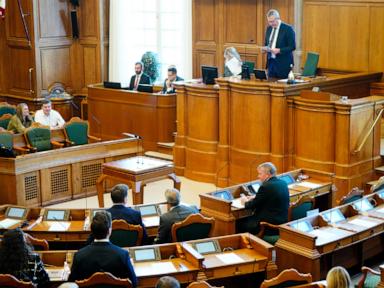
When lawmakers in Copenhagen recently voted to approve a comprehensive new defense and security framework with Washington and Nuuk, the headlines treated it like a dry diplomatic housekeeping item. Denmark approves security deal with US and Greenland, seeking to finally ease tensions with Trump. You probably scrolled past it while waiting for your morning train. It sounded like bureaucrats shuffling papers in warm rooms thousands of miles away from anything that touches your daily life.
That is a dangerous misreading of the map.
To understand why a signature in Copenhagen carries weight from the docks of Rotterdam to the suburbs of Ohio, you have to stop looking at the world on a flat Mercator projection. Flat maps lie to us. They stretch Greenland into a giant, distorted smudge at the top of the page, making it look like an irrelevant attic at the edge of civilization. Pick up a globe instead. Tilt the North Pole directly toward your eyes. Suddenly, the Atlantic and Pacific Oceans shrink into narrow canals, and Greenland sits dead center—a massive, unsinkable aircraft carrier parked directly between North America, Europe, and Russia.
The Ghost of 2019
Let us step back into a hypothetical room in Copenhagen in August 2019, just to feel the temperature drop. Imagine a mid-level Danish foreign ministry official—call her Astrid—staring at a wire report on her monitor while the rain lashes against the brick facade of Christiansborg Palace. Donald Trump, then in his first term, had just floated the idea of buying Greenland outright. When Danish Prime Minister Mette Frederiksen called the proposal absurd, the White House abruptly canceled a state visit.
Astrid and her colleagues did not laugh. They panicked.
For seventy years, Denmark’s entire national security strategy rested on a simple, unwritten bargain: Washington kept the nuclear umbrella open over Europe, and Copenhagen let the American military operate quietly out of Pituffik Space Base (formerly Thule Air Base) in Greenland’s frozen northwest. Suddenly, the transactional nature of modern American power had stripped away the polite diplomatic veneer. Greenland was no longer just an autonomous territory with a high suicide rate and a reliance on Danish block grants. It was real estate. And the biggest landlord on the block was knocking on the door.
Fast forward to the present reality. With Trump back in the White House and global shipping lanes fracturing under geopolitical pressure, the old gentleman's agreement could no longer hold the weight of the twenty-first century. The new tri-party security deal isn't just an update to a 1951 defense treaty. It is a survival mechanism. Copenhagen realized that if it did not formalize a framework that gave Washington expanded military access, early-warning radar upgrades, and clear rules of engagement, Washington might simply bypass Denmark and negotiate directly with Nuuk—or worse, treat the Arctic as a unilateral zone of control.
A House With Three Keys
Think of Greenland right now like an inherited family farmhouse sitting on top of an undiscovered lithium deposit.
In this analogy, Denmark holds the historical deed and pays the property taxes—roughly half a billion dollars a year in subsidies that keep Greenlandic hospitals and schools running. Greenlanders actually live in the house, maintain the roof, and desperately want to afford the mortgage themselves so they can finally declare full independence. Meanwhile, the United States is the heavily armed neighbor next door, watching rival gangs circle the property line and offering to install a state-of-the-art security system in exchange for a permanent key to the front gate.
If you are the person living inside that house, how do you feel?
Consider Malik, a composite representation of the young Inuit professionals living in Nuuk today. He grew up hearing stories from his grandfather about the 1950s, when Danish authorities forcibly relocated entire Inuit hunting families in the dead of winter to make room for the expansion of the American airbase at Thule. Nobody asked them. Nobody compensated them for decades. When Malik hears politicians in Washington talk about "strategic minerals" and "ballistic missile defense," he doesn't hear protection. He hears the echo of bulldozers.
This is the invisible emotional core that standard news reports miss. Every radar dome built on the permafrost carries the weight of colonial trauma. For years, Greenlanders watched Copenhagen and Washington make decisions about their land behind closed doors. The breakthrough in this latest agreement—the reason Nuuk actually signed off instead of sparking a constitutional crisis—is that Greenlandic officials were finally given a seat at the table as co-authors rather than spectators.
Under the new terms, American defense investments in Greenland must now include local economic provisions: dual-use infrastructure like upgraded civilian runways, deep-water ports that can handle both supply ships and Coast Guard cutters, and strict environmental oversight. Washington gets its eyes and ears in the High North; Nuuk gets the concrete and steel it needs to build an independent economy without selling its soul to predatory foreign mining conglomerates.
Why the Ice Melting Changes Your Commute
You might still wonder why any of this matters if you live in Chicago, London, or Singapore. We have enough crises closer to home. Why care about permafrost?
Because the Arctic is warming nearly four times faster than the rest of the planet, and physics does not care about our attention spans.
As multi-year sea ice vanishes, two brand-new maritime highways are opening up across the top of the world: the Northern Sea Route hugging the Russian coast, and the Northwest Passage threading through the Canadian archipelago right past Greenland’s western shore. Cutting through the Arctic shaves roughly forty percent off the shipping time between East Asia and Europe compared to the Suez Canal. No pirates in the Red Sea. No bottlenecks in Panama. Just open, freezing water.
Where cargo ships go, navies follow.
Russia has spent the last decade reopening dozens of Soviet-era Arctic military bases, deploying nuclear-powered icebreakers, and positioning hypersonic missile batteries along its northern frontier. China, despite sitting a thousand miles south of the Arctic Circle, has declared itself a "near-Arctic state" and spent billions trying to buy up Greenlandic airports, abandoned naval bases, and rare-earth mining licenses—efforts that Washington and Copenhagen repeatedly scrambled to block over the past eight years.
If a conflict ever erupts in the North Atlantic, the submarines slipping out of Russia’s Kola Peninsula must pass through the GIUK gap—the stretch of icy ocean between Greenland, Iceland, and the United Kingdom—to reach the East Coast of the United States or sever the undersea fiber-optic cables that carry ninety-five percent of intercontinental internet traffic. Those cables are the literal nervous system of your bank account, your hospital records, and your supply chain.
The security deal Copenhagen just approved is essentially an insurance policy on those cables. It allows the Pentagon to modernize early-warning sensor networks capable of tracking hypersonic glide vehicles flying over the North Pole—missiles that move too fast and too low for traditional Cold War radar to catch until it is too late.
The Fragile Art of De-escalation
Diplomacy rarely looks heroic. Most of the time, it looks like exhausted people in gray suits arguing over comma placements at two in the morning so that young men and women in uniform never have to fire a rifle.
I remember talking to a retired Nordic diplomat a few winters ago in Oslo about what it actually takes to manage an asymmetric alliance with a superpower. He compared it to steering a kayak next to an oil tanker. You cannot push the tanker off course. If you get directly in front of its bow, you will be crushed without the captain even noticing a bump. Your only survival strategy is to read the wake, anticipate the turn, and tie your line to the hull before the storm hits.
That is precisely what Denmark just pulled off.
By proactively locking in a bilateral and trilateral security framework early in the second Trump administration, Danish Prime Minister Mette Frederiksen and Foreign Minister Lars Løkke Rasmussen denied Washington a pretext for confrontation. They gave the White House a tangible win—expanded strategic footprint, burden-sharing on Arctic defense, and a united front against Russian and Chinese encroachment—without surrendering a single square inch of Danish or Greenlandic sovereignty.
Does this permanently erase the friction? Not a chance.
Beneath the ink on the agreement, the tectonic plates are still grinding. In Nuuk, the push for full independence from Denmark is stronger than it has ever been. Every major political party in Greenland favors breaking away from Copenhagen eventually; they only disagree on the timeline and how to replace the Danish financial subsidy. Meanwhile, beneath Greenland’s receding ice sheet sit some of the world’s largest untapped deposits of neodymium, dysprosium, and terbium—the exact rare-earth elements required to build electric vehicle motors, wind turbines, and F-35 fighter jets. Right now, China controls roughly eighty-five percent of global rare-earth processing.
Sooner or later, the diggers will return. When they do, the tension between preserving a fragile, sacred wilderness and feeding a hungry global supply chain will tear at Greenlandic society all over again.
The Light at the Edge of the World
If you ever visit Ilulissat, three hundred kilometers north of the Arctic Circle, you can walk out onto a wooden boardwalk overlooking the Kangia Icefjord. Every single day, the Sermeq Kujalleq glacier calves twenty million tons of ice into the bay.
Standing there, the sound isn't a gentle splash. It is a deep, subterranean thunder that vibrates inside your ribcage before the sound wave even reaches your ears. Massive cathedrals of blue ice, some taller than thirty-story buildings, fracture and roll over in slow motion, sending tidal swells crashing against the granite cliffs.
For centuries, human beings looked at that landscape and saw an unconquerable fortress. We built our maps, our alliances, and our economies on the assumption that the top of the world would stay frozen forever, keeping the great powers safely apart.
That wall is gone now. The ice is drifting south into the shipping lanes, and the world has arrived at Greenland's doorstep whether the island is ready or not. A signature in Copenhagen has bought the North a few years of quiet, a fragile truce between old allies who suddenly realized they needed each other more than they wanted to admit.
Outside the harbor in Nuuk tonight, the wind is still blowing off the water, cold enough to numb your fingers in seconds, carrying the smell of open ocean where there used to be only ice.