Silence.
In Beijing, silence is rarely peaceful; it is usually the sound of someone being erased.
Picture a brightly lit conference room inside the Bayi Building, the sprawling, fortress-like headquarters of China’s Central Military Commission. For months, a heavy mahogany chair at the long table has sat conspicuously empty. The man who used to occupy it wore four golden stars on his epaulettes, commanded tens of thousands of troops, and held the fate of regional stability in his calloused hands. Yesterday, he was an untouchable titan of the People’s Liberation Army. Today, his name is scrubbed from state media archives, his aides are being interrogated in undisclosed windowless rooms, and a younger, leaner, far more cautious general is quietly sliding into his seat.
To understand what just happened across China’s military command structure, you have to look past the dry press releases and the sterile seating charts of state television broadcasts. When Beijing quietly unveiled a fresh slate of People’s Liberation Army theater commanders following a relentless anti-corruption sweep, most outside observers treated it like a routine corporate reshuffle. They missed the pulse of the story. They missed the sheer human terror, the paranoid calculus, and the high-stakes gamble unfolding behind the red walls of Zhongnanhai.
I have spent years tracking the tremors of elite politics in East Asia, sitting across from former defense attachés in Taipei, exiled analysts in Singapore, and weary diplomats in Tokyo who stare at grainy satellite photos and state television footage the way medieval priests read entrails. You learn quickly that in an opaque system, a missing general is never just an administrative footnote. It is a symptom of a deeper fever. And when a new wave of PLA theater chiefs steps into the spotlight, they are not merely taking a promotion. They are walking onto a tightrope stretched over an abyss, knowing full well what happened to the men who fell before them.
The Architecture of Fear and Loyalty
To grasp the weight resting on these newly appointed commanders, consider a hypothetical character we will call General Lin. Imagine Lin waking up at 4:30 in the morning in a guarded compound in Nanjing or Guangzhou. Before he even puts on his olive-green tunic, he checks his secure briefing folder, hyper-aware that every phone call he makes, every requisition form he signs, and every dinner he attends is monitored by political commissars who answer directly to Xi Jinping.
Lin is not a caricature of a warmonger, nor is he a bumbling bureaucrat. He is a survivor. He rose through the ranks of China’s five theater commands—the Eastern, Southern, Western, Northern, and Central theaters—during an era when the PLA was transforming from a bloated, inward-looking peasant army into a modern, joint-operations fighting force capable of projecting power across the Taiwan Strait and the South China Sea.
Think of the PLA’s five theater commands like the load-bearing pillars of a massive suspension bridge. Established during Xi’s sweeping 2015 military reforms, these theaters replaced the old regional military districts that had become fiefdoms for corrupt warlords in uniform. In those old days, promotions were bought with briefcases of cash, fuel was siphoned off and sold on the black market, and combat readiness was a polite fiction maintained for visiting dignitaries. Xi smashed that system to pieces, centralizing operational control under the Central Military Commission and giving the five theater chiefs direct warfighting authority over air, naval, missile, and ground forces within their geographic zones.
Yet power, even redesigned power, breeds rot.
Over the past two years, a ferocious anti-corruption storm tore through the upper echelons of the Chinese military, claiming defense ministers, Rocket Force commanders, and senior procurement officials. Whistleblowers and intelligence leaks painted a staggering picture of decay: missiles allegedly filled with water instead of fuel, silo lids that would not open properly, and billions of yuan meant for high-tech modernization diverted into private pockets.
That is the wreckage the new theater chiefs have inherited.
Why State Television Tells the Real Story
Because Beijing never holds a press conference to announce who is running its war rooms, intelligence analysts have to play detective using the regime’s own propaganda. It sounds absurd, almost like a parlor game, until you realize how rigidly choreographed Chinese state media truly is.
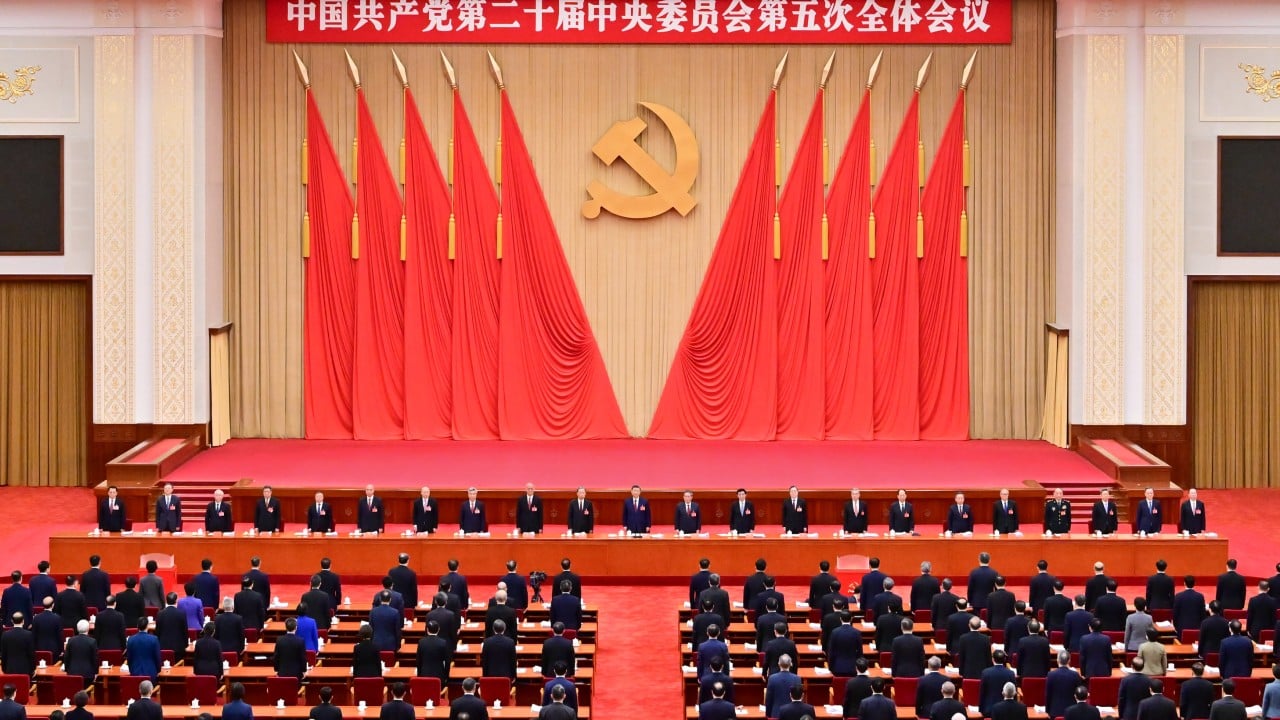
When the Central Military Commission convenes a high-level meeting, cameras from China Central Television pan slowly across the room. Analysts freeze the frame. They zoom in on the nameplates on the desks. They count the stars on the shoulders. They check the seating order down to the millimeter. When a familiar face vanishes from the front row and an unfamiliar officer sits in the designated theater commander slot—wearing the distinct arm patch of the Eastern or Southern Theater Command—the secret is out.
Through these meticulous visual breadcrumbs, paired with regional military newspaper reports and local government appearances, the new guard of PLA theater chiefs came into sharp focus. Men who spent their careers grinding through operational staff roles, naval task forces, and air defense brigades—officers like Wang Xiubin, Lin Xiangyang, and their newly elevated peers across the commands—emerged as the trusted hands chosen to steady the ship.
Notice who they are, and more importantly, who they are not.
They are not the flashy, politically connected patronage bosses of the 2000s. Many of these newly identified theater chiefs cut their teeth in joint-command exercises, amphibious landing drills, and high-altitude border standoffs. They speak the language of modern warfare—electronic jamming, drone swarms, hypersonic glide vehicles, and integrated logistics. Even more critically, they carry clean files. They survived the vetting of the Central Commission for Discipline Inspection, a body whose investigators can freeze a general’s assets and erase his legacy with a single signature.
The Invisible Cost of a Cleansed Command
Here is where the conventional wisdom gets this story completely backward.
When commentators in Washington or London read about corruption purges in the PLA, they often smile with relief. If Chinese generals are stealing money and getting arrested, the thinking goes, then China’s military must be hollow, broken, and incapable of fighting a real war.
That assumption is dangerously seductive. And it is wrong.
Think of a surgeon cutting out a malignant tumor. In the immediate aftermath of the operation, the patient is weak, bruised, and confined to bed. Nobody would ask that patient to run a marathon the next morning. In the short term, the anti-corruption drive has undeniably rattled the PLA’s nervous system. Officers are hesitant to make bold decisions out of fear that an aggressive procurement choice or an unconventional training exercise might later be misconstrued as malfeasance or disloyalty. Bureaucratic paralysis is a very real side effect of political terror.
But what happens six months or two years after the surgery succeeds? The patient recovers, stronger and cleaner than before, free of the parasite that was draining their vitality.
Xi Jinping is not purging his generals because he wants a weaker military. He is purging them because he demands a military that can actually fight and win when ordered. If you are a supreme leader contemplating the ultimate geopolitical gamble—whether coercing Taiwan into submission or confronting the United States Navy in the Western Pacific—the nightmare scenario is discovering on the first morning of a war that your missiles do not launch because a corrupt contractor pocketed the maintenance budget.
By clearing the ranks and installing vetted, technically proficient theater chiefs, Beijing is attempting to burn away the rot before the real test arrives.
Inside the Five Pressure Cookers
To feel the human reality of these appointments, look at the specific geography these new chiefs now command. Each theater is a pressure cooker with its own distinct flavor of dread.
In the Eastern Theater Command, headquartered in Nanjing, the new leadership stares directly across the hundred-mile stretch of water separating mainland China from Taiwan. Every single day, the commander here approves flight paths for fighter jets crossing the median line of the Taiwan Strait and naval patrols encircling the island. One miscalculation by a hotheaded pilot, one radar lock held a second too long, and this commander becomes the man who accidentally started World War III. He knows his predecessor’s missteps were scrutinized under a microscope; his own margin for error is zero.
Further south, the Southern Theater Command oversees the volatile waters of the South China Sea. Here, the daily grind involves tense standoffs with Philippine coast guard vessels near disputed shoals and close-quarters intercepts with American reconnaissance planes. The commander in Guangzhou has to project relentless, unblinking strength to satisfy Beijing’s nationalist rhetoric while somehow preventing a collision that drags the region into open conflict.
To the west, the Western Theater Command covers the largest landmass in the country, stretching from the restive deserts of Xinjiang to the freezing, oxygen-starved peaks of the Himalayas along the disputed border with India. Commanding troops at fifteen thousand feet, where frostbite claims more casualties than bullets and supply lines snake across treacherous mountain passes, requires a brutal, unsentimental mastery of logistics. Corruption in this theater does not just waste money; it leaves soldiers freezing in inadequate shelters.
Meanwhile, the Northern Theater Command watches the Korean Peninsula and the long border with Russia, managing the delicate, uneasy partnership between Moscow and Beijing while keeping a wary eye on nuclear instability in Pyongyang. And at the center sits the Central Theater Command, the ultimate strategic reserve tasked with defending Beijing itself—and, by extension, safeguarding the survival of the Chinese Communist Party.
The Paradox of Absolute Control
Let us pause and be honest about what we do not know, because anyone claiming total certainty about the inner workings of Zhongnanhai is selling you a fantasy.
We do not know if these newly installed theater chiefs truly believe every slogan they recite, or if they smile tightly during loyalty oaths while privately nursing exhaustion. We do not know whether the anti-corruption campaign has truly reached its final chapter, or if another wave of arrests is already quietly brewing inside the Rocket Force and the Equipment Development Department. In a system built on secrecy, trust is a scarce currency, and paranoia is the default operating system.
What we do know, grounded in decades of observing Leninist militaries, is the inescapable paradox that traps every strongman ruler.
When you demand absolute political obedience above all else, you inevitably punish the very initiative that modern warfare requires. Real combat is chaotic. Radio links fail, satellites get blinded, plans disintegrate within ten minutes of the first shot, and frontline commanders have to improvise on the fly. Yet if an officer spends twenty years climbing a ladder where survival depends on waiting for instructions from Beijing and never taking an unauthorized risk, how smoothly can he switch gears when chaos erupts in the Taiwan Strait?
Consider what happens next in that quiet conference room at the Bayi Building.
The newly appointed theater chief sits in that heavy mahogany chair, his uniform pressed to razor sharpness, his notebook open before him. Across the table sits Xi Jinping, demanding both flawless ideological purity and ruthless battlefield competence. The general nods, takes notes, and issues his orders with crisp, unambiguous authority. He has survived the purge. He has earned the stars on his shoulders.
Yet as he walks back down the long, marble-floored corridor toward his waiting black sedan, he passes the empty offices of men who sat in that exact chair just months ago—men who thought they were safe, right up until the morning the knock came at the door.