Hum.
That is the first thing you notice if you walk past a windowless industrial box at two in the morning. Not a roar. Not a siren. Just a low, continuous, vibrating hum that settles right into your teeth and makes the air feel slightly warmer than it ought to be.
For years, most of us treated "the cloud" like weather. Something airy, weightless, drifting somewhere above our heads where our photos lived, our groceries got ordered, and our chatbots thought up recipes at midnight. We rarely asked where the rain came from. We certainly did not think about the concrete slabs, the high-voltage substations, or the millions of gallons of water tucked behind chain-link fences in small towns and quiet suburbs across the country.
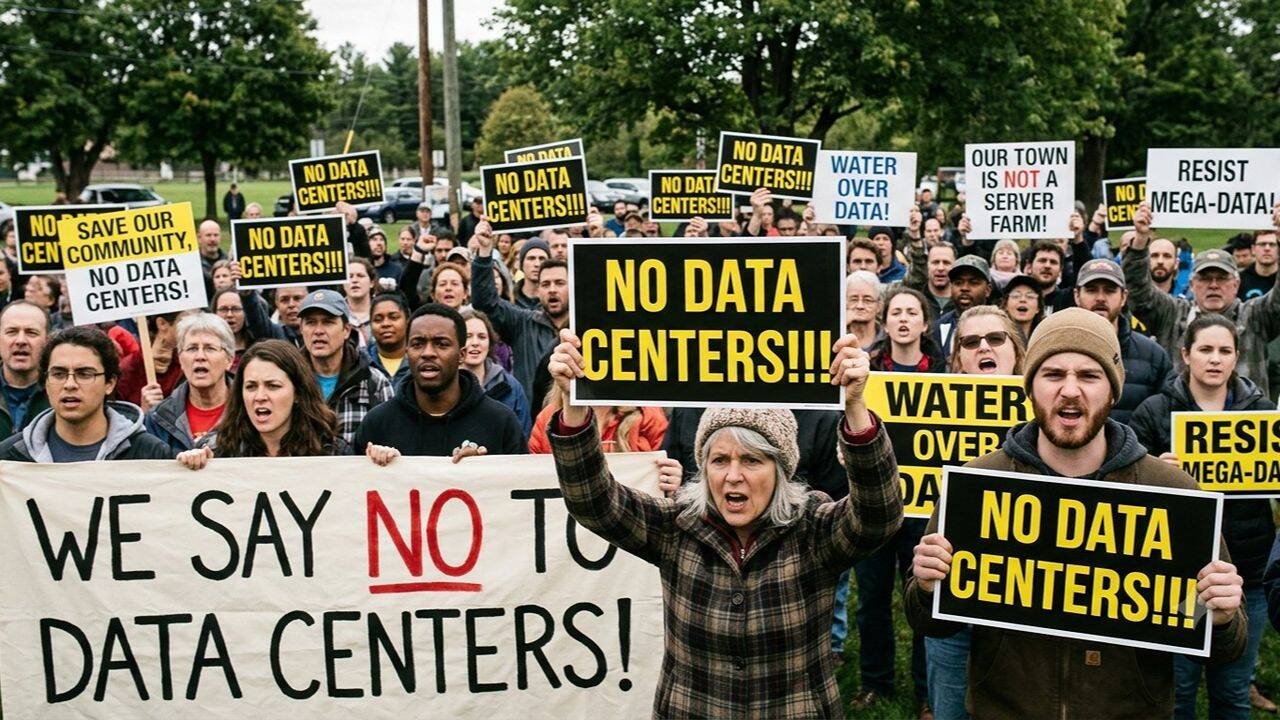
Now, those windowless boxes are arriving in force. And something remarkable is happening in the folding chairs of municipal basements and county planning boards from Virginia to Ohio, from Georgia to Oregon.
Democrats and Republicans are standing shoulder to shoulder, arguing over zoning maps, power lines, aquifer drawdowns, and tax abatements.
If you spend all day watching cable news, you might believe red and blue voters cannot agree on the color of the sky. Yet put two neighbors in a room when a multi-hundred-million-dollar server farm is proposed three hundred yards from a family farm or a subdivision cul-de-sac, and national party labels start peeling away like wet paint. One neighbor might carry a yard sign for a progressive mayor. The next might have a truck sticker backing a conservative governor. Together, they are looking at the exact same blueprint and asking the exact same question: Who pays for this when the lights flicker and the well runs thin?
When Abstract Code Meets Dirt and Copper
To understand why data centers have turned into unlikely bipartisan flashpoints, it helps to look at what they actually do.
(Note: The following walk-through of a municipal zoning hearing uses a composite hypothetical scenario built from real disputes reported across U.S. communities over the past several years.)
Picture a Tuesday night in a fictional county seat we will call Millbrook Township. The fluorescent lights in the high school cafeteria buzz overhead. Three hundred people have squeezed into metal chairs meant for two hundred. Up front sits a glossy rendering of a sleek, gray campus—two massive buildings, rows of backup diesel generators, and a new high-voltage transmission corridor cutting across pastureland.
A developer representative speaks first, talking about capital investment, construction jobs, and long-term property tax revenue. A few rows back, Elena—a retired schoolteacher who votes Democratic and worries deeply about climate change—leans forward, her jaw tight. Two seats over sits Dale, a contractor and lifelong Republican who spent forty years fixing furnaces and wells across the county.
They have almost never agreed on a single ballot measure in a decade. Tonight, both of them are holding printed copies of the county water report and the regional grid forecast.
Elena is thinking about carbon and peak electricity demand. If a massive data center complex draws as much power as a mid-sized city, how are utilities meeting that surge? Often, coal plants stay open longer than planned, or new gas turbines get pushed through. For someone who cares about emissions, an energy-hungry facility next door feels like a step backward.
Dale is looking at the numbers from a completely different angle—and arriving at a surprisingly similar worry. He cares about reliability, property rights, and whether local families are subsidizing corporate infrastructure. When a utility upgrades substations and transmission lines to serve a giant energy buyer, who ends up absorbing the cost through rate hikes? Often, everyday residential ratepayers and small businesses. And when heavy industrial zoning swallows agricultural land or pushes noise right up to neighboring homes, property rights stop feeling theoretical.
Neither Elena nor Dale hates technology. Elena uses video calls to talk to her grandchildren; Dale relies on digital mapping and ordering software to run his business. Their resistance isn't a rejection of modern life. It is a reaction to scale, speed, and surprise.
Why Left and Right Converge Around the Same Fence Line
Political analysts often look for grand ideological shifts when two sides align. Sometimes, though, alignment comes from something much simpler: shared physical limits.
A data center cannot live purely in software. Servers generate intense heat. Keeping thousands of racks of processors from overheating requires serious cooling—either massive air-cooled chillers that hum day and night or evaporative cooling systems that pull substantial volumes of water, especially during hot summer stretches. Add round-the-clock electricity demand that does not simply clock out at five o'clock, and suddenly a digital facility looks a lot like a heavy industrial plant wearing a minimalist disguise.
That physical reality cuts across traditional political divides in ways that catch seasoned strategists off guard.
On the political left, concerns frequently center on climate targets, strain on the electrical grid, water stewardship, and whether generous tax incentives strip public coffers of money needed for schools and roads while granting huge breaks to wealthy tech corporations. Community advocates ask whether residents bear environmental and utility burdens while seeing relatively few permanent local jobs once construction wraps up.
On the political right, skepticism often focuses on government subsidies and special tax deals for big corporations, eminent domain or aggressive land rezoning, strain on local infrastructure, and grid reliability—especially the fear that surging demand could make blackouts more likely or push monthly electric bills higher for working families.
Think of the electrical grid like a shared town bridge. For decades, everyone crossed it at a fairly predictable pace, and engineers planned maintenance accordingly. Now imagine a fleet of forty-ton haulers showing up twenty-four hours a day, demanding reinforced lanes and priority access. Even if the haulers help fund part of the bridge work, ordinary commuters still wonder what happens to their toll, their traffic, and their safety if a cable snaps. (That bridge comparison is a metaphor for grid capacity and cost allocation—real power grids involve regional operators, balancing authorities, and state regulators rather than a single roadway.)
When people feel the weight of a decision right outside their kitchen window, abstract debates over "innovation" lose their shine. Suddenly, the conversation is concrete: Will my well pressure drop in August? Will my electric bill jump next winter? Will the zoning board change the rules behind closed doors?
The Hidden Stakes Beneath the Hum
It is easy to dismiss local pushback as knee-jerk resistance to change. Sometimes critics use a shorthand label—NIMBYism—to wave away neighborhood concerns.
That label misses what is actually driving many of these fights.
In plenty of towns, residents aren't saying "never build anything anywhere." They are saying, "Show us the real numbers before you sign the deal." They want to know how much water a facility will draw on a ninety-five-degree afternoon. They want transparent rules on generator testing noise and emissions. They want assurance that if a company promises a certain level of investment or power efficiency, taxpayers won't be left holding the bag if projections shift.
There is also a quieter, more personal stake that rarely makes it into press releases: the feeling of being caught off guard.
Many residents first learn about a major project not through an open, months-long civic conversation, but through a small legal notice tucked in the back of a local paper or a sudden agenda item at a planning meeting. When people feel blindsided, trust evaporates fast. Once trust is gone, even reasonable compromises look suspicious.
I know what it feels like to live next to constant mechanical noise and wonder who made the call that put it there. Years ago, living near a busy commercial corridor, I learned how quickly a background sound stops being background. During the day, traffic fades behind life and conversation. At three in the morning, when the street empties out, a steady hum becomes the loudest thing in the room. It makes you protective of quiet places. It makes you pay attention to how decisions get made when nobody is watching.
And I will be honest: this territory is genuinely complicated. Artificial intelligence and cloud computing power real tools that doctors, researchers, small shop owners, and students use every day. Data centers are part of the backbone of modern society. At the same time, building them at breakneck speed without clear guardrails on energy, water, and local governance creates real friction. Pretending there is no trade-off is dishonest. Pretending every server farm is an ecological disaster is equally unhelpful.
What This Unlikely Alliance Reveals About American Politics
There is something oddly refreshing about watching neighbors who disagree on national cable shows find common ground over a county zoning map.
It reminds us that politics looks very different at ground level than it does in thirty-second clips. At the local level, people don't live inside algorithms. They live inside watersheds, school districts, and electric rate zones. When a proposal touches those shared foundations, practical self-interest and civic care tend to crowd out partisan theater.
Across several states, lawmakers from both parties have begun exploring middle ground—pushing for greater transparency around water and power usage, scrutinizing overly broad tax giveaways, requiring clearer impact studies, and insisting that large power users pay their fair share of grid upgrades rather than shifting costs onto households.
None of that is flashy. Zoning ordinances and utility tariffs rarely inspire bumper stickers. Yet real change in American life almost always starts in unglamorous places—a binder full of engineering specs, a heated public comment period, a compromise drafted over coffee after a long meeting.
The tension isn't going away anytime soon. Demand for computing power continues to climb, and communities across the country are still figuring out how much growth they can absorb without losing what makes their towns feel like home.
Outside that windowless building at two in the morning, the air still carries that low, steady hum. Inside the meeting rooms across America, neighbors from both sides of the aisle are finally listening closely enough to decide what kind of future they are willing to build around it.