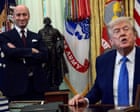
Five words.
That is all it takes to shake the concrete foundations of a multi-billion-dollar political machine, send shockwaves through West Wing corridors, and keep millions of families awake staring at their bedroom ceilings at three in the morning. "Might have been too tough."
When those words left Donald Trump’s mouth regarding his own administration's deportation policies—almost simultaneously as Stephen Miller stepped into the role of Deputy Chief of Staff for Policy—Washington reacted the way Washington always does. Pundits scrambled to their microphones. Live-blogs refreshed every forty seconds. Analysts treated the remark like a chess move on a felt board, debating optics, voter margins, and ideological friction between hardliners and pragmatists.
They missed the point entirely. They always do when they look at policy from thirty thousand feet.
Down on the ground, policy does not exist in polling cross-tabs or cable news chyrons. It smells like diesel exhaust at a 4:00 a.m. shift change in a Midwest meatpacking plant. It sounds like the heavy, metallic click of a deadbolt being turned twice before a parent goes to sleep. It feels like the sudden, cold sweat on the back of a small business owner's neck when three of his best foremen don't show up on a Tuesday morning, leaving half a roof exposed to an incoming storm.
To understand why a sudden softening of tone from the Oval Office collides so violently with the elevation of the administration’s most uncompromising immigration architect, you have to stop looking at the podium and start looking at the kitchen table.
The Architecture of a Paradox
Step inside the West Wing on any given morning, and you are walking into a building built on tension. On one side sits the instinct of the dealmaker—a leader acutely sensitive to the hum of the economy, the complaints of hospitality executives, the pleas of agricultural lobbies, and the undeniable visual drama of families torn apart on evening broadcasts. When Trump muses aloud that an enforcement sweep "might have been too tough," he isn't abandoning his base. He is reacting to friction. He is hearing the quiet panic of construction bosses in Texas, dairy farmers in Wisconsin, and hoteliers in Florida who are suddenly discovering that you cannot deport the foundation of an industry without the walls starting to crack.
Walk fifty feet down the hall, however, and you enter the orbit of Stephen Miller.
Miller does not deal in intuition or mood swings. He deals in statutory mechanics. As Deputy Chief of Staff for Policy, his mandate isn't to read the room; it is to build an engine that runs regardless of who is watching. For years, Miller has viewed immigration not as a labor market equation or a humanitarian debate, but as an existential ledger of sovereignty and law. To him, hesitation is the very flaw that hollowed out previous enforcement efforts. Where others see a sympathetic exception—a grandmother who has paid taxes for twenty years, a college student brought over as a toddler—the hardline policy apparatus sees a loophole that invites a million more crossings.
Here lies the central contradiction of modern American governance. You have the rhetoric of absolute, unyielding enforcement colliding head-on with the messy, deeply human reality of a country whose daily life is woven together by undocumented labor and mixed-status families.
Consider a hypothetical scenario, grounded in the exact realities playing out across the American heartland right now. Meet Mateo. Mateo isn't a statistic from a Border Patrol press release. He is forty-two years old, lives in a modest brick ranch house outside Omaha, and has spent the last sixteen years framing houses. He pays taxes using an Individual Taxpayer Identification Number. His two youngest children were born at the local county hospital; they recite the Pledge of Allegiance every morning in public school and argue about baseball stats at dinner.
When Washington talks about "mass deportation," Mateo doesn't hear a political slogan. He hears a countdown. He keeps a notarized folder of power-of-attorney documents taped to the inside of his pantry door, detailing who will pick up his kids from soccer practice if he doesn't come home from a job site.
Now, step across town to Mateo’s employer, a third-generation contractor named Greg who voted twice for stricter border controls. Greg wanted order at the southern border. He wanted fentanyl stopped and chaotic surges ended. He did not anticipate that the resulting dragnet would sweep up the very men who taught his own son how to read a blueprint. When Greg calls his congressman in a panic because housing starts are stalling and labor costs are spiraling, his frustration travels up the chain of command until it reaches the desk of the President.
That phone call—multiplied by ten thousand business owners, mayors, and community leaders—is the exact gravity pulling at Trump’s words.
The Invisible Ledger of Enforcement
People often ask why deportation policy swings so wildly between aggressive crackdowns and sudden moments of second-guessing. The answer isn't indecisiveness. It is math.
Modern enforcement operates much like a massive, high-pressure municipal water system. For years, politicians have focused almost exclusively on turning the main valve—demanding more arrests, wider raids, and faster removals. What rarely gets discussed in thirty-second soundbites is the plumbing downstream.
To detain and remove millions of people requires an infrastructure that simply does not exist at scale. According to federal budgetary analyses and nonpartisan migration studies, executing large-scale interior removals requires tens of thousands of additional detention beds, fleets of charter aircraft, armies of immigration judges, and diplomatic cooperation from receiving nations that frequently refuse to accept repatriation flights. Every single arrest triggers a cascade of logistical costs—roughly ten thousand to fourteen thousand dollars per person when accounting for apprehension, detention, legal processing, and transport.
When an administration pushes the system to maximum capacity, the pipes begin to burst in unexpected places.
- Local economies seize up. In sectors like agriculture, construction, elder care, and hospitality, undocumented workers make up between ten and twenty percent of the workforce. Removing them doesn't instantaneously create high-paying jobs for native-born workers; it often forces farms to let crops rot in the field and shuts down shifts at local processing plants.
- The tax base quietly erodes. Undocumented immigrants contribute tens of billions of dollars annually in federal, state, and local taxes—including payments into Social Security and Medicare systems from which they are legally barred from drawing benefits.
- Community trust evaporates. When local police departments are deputized into federal immigration sweeps, crime reporting drops across entire neighborhoods. Witnesses stop calling 911. Domestic violence victims stay silent rather than risk triggering a deportation proceeding that leaves their children orphaned.
I have stood in courthouse hallways watching this machinery grind in real time. You never forget the sound of a courtroom where three dozen people—some in worn work boots straight from a construction site, others clutching infants wrapped in fleece blankets—are processed in under forty minutes. There are no dramatic television speeches in those rooms. There is only the rustle of manila folders, the low murmur of court-appointed interpreters translating legal jargon into Spanish, Mam, or Haitian Creole, and the stunned, hollow silence of families realizing that an entire life built over decades can be erased by a single stamp on a piece of paper.
Once you have watched a ten-year-old boy translate a deportation order for his mother because no one else in the room speaks her indigenous dialect, the phrase "too tough" stops sounding like a political hedging strategy. It starts sounding like a bare minimum acknowledgment of human gravity.
Why the Timing Matters Now
Look closely at the choreography of this moment. Trump’s admission of possible overreach did not happen in a vacuum; it happened right as Stephen Miller consolidated policy control inside the White House.
In Washington, personnel is policy. Elevating Miller signals to the ideological faithful that the administration remains dead serious about structural restrictionism. His playbook is well-documented and meticulously researched: ending birthright citizenship through executive challenge, reviving strict public-charge rules that penalize immigrants who use basic social services, expanding expedited removal nationwide so suspects can be deported without ever seeing a judge, and stripping temporary protected statuses from hundreds of thousands of people fleeing collapsed states.
Miller’s genius—and what makes him such a formidable operator—is that he understands the federal bureaucracy better than almost anyone in his orbit. He knows which obscure regulatory levers inside the Department of Homeland Security and the Department of Justice can be pulled without waiting for Congress to pass a single bill. While politicians argue on television, Miller drafts the memos that rewrite the rules of the game.
So why would the President undercut that ironclad posture with a moment of public doubt?
Because political survival requires two different languages. One language is spoken to the base—a language of strength, unyielding borders, and zero tolerance. The other language is spoken to the broader public, the swing voters in suburban districts, and the corporate donors who fund campaigns. Those audiences want secure borders, yes, but they recoil at images of weeping children, raided churches, and shuttered neighborhood businesses.
Trump has always possessed an uncanny, almost animal instinct for where the public stomach turns. During his first term, it was the visceral outrage over family separations at the border—a policy championed by hardliners that generated such relentless bipartisan condemnation that Trump himself eventually signed an executive order halting it. He learned a hard lesson then: you can win an argument on cable news and still lose the country in the living room.
His recent remark is a pressure-release valve. It gives him room to maneuver. If enforcement sweeps spark economic backlash or humanitarian outrage, he has already planted the flag of moderation, allowing him to claim that he wanted a firm hand, not a cruel one. Meanwhile, inside the building, Miller’s machinery keeps humming, drafting the next wave of executive actions.
The Fog of Uncertainty
If you feel confused trying to square these two realities—the softening rhetoric at the podium and the hardening personnel in the West Wing—you are paying attention. The ambiguity is not an accident. It is a feature of how power operates when ideological purity collides with governing reality.
For millions of people living in the shadows of American immigration law, however, ambiguity is its own kind of punishment.
Terror has a specific rhythm, and uncertainty is its metronome. When rules are clear, even harsh ones, human beings can adapt. They can plan, save money, consult attorneys, or make painful choices about relocating. When the signals from the top contradict each other every forty-eight hours, families are paralyzed. Do you send your child to the emergency room when they have a high fever, or do you worry that hospital intake forms might somehow cross paths with federal databases? Do you report a wage-theft violation against a corrupt boss, or do you swallow the loss because drawing attention to yourself could cost you everything?
Even legal immigrants and naturalized citizens feel the chill. History shows us that aggressive enforcement eras rarely stay neatly inside their intended lines. During the mass repatriation drives of the 1930s and the federal sweeps of the 1950s, hundreds of thousands of American citizens of Mexican descent were swept up and deported alongside undocumented workers simply because they looked a certain way or lacked immediate proof of citizenship in their pockets. Bureaucracies built for speed inevitably sacrifice accuracy.
Beyond the Live-Blog Ticker
Tomorrow morning, the political cycle will move on to another headline. Another live-blog will update with a new quote, a new court injunction, or a new press briefing from the North Lawn. The pundits will tally who won the news cycle—the pragmatists who want a gentler touch, or the architects like Stephen Miller who want an impenetrable wall of law.
Down in Omaha, Mateo will wake up at 4:30 a.m. in the dark. He will brew coffee quietly so he doesn't wake his kids, lace up his steel-toed boots, and glance once at the white manila folder taped inside the pantry door before stepping out into the cold morning air.
Washington can debate whether the policy is too tough, not tough enough, or calibrated just right for the next election. Out on the highway, watching the taillights glow red against the pre-dawn fog, the people holding up the country’s roofs, fields, and kitchens are simply praying they make it home for dinner.