Two hundred grams of ground beef. That is the weight of a smartphone, a modest paperback, or the exact portion a butcher in the working-class neighborhood of Lanús wraps in white paper when a customer slides crumpled thousand-peso bills across the counter with lowered eyes.
Numbers in economics have a way of anesthetizing us. When a headline announces that Argentina’s poverty rate has climbed back above 30 percent under President Javier Milei, reversing a fragile, hard-won period of decline, the brain registers a bar chart. It sees a line dipping, hesitating, and then turning upward again. It does not hear the scrape of a chair pulled back from a dinner table where the portions have quietly halved. It does not smell the damp cardboard stacked by cartoneros sorting recyclables under flickering streetlights at two in the morning.
I have spent years watching how currency crises and austerity shockwaves move through Argentine households, and there is a specific sound they make before they ever show up in official statistics from INDEC, the national statistics agency. It is the sound of metal shutters rolling down halfway on neighborhood bakeries at four in the afternoon because turning on the ovens for the evening batch costs more in electricity than the bread will bring in.
The Arithmetic of a Shrinking Table
To understand why a climb back over that 30 percent threshold feels like a cold wind blowing through a room that had just begun to warm, you have to understand what the preceding months felt like. For a brief stretch, the fever had seemed to break. Monthly inflation, which had raged at triple-digit annual rates and turned every trip to the supermarket into a sprint against repricing guns, began to cool. Real wages clawed back a fraction of their lost ground. Poverty, which had spiked violently during the initial shock therapy of late 2023 and early 2024—when a massive currency devaluation and the slashing of energy and transport subsidies sent millions tumbling below the breadline—had started to recede. People exhaled. Not deeply, never comfortably, because in Argentina you never trust calm weather for long, but enough to buy a carton of milk without checking the bank app three times at the register.
Then the floor shifted again.
Consider a hypothetical family—let us call them Mateo and Lucía, living with their two school-age children in a modest apartment in Greater Buenos Aires—whose household budget mirrors the exact pressures captured in the latest national data. Mateo drives a delivery van; Lucía works part-time doing administrative billing for a clinic. Neither is unemployed. In the textbooks of classical economics, two working adults in a major capital should form the bedrock of a stable lower-middle class.
Yet in modern Argentina, employment is no longer a reliable moat against poverty.
Why? Because of the brutal divergence between the prices that froze and the prices that kept climbing. Think of a household budget like a lifeboat with two holes. For months, the biggest leak—food inflation—slowed down enough that Mateo and Lucía could bail faster than the water came in. Then the second leak widened. Utility bills, deregulated and stripped of decades-old state subsidies, doubled and tripled. Bus and train fares jumped. Health insurance premiums, freed from price caps, surged far ahead of collective bargaining agreements. Even if the price of rice and cooking oil stopped skyrocketing every Tuesday, the fixed costs of simply keeping the lights on and getting to work swallowed the paycheck whole before the grocery cart was even rolled out of the aisle.
Wait. Look closely at what happens to the math when fixed bills eat seventy percent of an income.
You cannot negotiate with the electric company. You cannot pay half a bus fare. The only variable expense left in a working family's life is what goes into their stomachs, and whether they buy shoes when the soles split. So the adjustments happen in silence, behind closed doors, among people who still wear pressed shirts to work and still look middle-class on the commuter train.
Shock Therapy and the Patient on the Table
When Javier Milei took office wielding a chainsaw as his campaign emblem, his diagnosis of Argentina’s chronic illness was blunt and, in many respects, undeniable. For decades, successive governments had spent money they did not have, printed pesos to cover the gap, and papered over the resulting inflation with price controls, export taxes, and sprawling subsidies that distorted every signal in the economy. The state was bloated; the central bank was empty; the currency was melting ice.
Milei’s prescription was radical fiscal austerity—the most aggressive budget-cutting campaign in modern South American history. Public works ground to a halt. Pensions were allowed to erode in real terms before a new indexation formula took hold. Transfers to provinces dried up. The government achieved a fiscal surplus in record time, a feat that earned standing ovations from Wall Street bondholders, the International Monetary Fund, and libertarian admirers around the world.
From thirty thousand feet, the spreadsheet looked miraculous. Country risk plummeted. The gap between the official exchange rate and the black-market dollar narrowed to a whisper.
Down on the sidewalk, however, fiscal surpluses are not abstract triumphs. They are built out of someone else’s forgone income.
Economists use the term "recessionary adjustment" as though it were a gentle turning of a dial. In reality, it is more like slamming the emergency brake on a crowded train going eighty miles an hour. The train stops, yes—the derailment of hyperinflation is averted—but everyone standing in the aisles is thrown violently forward. Construction workers lost their jobs first when public infrastructure projects froze overnight. Factory hands followed as domestic consumption collapsed. Informal workers—the mechanics, the seamstresses, the street vendors who make up nearly half of Argentina’s labor force and have no union contracts to cushion the blow—watched their daily earnings evaporate while their costs soared.
When poverty initially surged past 50 percent in the first half of 2024 before retreating as inflation cooled, defenders of the administration argued it was the unavoidable trough of a V-shaped recovery. Pain now, prosperity later. The curve would bend down, and stay down.
The return of the poverty rate above 30 percent shatters that neat, reassuring geometry. It suggests that the recovery has not been a rising tide lifting all boats, but a selective current carrying capital-intensive sectors—energy, mining, agribusiness, finance—while leaving labor-intensive urban industries stranded on the mudflats.
The Invisible Line Between Getting By and Going Under
Statistics draw a razor-thin border between the poor and the non-poor. INDEC calculates the Total Basic Basket—the minimum monthly income a family needs to cover basic food, clothing, transport, and housing costs. Earn one peso above that line, and you are counted among the non-poor. Earn one peso below it, and you cross into poverty.
That binary line hides a vast, anxious twilight zone.
I remember talking to a retired schoolteacher in Córdoba who kept a meticulous spiral notebook on her kitchen table, recording every single purchase down to a single lemon or a strip of ibuprofen. She was not technically below the indigence line—the threshold measuring whether a household can afford even basic calories—nor was she, in some months, even counted as poor. Yet she had stopped heating her living room in July, wearing two sweaters and a wool cap indoors while reading under a single desk lamp. She had replaced fresh fruit with mate, drinking the bitter herbal infusion throughout the afternoon to dull the edge of hunger between a thin lunch and a bowl of soup at night.
When poverty ticks back up past 30 percent, it means millions of people who had barely clawed their way a few inches above that statistical line have slipped back beneath the surface.
What makes this reversal particularly corrosive is the psychological whiplash. Argentina is no stranger to hardship; generations have developed calluses from the crises of 1989, 2001, and 2018. People here know how to improvise, how to stretch a stew with potatoes, how to patch what breaks. What exhausts the human spirit is not merely scarcity—it is the sensation of running up an escalator moving downward at accelerating speed. You do everything right. You cut the streaming subscriptions. You switch from name-brand pasta to the unlabelled bags on the bottom shelf. You take on an extra shift on Saturdays. And still, when the numbers come out, you are poorer than you were six months ago.
The Structural Trap Behind the Numbers
Why is it so hard for Argentina to sustain a decline in poverty without triggering another flare-up of inflation, or to crush inflation without triggering another surge in poverty?
Think of the Argentine economy as an old house with a cracked foundation. For twenty years, previous administrations tried to make the house livable by cranking up the thermostat—pumping demand through cheap credit, subsidized utilities, and expanding public payrolls. It felt warm inside for a while, until the boiler overheated and blew the pipes apart in bursts of runaway inflation. Milei came in, shut off the boiler completely, and opened all the windows to let the toxic fumes clear. The air is cleaner now. The danger of an immediate explosion has receded.
But the house is freezing, and nobody has yet rebuilt the foundation.
Without a massive wave of productive investment that creates formal, private-sector jobs—not speculative financial flows chasing high interest rates, but factories, software hubs, logistics networks, and small businesses hiring real people—wage growth hits a hard ceiling. Meanwhile, keeping the peso strong to anchor inflation makes Argentina expensive in dollar terms. Tourists from neighboring Brazil and Chile, who used to flood Buenos Aires shopping malls because everything was dirt cheap, now stay home. Argentine manufacturers find it cheaper to import finished goods from abroad than to make them locally, putting further pressure on domestic factories and employment.
This is the quiet squeeze at the heart of the current moment. Macro-stability without micro-vitality produces a strange, brittle equilibrium: bond markets celebrate while neighborhood commercial strips hang "For Rent" signs in dusty windows.
What the Future Demands
I do not pretend to have an easy formula that resolves Argentina’s century-old riddle overnight. Anyone who claims that slashing the state is painless is lying to you, and anyone who claims Argentina could have kept printing money forever without ending in catastrophic hyperinflation is lying to you just as badly. The tragedy of Argentine politics is that voters are perpetually forced to choose between two different kinds of pain—the slow poison of inflation or the acute trauma of recession.
Yet a society cannot survive indefinitely as a laboratory for macroeconomic orthodoxy while a third of its citizens—and an even higher share of its children—live in poverty. Children do not grow in a V-shape. A year of inadequate protein, crowded housing, and stressed, exhausted parents leaves marks that no future fiscal surplus can retroactively erase.
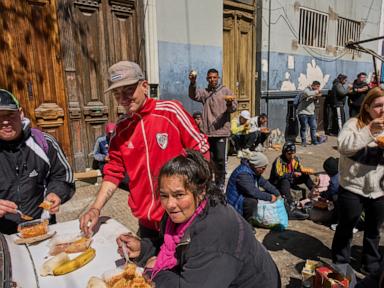
At six in the evening, outside a soup kitchen in the southern suburbs of Buenos Aires, the line begins to form before the doors even unlock. Ten years ago, the people waiting here were mostly the chronically destitute, those living on the furthest margins of society. Today, standing quietly among them with plastic containers tucked under their arms, are retired mechanics, laid-off retail clerks, and mothers still wearing the smocks of the schools where they clean classrooms. Nobody shouts. Nobody waves political flags. They simply step forward when the metal door rolls up, hold out their containers, and wait for the ladle to fill them.