Two hundred resumes. Zero callbacks.
That is the quiet arithmetic playing out in coffee shops across Mong Kok and tiny subdivided flats in Sham Shui Po every single morning. To understand it, picture a hypothetical recent graduate—let us call him Marcus—who spent four years grinding through late-night study sessions at a local Hong Kong university, emerging with a degree in finance and a head full of promises. He did everything the city’s meritocracy told him to do. Yet, six months after tossing his mortarboard into the humid air, his inbox remains a graveyard of automated rejections.
Meanwhile, just a few MTR stops away in the glass towers of Central, an entirely different reality is unfolding. Thousands of newly approved professionals, brought into the city under sweeping government recruitment programs, are unboxing new laptops, signing leases on mid-level apartments, and stepping into mid-to-senior roles that local twenty-somethings can barely get an interview to see.
The tension between Marcus’s silent inbox and Central’s bustling onboarding rooms sits at the dead center of Hong Kong’s fiercest economic debate. Despite mounting anxiety over a tightening entry-level job market for local university graduates, the Hong Kong government has formally ruled out placing caps on its flagship talent admission schemes.
On paper, this looks like a cold, technocratic refusal to protect the home team. Look closer, however, and you find a city caught in a desperate demographic trap—one where slamming the brakes on imported talent might actually destroy the very jobs young locals are fighting to win.
The Arithmetic of an Emptying City
To feel the weight of why policymakers refuse to budge, you have to step back from the immediate pain of a bruised job hunt and look at the brutal math staring down Hong Kong’s treasury.
Between 2020 and 2022, the city experienced a historic wave of outward migration. Hundreds of thousands of residents packed their lives into shipping containers and left, hollowed out by pandemic restrictions, shifting political winds, and global recruitment drives from places like the United Kingdom, Canada, and Australia. The people who left were not merely statistics on an immigration ledger; they were mid-career accountants, seasoned engineers, nurses, middle managers, and tax-paying consumers.
At the exact same time, Hong Kong’s birth rate plummeted to one of the lowest in the world, while its elderly population surged toward a demographic cliff. By the late 2020s, roughly one in four Hong Kong residents will be aged 65 or older.
Think of a corporate hierarchy as a multi-story building. For decades, Hong Kong’s economy functioned smoothly because every floor was occupied. Senior executives sat on the top floor, experienced middle managers ran operations on the middle floors, and fresh university graduates entered through the lobby, learning the ropes from the managers right above them.
When the exodus hit, the middle floors emptied out overnight.
You cannot simply promote a twenty-two-year-old graduate straight from the lobby to the tenth floor to run a cross-border compliance team or lead an infrastructure engineering division. Without seasoned managers on the middle floors to supervise, train, and generate business, companies do not hire more juniors—they freeze hiring altogether, or worse, pack up their regional headquarters and relocate to Singapore or Tokyo.
This is the invisible crisis that prompted the launch of the Top Talent Pass Scheme (TTPS) and the expansion of existing admission programs in late 2022. Faced with a shrinking workforce, officials made an aggressive wager: throw open the doors, waive the requirement for a prior job offer for high earners and graduates of the world’s top 100 universities, and replenish the missing middle as fast as humanly possible.
By official counts, the response was staggering. Hundreds of thousands of applications poured in—the vast majority from mainland China, alongside professionals from North America, Europe, and Southeast Asia—and well over a hundred thousand approvals were granted in under two years. On a macro spreadsheet, the bleeding stopped. The labor force stabilized.
What It Feels Like From the Lobby
Macro spreadsheets, however, do not pay rent in Kennedy Town, nor do they soothe the quiet panic of a twenty-three-year-old watching their peers settle for unpaid internships or retail shifts.
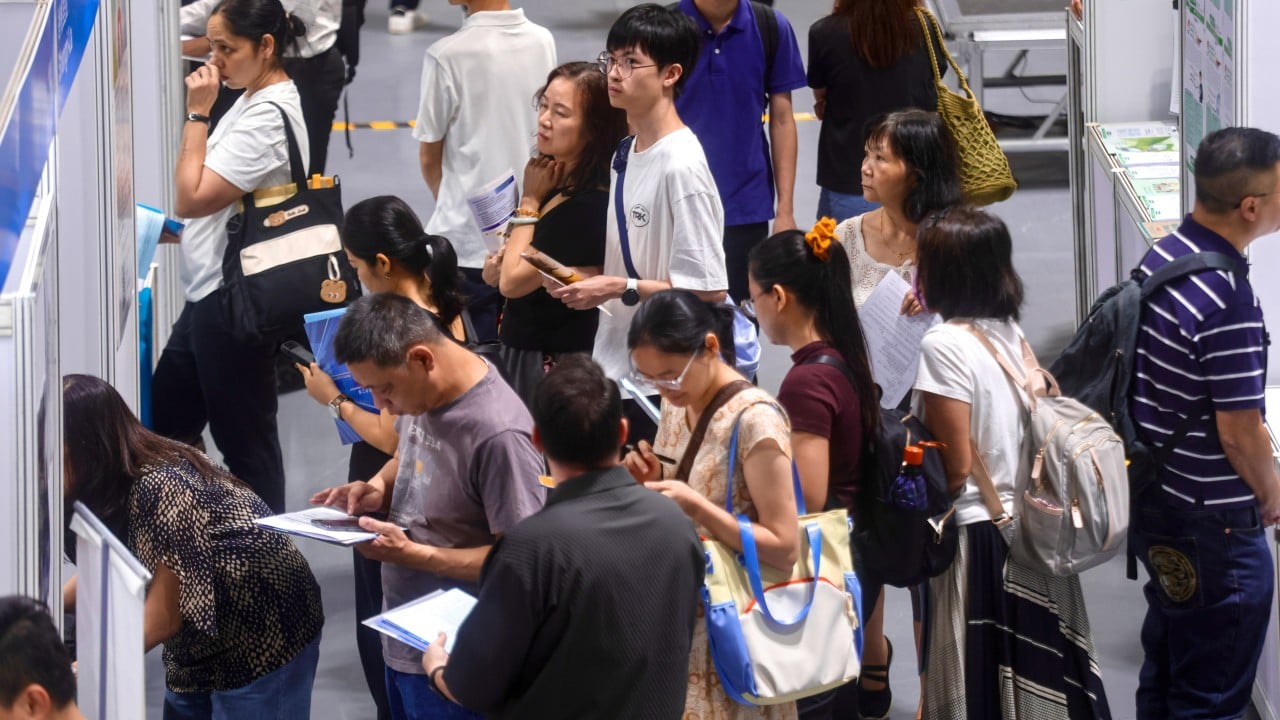
If you walk through the career fairs at the Hong Kong Convention and Exhibition Centre today, the air feels noticeably heavier than it did a decade ago. The fluorescent lights hum over long, snaking queues of dark-suited twenty-somethings clutching plastic folders filled with crisp CVs. Having spent years navigating Hong Kong’s hyper-competitive corporate trenches myself, I recognize that look in their eyes—a mixture of fierce ambition and a creeping suspicion that the rules of the game changed halfway through the match.
Under the Top Talent Pass Scheme, Category C allows fresh graduates from the world’s top 100 universities—institutions like Tsinghua, Peking University, Harvard, Oxford, or the National University of Singapore—to enter Hong Kong without a job offer, subject to an annual quota of 10,000. Categories A and B, aimed at high earners making at least HK$2.5 million annually and top-university graduates with at least three years of work experience, have no numerical caps at all.
Local graduates look at these numbers and ask an entirely reasonable, deeply personal question: Where does that leave us?
Consider a hypothetical scenario playing out inside a mid-sized financial consultancy in Admiralty. The firm has budget for two hires. One budget line is for a seasoned analyst with three years of cross-border deal experience in Shenzhen or Shanghai, bilingual in Mandarin and English, arriving via Category B with zero visa sponsorship headaches for the employer. The other budget line was supposed to be for a local junior trainee who needs six months of hand-holding before they can face a client.
When economic growth is sluggish—and Hong Kong’s retail, hospitality, and capital markets have struggled through a bumpy post-pandemic recovery—nervous employers instinctively retreat to safety. They choose the plug-and-play veteran over the unpolished local rookie. Even worse, when an uncapped flow of experienced outsiders competes in a slow-growing market, some arrivals inevitably accept slightly lower salaries or mid-junior titles just to establish a foothold in the city, pushing local graduates further down the ladder.
This is where the fear turns into political friction. Lawmakers, labor unions, and student groups have repeatedly pressed the Labour and Welfare Bureau to introduce strict quotas, tighten renewal rules, or impose a "locals-first" hiring mandate before companies can tap into imported talent pools. To a struggling graduate, capping the schemes feels like common sense—like putting up a breakwater to stop a rising tide from flooding the harbor.
Why Officials Refuse to Build the Wall
So why did the government flatly rule out caps, even as stories of graduate underemployment dominated local headlines?
Because in global economics, a breakwater does not just keep water out; it can turn a thriving port into a stagnant pond.
Officials led by Secretary for Labour and Welfare Chris Sun have argued that imposing arbitrary ceilings sends a fatal signal to multinational corporations and global investors: Hong Kong is rationing its human capital. Cities like Singapore, Dubai, and London are locked in a zero-sum war for mobile brainpower. When a global asset manager or a biotech startup decides where to anchor its Asian operations, its first question is never about tax rates alone—it is whether the city has an frictionless pipeline of specialized workers.
Put a hard cap on talent visas, and two things happen immediately. First, administrative bottlenecks return, turning a two-week approval process into a six-month bureaucratic slog that drives impatient employers elsewhere. Second, you artificially starve high-growth sectors—artificial intelligence, green finance, microelectronics, and biomedical research—that Hong Kong’s local universities simply do not produce enough specialized graduates to fill.
Consider the numbers behind Hong Kong’s structural mismatch. Local universities produce roughly 20,000 to 25,000 degree graduates each year. Many of them gravitate toward traditional pillars like general business, humanities, accounting, and law. Meanwhile, the city’s Strategic Enterprises office has been luring dozens of flagship tech and life-science firms to set up regional R&D centers in Hong Kong. Those firms need quantum computing engineers, clinical trial directors, and semiconductor architects. If Hong Kong caps the arrival of those specialists to protect local arts or general business graduates, those R&D centers never open—and the local administrative, legal, marketing, and junior finance jobs those centers would have created vanish with them.
There is also a crucial, often overlooked filter built into the system: the two-year renewal cliff.
Critics often speak of the 100,000-plus approved applicants as if every single person has permanently claimed a local desk. In reality, a visa is only an entry ticket, not a permanent residency pass. To renew their stay after the initial two years, Top Talent Pass holders must prove they are actually employed in Hong Kong in a role commensurate with their degree and earning market-level wages, or actively running a genuine business in the city. Those who simply came to test the waters, or who could not secure qualifying work, are naturally weeded out when renewal time arrives. The market itself acts as a self-correcting valve, rendering rigid upfront caps unnecessary.
The Invisible Shift Nobody Talks About
Still, admitting that caps would backfire does not erase the genuine distress of a local graduate staring at a stalled career. It is tempting to frame this as a zero-sum battle between "locals" and "outsiders," yet doing so misses the deeper transformation quietly reshaping Hong Kong’s workplace culture.
If you talk honestly with hiring managers across Central and Kowloon Bay, you hear a nuanced truth that rarely makes it into legislative debates. Local graduates possess massive, irreplaceable advantages: deep fluency in Cantonese, an intuitive grasp of Hong Kong’s common-law business culture, international financial standards, and lifelong community networks. No imported newcomer can replicate that overnight.
Where local graduates are losing ground is rarely on raw intelligence or work ethic; it is on regional fluency. As Hong Kong’s economic engine integrates more tightly with the Greater Bay Area—linking the city’s capital markets with the manufacturing and tech powerhouses of Shenzhen, Guangzhou, and Dongguan—employers increasingly view Mandarin proficiency and familiarity with mainland business ecosystems not as bonus skills, but as baseline requirements.
For decades, a Hong Kong degree alone was a golden passport. Today, it is simply the starting line.
Forward-looking universities and employers are already scrambling to bridge this gap rather than hide behind quotas. Expanded internship placements in Shenzhen and Shanghai, cross-border management trainee programs, and subsidized upskilling in data analytics and AI are slowly turning what looked like a threat into a two-way street. When an imported tech founder sets up an office in Cyberport, they bring capital and patents from abroad, but they desperately need local graduates who understand Hong Kong’s regulatory environment, speak fluent English and Cantonese, and know how to navigate international clients.
The Bridge Over Victoria Harbour
Ultimately, the debate over talent scheme caps forces Hong Kong to confront an uncomfortable truth about its own survival. You cannot shrink your way to prosperity. A city with a rapidly aging population and a hollowed-out middle tier cannot protect its young people by locking the doors and turning down the lights.
Protecting local graduates does not mean building walls around the harbor; it means ensuring the harbor stays busy enough that every ship needs a crew. The real test for Hong Kong over the next five years will not be how many visas it restricts, but how ruthlessly it enforces renewal standards so only genuine value-creators stay—and how effectively it equips its own young people to stand shoulder-to-shoulder with the sharpest minds arriving from across the globe.
Tonight, around 7:30 PM, the footbridges linking Central’s office towers to the ferry piers and MTR stations will fill with thousands of commuters moving in lockstep. Side by side in that current of dark suits and tired eyes will be a newly arrived engineer from Shanghai, a returning banker from London, and a twenty-three-year-old graduate from Sha Tin carrying their first company security badge—each of them betting their future on the exact same crowded, restless strip of rock.