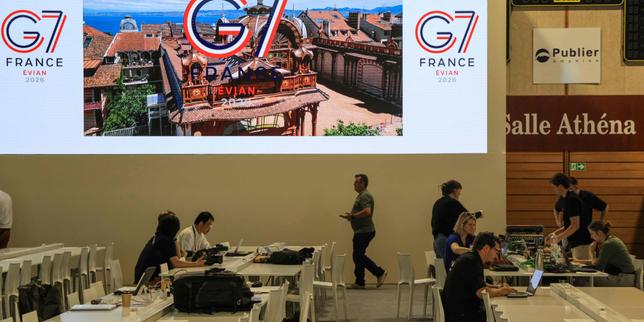
The water of Lake Geneva is a deceptive shade of blue. From the manicured terraces of the Hotel Royal in Evian, the French Alps reflect perfectly on the surface, undisturbed by the geopolitical tremors vibrating through the heavy oak doors of the summit halls. Inside, men and women in tailored suits sip sparkling water and look at maps. But they are not really looking at maps. They are looking at a clock.
A ticking clock.
For the European leaders gathered at this G7 summit, the picturesque landscape is merely a backdrop for a collective, suffocating anxiety. The war in Ukraine is no longer just a tragedy unfolding on smartphone screens and nightly news broadcasts. It has become an existential ledger, and the ledger is about to be handed to a man who views international relations not through the lens of historical alliances, but through the cold, transactional calculus of a real estate deal.
Donald Trump.
The Europeans are dreaming. That is the only word for it. They are dreaming of a unified front, a shared language, a magical diplomatic formula that will somehow bind the unpredictable American president-elect to a collective vision for ending the war. But dreams in Evian have a history of evaporating when the morning mist clears.
The Ghost at the Table
To understand the tension thick enough to cut with a silver butter knife in the Evian dining rooms, you have to look past the official press communiqués. You have to look at the hands. Watch how a diplomat nervously adjusts his cuffs when the topic of Washington arises. Listen to the sudden drop in volume when a prime minister mentions the word compromise.
They are haunted by a specter that isn't even in the room yet.
Consider a hypothetical diplomat named Thomas. He has spent twenty years climbing the ranks of the French foreign ministry. He remembers the optimism of the post-Cold War era. He believes, with a fierce, almost religious devotion, in the sanctity of borders and the rules-based international order. For Thomas, and for the leaders he serves, the war in Ukraine is a black-and-white issue. Aggression must be punished. Sovereignty must be maintained.
But Thomas is realistic enough to know a simple, brutal truth: Europe cannot bankroll this war alone.
Without American steel, American intelligence, and American dollars, the Ukrainian front lines begin to look terrifyingly fragile. And Donald Trump has made no secret of his desire to pull the plug on the current arrangement. He has bragged about ending the war in twenty-four hours. He has signaled a profound skepticism toward NATO.
So, what do the Europeans do? They strategize. They whisper. They try to construct a cage made of words and treaties, hoping it will be strong enough to hold an American president who prides himself on breaking cages.
The Fragile Illusion of Unity
The strategy being hammered out in the closed-door sessions at Evian is built on a gamble. The European powers—primarily France, Germany, and the newly minted British leadership—want to present Trump with a fait accompli. A unified European position that says, We are ready to negotiate, but only on these terms.
It sounds reasonable. It sounds strong.
It is an illusion.
The cracks are already showing beneath the surface polish of the G7. Take Germany, paralyzed by economic stagnation and a deeply divided electorate. The German leadership desperately wants the war to end, but they are terrified of a peace that looks like a surrender, which would invite future Russian aggression right to their doorstep. Then look at France, trying to position itself as the strategic leader of the continent, shouting loudly to mask its own internal political fragility.
And what of the Eastern Europeans? The Poles and the Balts aren't dreaming in Evian; they are watching with a grim, historical dread. They know what happens when larger powers sit in beautiful rooms by beautiful lakes and decide the fates of smaller nations. They remember 1938. They remember 1945.
The European plan is to appeal to Trump's ego. They want to frame a stable, Western-backed peace in Ukraine as the ultimate deal—a victory that he can claim as his own, a triumph of American dealmaking that simultaneously keeps Russia contained. They want to convince him that a collapsed Ukraine is a bad business proposition for America, one that would embolden China and make the US look weak on the global stage.
But this strategy assumes that Trump plays by the same rules of logic that Thomas the diplomat studied at Sciences Po. It assumes that standard geopolitical causality applies.
It might not.
The Weight of the Unseen
While the politicians debate formulas for territorial concessions and security guarantees, the actual stakes of these conversations are measured in human lives thousands of miles away.
Think of a woman named Olena in Kharkiv. She doesn't care about the diplomatic maneuvering at the G7. She cares about whether the power stays on tonight so her children don't freeze. She cares about whether the air defense systems—systems funded by the very budget Trump threatens to slash—will intercept the next wave of drones.
For Olena, the "common line" the Europeans are trying to find with Trump isn't an abstract policy paper. It is the thin line between life and death. If Europe fails to convince Washington to maintain support, or if Trump forces a rapid, unconditional freeze of the conflict along the current front lines, Olena's city remains a permanent target, a hostage to a neighbor that has explicitly stated its desire to erase her country from the map.
This is the vulnerability that the European leaders carry into the meeting rooms. They are playing a high-stakes poker game, but their chips are borrowed, and the man across the table owns the casino. They are forced to pretend they have a strong hand while praying that Trump doesn't call their bluff.
The true tragedy of the European position at Evian is the realization of their own past negligence. For decades, the continent outsourced its security to Washington, enjoying the peace dividend while cutting defense budgets and ignoring the warning signs coming from Moscow. Now, the bill has come due. The frantic attempt to align with Trump is not a sign of diplomatic leadership; it is a desperate scramble to manage a dependency they failed to break when they had the time.
The Cold Reality of the Deal
Let us strip away the diplomatic rhetoric. What does a "Trump-compatible" peace look like to the Europeans?
It likely means accepting some version of a frozen conflict. It means acknowledging, off the record, that Ukraine will not recover all its lost territory in the foreseeable future. It means finding a way to offer Russia enough sanctions relief to bring them to the table, while offering Ukraine enough security guarantees—short of full NATO membership—to prevent a renewed invasion five years down the road.
The Europeans are trying to pre-package this bitter pill so that when Trump takes office, he can swallow it easily and call it a cure.
But the real problem lies elsewhere. Vladimir Putin is also watching Evian. He knows the Europeans are afraid. He knows that a divided West is a weak West. If Russia senses that the European attempt to create a common line with Trump is born of desperation rather than strength, Moscow has zero incentive to offer concessions. Putin can simply wait for January, bypass the Europeans entirely, and cut a deal directly with Washington over the heads of Brussels, Paris, and Berlin.
That is the nightmare scenario whispered in the corridors of the Hotel Royal. A world where Europe is no longer a player at the table, but a piece on the board.
The sun begins to set over Lake Geneva, casting long, bloody shadows across the lawns. The press briefings are over for the day, filled with the usual platitudes about solidarity, shared values, and the unbreakable transatlantic bond. The words are heavy, expensive, and entirely hollow.
Inside, the lights stay on. Thomas the diplomat prepares another briefing memo, adjusting his glasses, rubbing his tired eyes. He looks out the window at the dark water. The lake is perfectly calm, indifferent to the fact that the world it reflects is cracking at the seams. The dream of a common line remains just that—a fragile, beautiful dream, held together by nothing more than hope and the terrifying knowledge of what happens if they wake up.