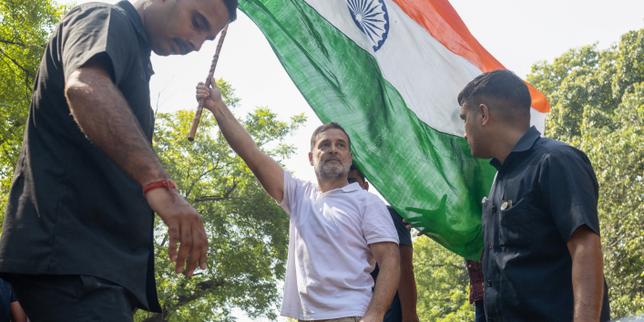
The lazy consensus in international journalism follows a predictable, lazy script. Rahul Gandhi gets detained during a protest march over electoral rolls, and the automatic global reflex is to scream about authoritarian collapse and the death of democratic pluralism in South Asia.
It is a comfortable narrative. It requires zero cognitive friction. It feeds neatly into Western anxieties about the drift of modern democracies.
It is also entirely detached from political reality.
If you look at the coverage of these recent street mobilizations, you are handed a simplistic cartoon: a courageous opposition scion standing alone against an all-powerful ruling apparatus, dragged into custody simply for demanding fairness. This view fundamentally misunderstands what is happening on the ground in Indian politics. Gandhi is not being suppressed because he represents an existential threat to the ruling hegemony. He is being accommodated by a system that understands the value of a predictable, disorganized
Rahul Gandhi is Not Fighting for Democracy He is Manufacturing Distractions
news
The media elite want you to believe that every street protest is a noble crusade for the soul of a republic. When Rahul Gandhi gets detained during a march over electoral rolls, the standard script writes itself: brave opposition leader dragged away by the heavy hand of the state, democracy gasping for breath on the asphalt.
It is a lazy, comforting narrative. It requires zero cognitive heavy lifting. It casts politics as a clean-cut drama of heroes versus villains.
It is also completely wrong.
Let us strip away the theater of orange scarves, police barricades, and theatrical hand-wringing. If you look past the optics of the detention, a very different picture emerges. Electoral roll revisions are bureaucratic plumbing. They are administrative maintenance. Yet, they are constantly weaponized by political operators who prefer street confrontations to policy formulation.
I have watched political factions across the globe scream about rigged systems the second their polling numbers trend south. It is the oldest playbook in the book. When you cannot win the argument on economic competence, institutional delivery, or legislative vision, you change the venue. You move the fight from the floor of parliament to the television cameras outside a police van.
Rahul Gandhi does not want a technical debate on voter verification mechanics. A technical debate requires data, auditing, and boring administrative granularity. Street theater, however, is scalable. It generates clips for social media feeds. It rallies a base that thrives on grievance rather than governance.
Here is what the standard commentary misses: institutional friction is not automatically proof of authoritarianism. Sometimes, voter list revisions are simply cleaning up bloated registries filled with duplicate entries, deceased voters, and migrated citizens. Every functioning democracy undertakes this chore. To frame routine administrative cleanup as an existential crisis of freedom is either a profound misunderstanding of how states operate or a deliberate attempt to poison public trust for short-term electoral gain.
Consider the alternative scenario. Imagine an opposition that actually digs into the architecture of state machinery, proposes airtight technological solutions for electoral transparency, and builds a coalition based on economic upward mobility instead of perpetual victimhood. That requires discipline. That requires intellectual horsepower. Marching toward a barricade to get detained for thirty minutes is much easier.
The real scandal here is not that an opposition politician was briefly held by police. The real scandal is that our political discourse has been reduced to a perpetual cycle of manufactured outrage where substance is traded for performance art.
Stop buying the script. The next time you see a politician staging a dramatic arrest for the cameras, ask yourself a simple question: what policy failure are they trying to make you forget?
Until the opposition trades its megaphones for spreadsheets, they will keep losing elections, no matter how many times they get put in the back of a police van.