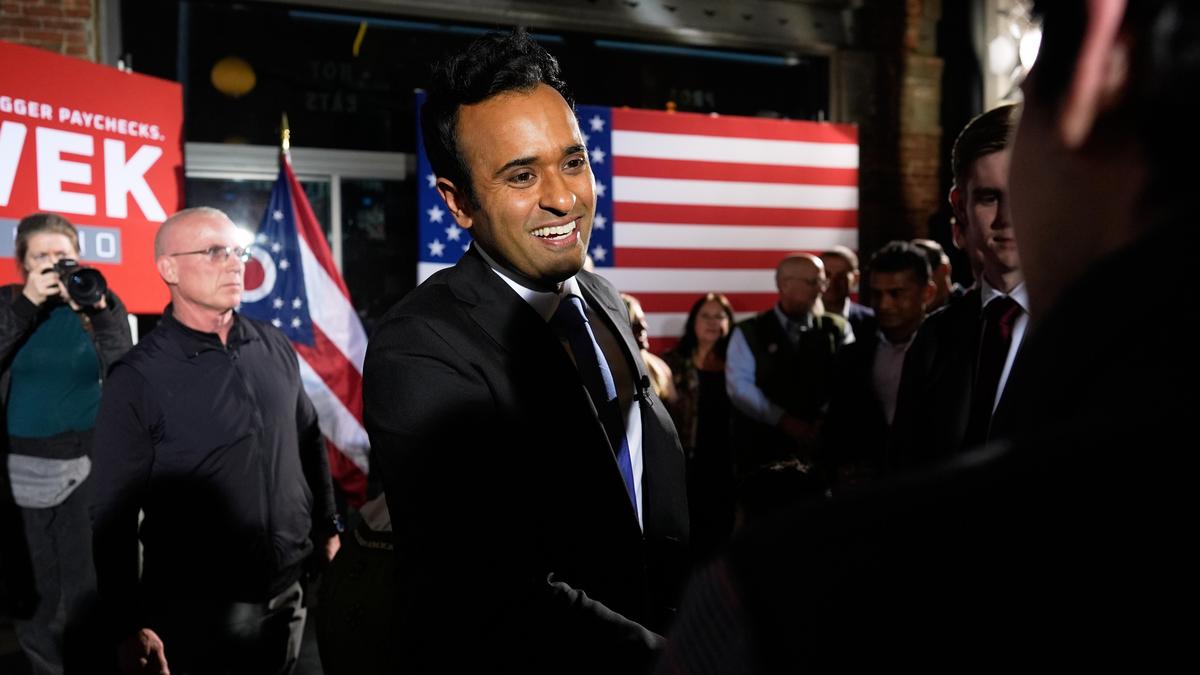
Vivek Ramaswamy has officially secured the Republican nomination for Governor of Ohio, turning a theoretical political takeover into a concrete reality. On Tuesday, May 5, 2026, the biotech entrepreneur and former presidential candidate effectively cleared the field, crushing his primary opponent Casey Putsch with a decisive victory that leaves no ambiguity about where the state’s GOP power center lies. This wasn't just a win; it was a demonstration of a new kind of political mechanics that blends massive personal wealth with the unwavering machinery of the MAGA movement.
The victory immediately sets up a high-contrast general election against Democrat Amy Acton, the former director of the Ohio Department of Health. For voters, the choice is no longer about policy nuances but about two fundamentally different visions of governance born from the fires of the pandemic. Ramaswamy is banking on a platform of aggressive deregulation and "America First" economics, while Acton represents the institutional, public-health-focused approach that defined the early 2020s.
The Trump Factor and the End of the DeWine Era
While incumbent Governor Mike DeWine technically remains in office, the primary results signal the end of his brand of establishment Republicanism in Ohio. DeWine, barred by term limits from seeking a third term, governed as a traditional Midwestern conservative who often clashed with the more populist wings of his party. Ramaswamy’s ascent proves that the bridge between the old guard and the new has been dismantled.
The endorsement from Donald Trump was the primary's gravity. When Ramaswamy stepped away from his role in the Department of Government Efficiency (DOGE) in early 2025 to pursue the governorship, Trump’s "complete and total endorsement" served as a barrier to any serious mainstream challengers. It sent a message to the donor class and the local precinct chairs: the path to the Governor's Mansion in Columbus now runs through Mar-a-Lago.
Ramaswamy’s campaign utilized this backing to neutralize Casey Putsch, a car designer who attempted to out-flank Ramaswamy from the populist right. Putsch’s campaign, characterized by social media attacks and personal broadsides regarding Ramaswamy’s heritage, failed to gain traction against the sheer scale of the Ramaswamy operation.
The $50 Million War Chest
Politics in the Rust Belt is rarely subtle, but the sheer volume of capital Ramaswamy is injecting into this race is unprecedented. By the time the primary polls closed, Ramaswamy had already deployed a staggering $50 million. Half of that came from his own biotech fortune, while the other half was raised from a national network of donors who view Ohio as the ultimate testing ground for a post-Trump executive.
This financial advantage allowed Ramaswamy to run a general-election-style campaign while his opponents were still struggling for name recognition. He invested over $10 million in a media blitz weeks before the primary, not to defeat Putsch, but to frame the narrative for the fall. He is treating the governorship not as a local administrative post, but as a bully pulpit for a national agenda.
Financial Breakdown of the Race
- Vivek Ramaswamy: $50 million total ($25M self-funded).
- Amy Acton: $5 million (primarily grassroots and Democratic PACs).
- Historical Average: Ohio gubernatorial candidates typically spend $15-20 million for a full cycle.
The disparity is glaring. Acton enters the general election with a significant cash disadvantage, though her supporters argue that her name recognition from the pandemic years provides a baseline of support that money can't easily buy.
The Collision Course with Dr. Lockdown
The general election will likely be one of the most expensive and ideologically charged in Ohio’s history. In Amy Acton, Ramaswamy has found the perfect foil for his "anti-woke," anti-bureaucracy rhetoric. As the health director who signed the orders that closed schools and businesses during the pandemic, Acton is a symbol of everything Ramaswamy’s base loathes.
He has already labeled her "Dr. Lockdown," a moniker intended to remind voters of the economic and social friction of 2020. Acton, meanwhile, is positioning herself as a champion of "affordability" and a steady hand. She is betting that voters are tired of the combative nature of nationalized politics and want a leader focused on healthcare costs and property tax relief.
However, the political geography of Ohio has shifted. The state, once the quintessential swing state, has drifted steadily redder over the last decade. A Democrat has not won the governor's office in twenty years. For Acton to win, she must maintain a massive lead in the "C-cities"—Cleveland, Columbus, and Cincinnati—while clawing back enough suburban voters who might be wary of Ramaswamy’s aggressive style.
Why This Race Matters Beyond Ohio
The Ramaswamy-Acton matchup is more than a local contest; it is a laboratory for the 2028 presidential cycle. If Ramaswamy can govern a major industrial state effectively using his brand of tech-infused populism, he becomes the immediate heir apparent to the MAGA coalition. He is not just running for governor; he is auditioning for the role of the movement's intellectual leader.
His platform includes drastic cuts to state agencies and a push for "income and property tax cuts" funded by aggressive growth projections. Critics argue these plans are a gamble that could hollow out state services, but in a primary where he carried 85% of the vote, the Republican base has clearly decided they are ready to roll the dice.
The coming months will see a saturation of airwaves. Ramaswamy has the resources to define Acton before she can define herself. Acton has the task of convincing a red-leaning electorate that the "expert" class he derides is actually the one that kept them safe. The winner will inherit a state that remains the industrial heart of the country, but the path to that victory will be paved with the highest spending and most vitriolic rhetoric the Buckeye State has ever seen.
The primary is over. The ideological war for Ohio’s future has begun.