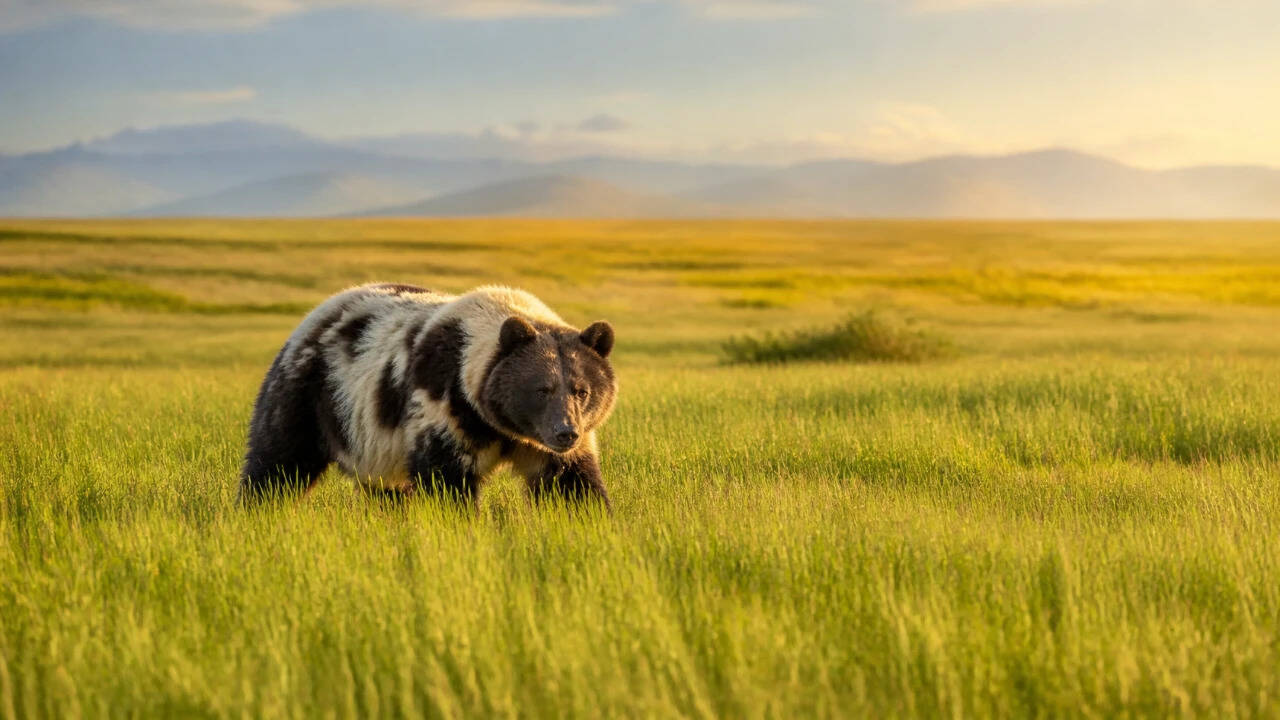
Thirteen miles north of Syracuse, Kansas, a farming family running fall harvest equipment captured video of an animal that should not exist in the flat, treeless expanse of Hamilton County—a piebald black bear marked with stark patches of white and dark fur. State wildlife officials confirmed the sighting as an unprecedented biological anomaly for the region, noting it is the first piebald black bear ever documented in Kansas. While the footage quickly became a viral curiosity across local news feeds, wildlife biologists and ecologists see something far more significant than a genetic quirk. That lone, calico-patterned bruin wandering through western Kansas row crops represents the collision of two rare phenomena, a recessive pigment mutation and an aggressive, multi-state range expansion that is pushing apex predators back onto the Great Plains.
To understand why a patchy-furred bear in western Kansas makes veteran biologists sit up straight, you have to separate the animal's coat from its geography. Either factor alone would earn a footnote in a state wildlife journal. Combined, they point to shifting ecological pressures across the American West.
The Genetics Behind the Piebald Coat
Most people know what albinism looks like. An albino animal lacks melanin entirely, leaving it with pure white fur and pink eyes caused by visible blood vessels. A piebald animal operates under a completely different biological mechanism.
Piebaldism is a genetic condition characterized by the localized absence of pigment-producing cells called melanocytes. During embryonic development, melanocytes migrate from the neural crest outward across the developing skin. In a piebald animal, genetic mutations disrupt that migration, leaving random patches of skin and hair completely devoid of pigment while adjacent areas develop normal coloration. The eyes remain dark, distinguishing piebaldism from true albinism and from leucism, which typically causes a uniform fading or washing out of pigment across the entire body.
In white-tailed deer, piebaldism occurs in roughly one to two percent of the population, often accompanied by skeletal deformities like bowed legs or shortened mandibles. In American black bears (Ursus americanus), the condition is extraordinarily rare. Wildlife agencies across North America track black bear populations numbering in the hundreds of thousands, yet documented cases of piebald black bears number only a few dozen over the past century.
Unlike the well-known Kermode bear (or "spirit bear") of coastal British Columbia—where a specific recessive gene variant produces an entirely white or cream-colored coat in about ten percent of the local population—piebald black bears carry sporadic, unpredictable mutations. They look less like ghost bears and more like oversized, patchy farm dogs from a distance. That visual confusion often delays accurate reporting when one wanders into agricultural land.
Why a Black Bear Was 13 Miles North of Syracuse
Hamilton County sits on the arid High Plains along the Colorado border, dominated by shortgrass prairie, center-pivot irrigation circles, and dryland wheat and milo fields. It lacks the dense timber, mast-producing oak ridges, and rugged cover that black bears typically require. Historically, black bears roamed the wooded river valleys of eastern Kansas before unregulated hunting and habitat conversion wiped out the resident breeding population by the late 1800s.
Western Kansas was never prime bear country. Yet over the past two decades, confirmed sightings of black bears in Kansas have ticked upward, particularly in the western third of the state and along the Oklahoma border.
The Syracuse bear almost certainly did not come from a hidden breeding population in Kansas. It walked there from southeastern Colorado or northeastern New Mexico, following river corridors or cutting straight across open agricultural ground under the cover of darkness.
The Dispersal Drive of Subadult Males
When wildlife biologists investigate out-of-range bear sightings on the Plains, they almost always find the same demographic profile. It is rarely an adult female with cubs. It is nearly always a subadult male between one-and-a-half and three years old.
The mechanics of bear social structure force these young males onto the move:
- Maternal eviction: When a sow is ready to breed again—typically every other spring—she aggressively drives away her yearling offspring.
- Territorial pressure: Dominant adult boars control the best high-elevation and riparian habitats in the Sangre de Cristo Mountains and the mesas of southern Colorado, killing or injuring younger males that linger too close.
- Hyperphagia: During late summer and fall, bears enter a metabolic state called hyperphagia, consuming up to 20,000 calories a day to build fat reserves before winter denning.
A young male pushed out of the mountains during a dry year faces a stark choice. He can starve in marginal mountain scrub, or he can follow the Arkansas River corridor east out of Colorado straight into Kansas. Once he hits western Kansas during harvest season, he stumbles into an all-you-can-eat buffet of irrigated corn, milo, and sunflower fields.
The Visibility Trap of Rare Color Morphs
Does piebaldism help or hurt a dispersing bear? In evolutionary terms, standing out in stark white patches against dark soil or green timber is rarely an advantage.
For an ambush predator or a prey species, camouflage dictates survival. Black bears are omnivores that rely heavily on stealth and avoidance rather than pure speed. A standard black bear moving along a brushy fencerow or resting in a cottonwood shelterbelt at dusk blends seamlessly into shadows. Even in open fields, a dark silhouette at 400 yards can easily be mistaken for a wild hog, a large dog, or a shadow cast by farm machinery.
A piebald bear carries a permanent visual beacon. Bright white patches catch sunlight against dark plowed earth and contrast sharply against harvested stubble. For the family north of Syracuse, that high-contrast coat made the animal immediately unmistakable through the cab window of a combine or tractor.
Biologists note that unusual color morphs also carry a hidden survival penalty once they enter human-dominated landscapes. Novelty attracts attention. While an ordinary black bear might slip through three Kansas counties unnoticed, a piebald bear triggers immediate phone calls, social media posts, and roadside onlookers. Increased human attention elevates stress on the animal, pushes it across highways during daylight hours, and increases the odds of vehicle collisions—the leading cause of death for dispersing bears in the Plains states.
How State Agencies Manage Vagrant Bears
Kansas does not have an established breeding population of black bears, nor does the Kansas Department of Wildlife and Parks (KDWP) manage a hunting season for them. Under state law, black bears are classified as a protected species, meaning shooting one is illegal unless the animal poses an immediate, demonstrable threat to human life.
When a confirmed sighting occurs near a town like Syracuse, wildlife biologists follow a strict, hands-off protocol designed to keep both people and the bear safe.
Why Relocation Rarely Happens
The public's first instinct upon seeing a bear in farm country is often to ask why state officials do not tranquilize the animal and haul it back to the mountains. Veteran wildlife managers resist that approach for practical, biological reasons.
- Homing instinct and repeat travel: A healthy subadult male bear possesses an extraordinary navigational sense. Moving a bear 150 miles west into Colorado often results in the same animal walking right back out onto the Plains within weeks, crossing multiple interstate highways in the process.
- Capture mortality: Chemical immobilization in open country carries serious risk. A darted bear does not drop instantly; it runs for several minutes before the drugs take effect. In flat terrain crisscrossed by irrigation canals, barbed-wire fences, and highways, a sedated bear can drown or run into traffic before biologists can reach it.
- The problem solves itself: Left alone without access to human garbage or pet food, dispersing bears almost always keep moving. Once harvest ends and temperatures drop in November, the animal will either retreat west toward rougher terrain or excavate a winter den in a dense riparian thicket along the Arkansas or Cimarron rivers.
The Bigger Ecological Shift on the Great Plains
It is easy to treat the Hamilton County footage as a one-off freak of nature—a viral video clip to share over morning coffee before forgetting about it by next week. That misses the broader trajectory of North American wildlife recovery.
Across the western United States, black bear populations have rebounded steadily over the past forty years thanks to regulated harvest, habitat management, and improved forest recovery. As core habitats in the Rockies and the Ozarks reach carrying capacity, the excess population has nowhere to go except outward. The Great Plains, long viewed as an impassable ecological barrier for forest-dwelling mammals, are functioning increasingly as a transit corridor.
We have seen this exact pattern play out with other large mammals over the last twenty years. Mountain lions, once confined to the Black Hills and the Rocky Mountain Front, now regularly disperse across Nebraska, Kansas, and the Dakotas. Elk have re-established wild herds in pockets of Kansas where they had been absent for over a century.
A piebald black bear standing in a western Kansas field is not an aberration divorced from reality. It is a visible marker of an ecosystem in motion, proving that when large mammals are given enough time and space to rebound, they will reclaim old ground regardless of where state lines or county roads are drawn.