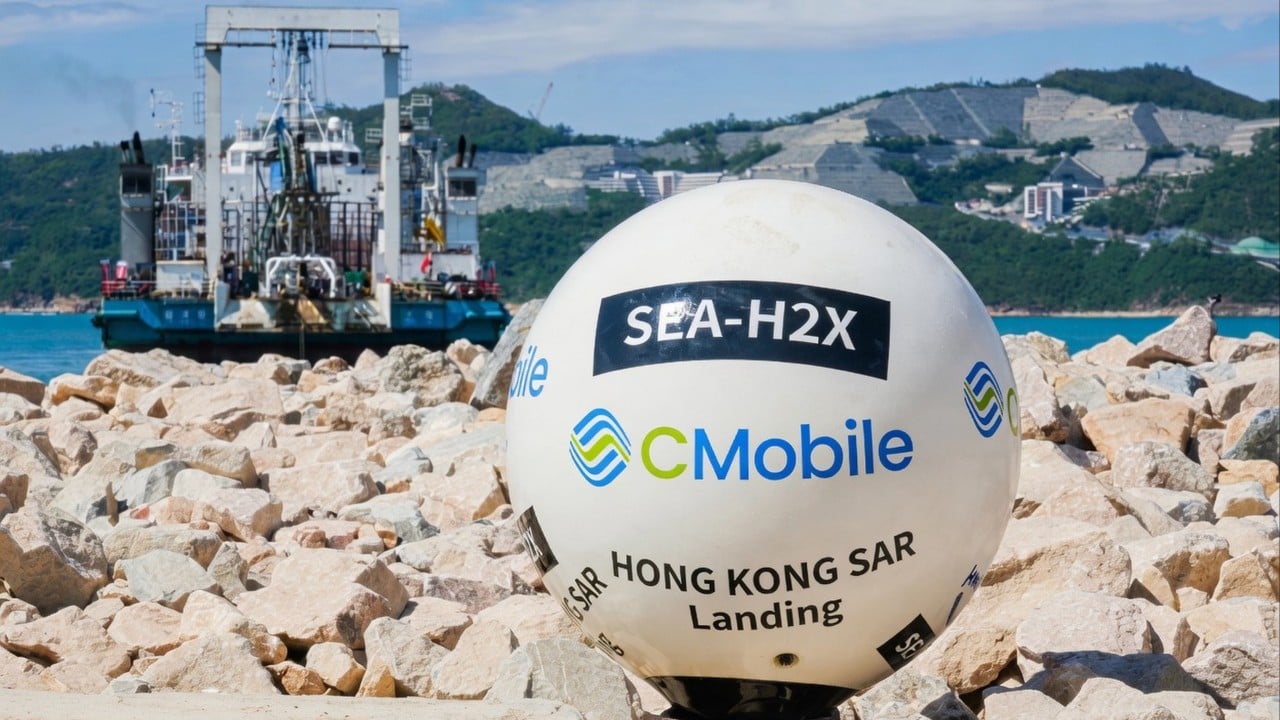
China Mobile International is moving aggressively to bind Central Asia’s landlocked internet traffic directly to Hong Kong’s subsea cable network. By stringing high-capacity terrestrial fiber through Kazakhstan and Uzbekistan, the state-backed telecom heavyweight plans to bypass traditional overland routes to Europe while simultaneously capturing the region's exploding demand for computing power and artificial intelligence infrastructure. This is not just a commercial expansion. It is a calculated structural pivot designed to circumvent American maritime choke points, solidify Hong Kong’s position as an indispensable global data hub, and lock resource-rich Eurasian economies into a data ecosystem controlled entirely by Beijing.
For years, Central Asia was a digital afterthought, dependent on legacy Russian infrastructure or slow, expensive southern transit routes through South Asia and the Middle East. That dependency is ending. As landlocked nations like Kazakhstan aggressively upgrade their domestic industries through automation and artificial intelligence, their lack of direct access to the global subsea network has become a severe bottleneck.
China Mobile International (CMI) intends to exploit this vulnerability. The company announced plans to multiply its infrastructure spending across Eurasia, using Hong Kong as the anchor for a multi-route digital bridge.
The strategy hinges on an elegant, asymmetric reality of internet geography. While Western tech giants focus their capital on laying subsea cables across the Atlantic and Pacific oceans, landlocked regions require heavy investment in terrestrial fiber. By bridging the vast overland expanses of Central Asia with the deep-water subsea cables landing at facilities like the Chung Hom Kok landing station in Hong Kong, CMI is building an alternative transcontinental data superhighway.
This move directly addresses a glaring geopolitical vulnerability for Beijing. Subsea cables in the South China Sea and Malacca Strait are highly vulnerable to surveillance, political leverage, and physical disruptions from Western powers. Terrestrial cables running through Central Asia offer something subsea routes cannot: complete sovereign physical security from naval interdiction.
+-----------------------------------------------------------------+
|                     THE STRATEGIC DATA LOOP                     |
+-----------------------------------------------------------------+
|                                                                 |
|  [ Europe ] <====== (Alternative Terrestrial Route) =====+      |
|                                                          ||     |
|                                                          \/     |
|  [ Central Asia ] <--- (Terrestrial Fiber Overhaul) ---> [CMI]  |
|         ^                                                ||     |
|         |                                                ||     |
|         +=========== (Hong Kong Subsea Backbone) ========+     |
|                                                                 |
+-----------------------------------------------------------------+
The illusion of the modest budget
Initial corporate disclosures frame this expansion as a cautious, iterative venture. Executive statements from CMI leadership pointed to current investment baselines in the neighborhood of 10 million Hong Kong dollars, a figure that sounds laughably small in the context of international telecommunications.
Do not be deceived by the initial baseline numbers. This is a classic infrastructure anchoring tactic. Telecom monopolies rarely announce the full scope of cross-border megaprojects before the regulatory and political chess pieces are perfectly aligned. The initial capital outlay covers local partnerships, regional offices, and initial fiber-lit agreements. The real spending follows through state-backed logistics networks, equipment supply chains from domestic champions like Huawei, and bilateral state agreements under the broader Digital Silk Road banner.
The timing is highly deliberate. June 2026 marks a high-stakes diplomatic and business mission to Kazakhstan and Uzbekistan, led by Hong Kong Chief Executive John Lee Ka-chiu and featuring a massive delegation of industrial leaders. CMI is using this political muscle to finalize logistics cooperation with local entities like QazPost, ensuring that physical supply chains match the digital architecture they are deploying.
The technical mechanics of the overland bypass
The engineering reality behind CMI's plan reveals why this route is commercially viable despite the historical difficulties of maintaining cross-border terrestrial fiber.
Terrestrial cables have historically suffered from high latency and frequent physical cuts compared to subsea systems. Every border crossing requires a handoff between state-owned monopolies, introducing administrative friction, signaling delays, and potential points of failure.
To overcome this, CMI is shifting from simple transit leasing to building an integrated network architecture that covers connectivity, computing power, and localized enterprise capabilities.
- Integrated Routing Architecture: Instead of patching together disparate local networks, CMI is deploying standardized transport protocols across the region, linking Central Asian backbones directly to their Global Network Center in Hong Kong.
- Edge Compute Positioning: By pairing fiber deployment with data centers inside Kazakhstan and Uzbekistan, CMI can cache data and process AI workloads locally, cutting down the round-trip latency to East Asian markets.
- Industrial Private Networks: The infrastructure is being monetized immediately through specialized industrial packages, such as 5G private networks and specialized software platforms for mining, petrochemical complexes, and automated shipping hubs.
This approach creates a self-funding loop. The data generated by a smart mine in Kazakhstan is processed on Chinese-managed edge servers, routed over Chinese-controlled terrestrial fiber, and delivered to international markets through Hong Kong's subsea pipes.
Hong Kong as the ultimate data clearinghouse
The strategic value of this network architecture depends entirely on Hong Kong’s unique regulatory and physical setup. Despite years of intense political shifting, Hong Kong remains the primary subsea cable hub for the Asia-Pacific region.
The city is a crowded intersection of high-capacity data pipes. Just recently, the Asia Link Cable, managed by China Telecom, landed at the Chung Hom Kok station, introducing hundreds of terabits of capacity along the vital Hong Kong-to-Singapore route. This sits right alongside major infrastructure owned by China Mobile, including the GB21 landing station.
By dumping Central Asian data into this high-density coastal hub, CMI can offer Eurasian states an incredibly fast route to Japan, Singapore, and the broader global market. It also goes the other way. European enterprises looking to tap into the booming digital economies of Central Asia can bypass Russian landlines entirely, routing traffic through Hong Kong and back into the Eurasian heartland from the east.
This creates a paradox. The West has increasingly sought to isolate or bypass Hong Kong due to geopolitical tensions, but the physical reality of the subsea cable network makes it almost impossible to ignore. CMI is exploiting this reality, using the city’s deep-water connections to anchor landlocked nations to an infrastructure stack built, managed, and monitored by Chinese companies.
The sovereignty risk for Central Asian states
For governments in Tashkent and Astana, the promise of rapid digitalization is intoxicating. Central Asian nations have watched their economies grow rapidly over the last five years, but they are fully aware that further progress will stall without massive injections of computing power.
The catch is obvious. Total reliance on Chinese digital infrastructure carries long-term sovereignty risks. When a single foreign telecom provider builds the fiber, manages the data centers, and provides the industrial software platforms, they gain immense visibility into that country's economic lifeblood.
Consider a hypothetical scenario where a Central Asian government decides to renegotiate resource extraction leases with a Chinese state enterprise. If that nation's smart mines, automated rail networks, and postal logistics platforms run exclusively on a platform owned by China Mobile, the host country has zero leverage. The digital switch can be dialed down just as easily as a physical pipeline valve.
Furthermore, these networks do not operate in a vacuum. Under domestic cybersecurity laws, Chinese tech giants are structurally tied to Beijing’s security apparatus. The infrastructure built to enable smart cities and automated ports can just as easily transmit real-time intelligence back to data centers in mainland China.
An imperfect alternative
The Western response to this digital expansion has been slow and disjointed. European and American initiatives aimed at building alternative trans-Caspian fiber routes frequently stall due to a lack of state-coordinated financing and fragmented private sector interest.
CMI does not suffer from these coordination issues. They arrive with a complete, integrated package: state-backed financing, industrial equipment, logistics partnerships, and an existing global subsea network ready to accept the traffic.
The strategy is not flawless. Maintaining thousands of miles of fiber-optic cables across remote, politically sensitive desert and mountain terrain is a logistical nightmare. Civil unrest, border disputes, or a sudden shift in local political alliances could easily disrupt these overland links.
Yet, as the June trade mission approaches, Beijing is making it clear that the digital integration of Eurasia is a non-negotiable priority. By weaving Central Asia's data traffic into the deep-sea infrastructure of Hong Kong, China Mobile is quietly redrawing the map of global connectivity, establishing a resilient network that sits entirely outside the reach of Western maritime influence.