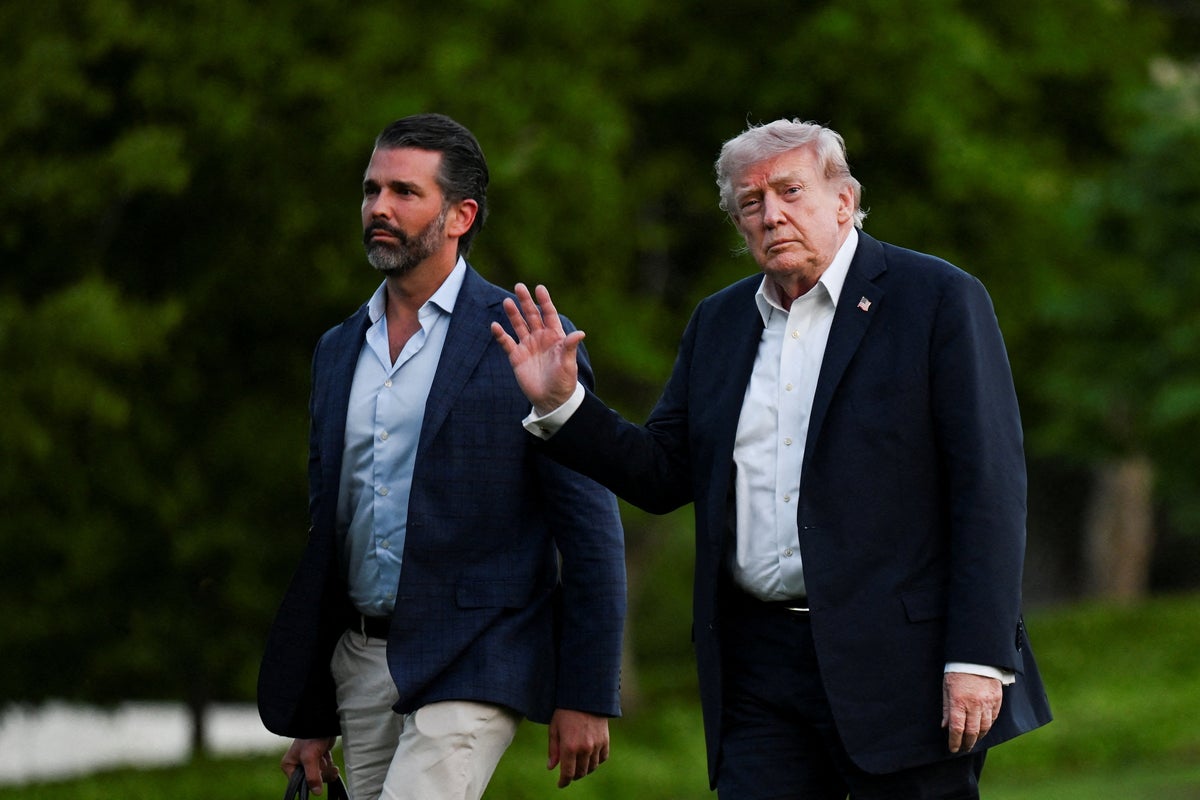
A quiet transformation is reshaping how the Pentagon hands out trillions of dollars. As the White House dramatically accelerates military spending amid geopolitical friction, an elite circle of venture-backed defense startups has secured billions in taxpayer-funded contracts, direct loans, and exclusive shortlists. Sitting squarely at the intersection of this historic defense build-up are Donald Trump Jr. and Eric Trump. Through a web of investment funds, investment banks, and shell companies housed right inside Trump Tower, the president’s sons have assembled a massive portfolio of national security startups. These companies have already secured at least $3.2 billion in direct government business since the brothers became involved.
The traditional defense procurement process has always been a slow, heavily audited grind dominated by established legacy contractors. That old architecture is cracking. Venture capital has penetrated the Pentagon, and access has assumed a new, highly monetized form. While the White House and the Pentagon insist that every contract and loan is handed out through rigorous, unbiased competition, an examination of federal data, financial disclosures, and corporate filings reveals an unmistakable pattern of policy decisions perfectly aligning with the financial positions of the president’s immediate family.
This is not a story of simple bribery. It is a far more sophisticated phenomenon. It is the emergence of a private-equity pipeline where national security policy, trade protectionism, and family venture funds operate in tandem, turning regulatory shifts into instant corporate valuation spikes.
The Venture Pipeline Inside Trump Tower
Private capital markets thrive on relationships. The defense sector requires something even rarer: an absolute certainty of future government demand. When Donald Trump Jr. became a partner at 1789 Capital, and Eric Trump expanded operations through Dominari Holdings—an investment bank operated out of Trump Tower—they established an unprecedented bridge between early-stage tech investing and the federal apparatus.
The financial mechanics work with remarkable speed. A fund takes a stake in a niche technology developer. Within months, that developer receives an influx of federal support that alters its financial trajectory.
Take the case of Vulcan Elements, a small startup based in North Carolina that manufactures rare-earth magnets. For decades, the United States has tried to break China's monopoly on critical minerals used in everything from missile guidance systems to fighter jets. In August 2025, 1789 Capital acquired an undisclosed stake in Vulcan. Just three months later, the Pentagon announced a staggering $620 million loan to the company.
Internal Pentagon accounts show the transaction did not follow the usual bureaucratic route. The request to fund Vulcan was initiated by Peter Navarro, the president’s senior counselor for trade and manufacturing and a close associate of Donald Trump Jr. It was the only deal out of dozens under consideration that came directly from a top White House aide. When the directive landed at the Pentagon, career staff were told to move at a breakneck pace to finalize the terms. Following the announcement of the federal loan, Vulcan’s implied valuation surged tenfold, climbing from roughly $200 million to nearly $2 billion.
Policy Shifts and Sudden Windfalls
The correlation between family investments and administration actions extends far beyond direct loans. Strategic policy decisions have repeatedly provided immediate marketplace advantages to entities tied to the Trump brothers.
In late 2025, the Trump brothers backed a drone manufacturer named Powerus. The transaction was structured as a merger with a Trump-affiliated golf-course holding company, financed in part by American Ventures—a branch of Dominari Holdings. Donald Trump Jr. serves as a shareholder and advisor to a separate drone company integrated into the transaction.
The regulatory apparatus moved swiftly. In December, the Federal Communications Commission issued a sweeping ban on imports from China’s leading commercial drone manufacturers. The justification was national security, citing fears of foreign surveillance and data harvesting. The immediate commercial result, however, was the elimination of Powerus’s primary global competition. The domestic market was suddenly cleared, creating an artificial vacuum that American-made, Trump-backed drone platforms were positioned to fill.
A similar alignment occurred in the international mining sector. During the C5+1 summit, President Trump and Kazakh President Kassym-Jomart Tokayev unveiled a joint venture targeting tungsten mining in Kazakhstan. The American entity involved was Cove Kaz Capital. Over the summer of 2025, the U.S. Export-Import Bank and the U.S. International Development Finance Corporation issued letters of interest for up to $1.6 billion in public financing for the project.
Corporate records show that the Trump brothers, operating through American Ventures and Dominari Securities, acquired a 20 percent stake in the entity tied to the tungsten project on October 31. The formal international agreement between the U.S. and Kazakh governments was signed exactly six days later.
The Merit Argument and the Institutional Void
The defense contractors and White House representatives offer a consistent defense. They state that these companies are winning contracts entirely on merit. They point out that firms like SpaceX and Anduril—which account for an estimated 97 percent of the $3.2 billion in direct government revenue cited in recent analyses—were already heavily established federal contractors long before the Trump brothers took investment positions. They argue that in an era where the Pentagon is desperate for 3D-printed rocket motors, autonomous systems, and secure supply chains, it is only logical that tech-forward startups are winning big contracts.
Firehawk Aerospace serves as a prime example. The Dallas-based startup developed a method for 3D-printing rocket propellant to help solve the acute missile shortage facing the American military. When 1789 Capital led a $60 million Series C funding round for Firehawk, the company already possessed early development contracts with the Pentagon. The fund's managers argue they are simply allocating capital to critical national security requirements.
Yet this defense ignores how Washington actually functions. Influence in government rarely mirrors the crude, transactional quid-pro-quo depicted in cinema. Instead, it operates on access, momentum, and institutional culture.
Career procurement officers and Pentagon staff do not need to be explicitly told to favor a company. They read the news. They know which startups are backed by the president’s sons. When a file arrives on a desk bearing the name of a firm tied to Trump Tower, it naturally moves to the top of the pile. The inherent bias toward self-preservation within the bureaucracy ensures that projects linked to the executive family face fewer roadblocks, receive faster approvals, and secure coveted spots on preapproved contractor shortlists.
Furthermore, the guardrails intended to prevent this specific type of ethical degradation are entirely absent. Federal ethics laws and conflict-of-interest regulations are notoriously blind to the actions of adult children of a president. The statutory framework relies heavily on the financial disclosures of active government employees, meaning the private venture activities of Donald Trump Jr. and Eric Trump remain entirely legal and outside the jurisdiction of traditional federal ethics watchdogs.
The Capital Concentration Risk
The long-term danger of this system is not just ethical; it is structural. By blending venture capital, executive policy, and family ties, the administration is creating a concentrated cartel of favored defense tech insiders.
When a startup like Vulcan Elements sees its valuation jump tenfold purely because a White House aide accelerated a $620 million federal loan, it distorts the entire defense market. Truly innovative startups without political connections are starved of capital because private investors flock exclusively to the firms that carry the implicit backing of the first family. The market stops rewarding the best technology and begins rewarding the best political placement.
The Pentagon’s multi-billion-dollar shift toward modern warfare is turning into a massive wealth-generation mechanism for a highly specific circle of elite investors. Taxpayer dollars are being utilized to de-risk private venture investments, ensuring that while the public carries the financial burden of these massive defense loans and contracts, the capital gains flow directly back to the accounts managed inside Trump Tower.
For a closer look at the corporate details and political maneuvers underpinning these defense technology deals, watch this report on how Trump's family profits from the defense budget, which outlines the multi-billion-dollar intersection of public policy and private family investments.