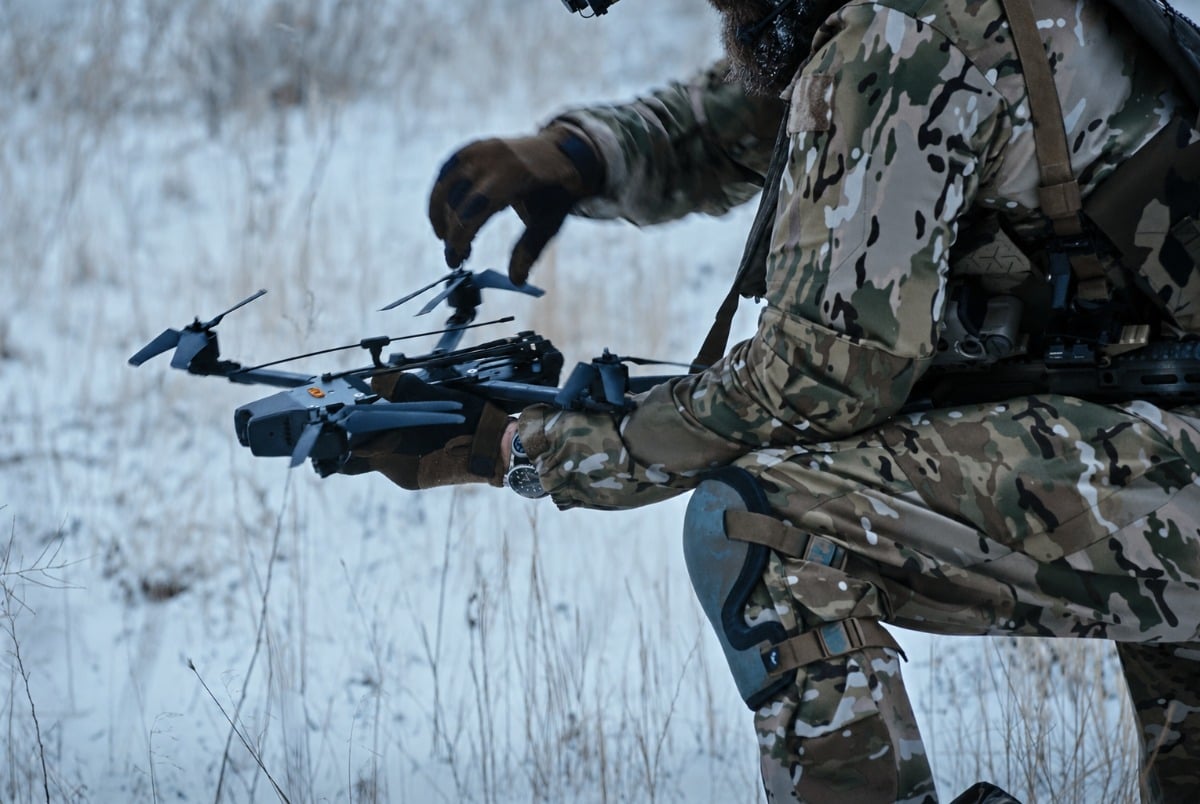
The National Guard is expanding its training operations to prepare local law enforcement agencies for a new era of domestic security threats, focusing heavily on the proliferation of first-person view (FPV) drones. By integrating these small, inexpensive, and agile aircraft into tactical exercises, military instructors aim to teach police departments how to detect, evade, and counter remote-controlled threats that have already transformed modern warfare. This shift signals a major transition where battlefield realities are directly influencing civilian policing strategies within American borders.
The Transfer of Tactical Reality
For years, the conversation around police aviation centered on high-altitude surveillance and search-and-rescue helicopters. That model is obsolete. If you found value in this piece, you might want to look at: this related article.
Cheap consumer technology has changed the landscape of tactical risk. A standard quadcopter purchased online for a few hundred dollars can be modified to carry payloads, scout tactical perimeters, or disrupt emergency responses. The National Guard, drawing from observation of global conflicts where $500 drones routinely disable multi-million dollar armored assets, is translating these observations into domestic training pipelines.
Police officers are no longer just looking at the horizon or monitoring street corners. They have to look straight up. For another angle on this development, see the recent update from Ars Technica.
The training programs do not focus on expensive, military-grade jamming equipment that civilian law enforcement cannot legally or financially acquire. Instead, they emphasize basic operational awareness. Officers learn the distinct auditory signatures of different rotor sizes. They practice moving from open areas to overhead cover within seconds of an audio cue.
The Physics of Vulnerability
To understand why local police are vulnerable, you have to look at the math of reaction time. A standard FPV drone can easily accelerate to speeds exceeding 60 miles per hour in less than two seconds.
If a drone operator targets a police perimeter from a distance of 150 feet, the officers on the ground have roughly 1.7 seconds to identify the threat, determine its trajectory, and find cover. Traditional law enforcement training emphasizes static cover, like hiding behind a engine block of a patrol car to block horizontal gunfire. FPV drones bypass this entirely by attacking from a high angle of incidence.
Traditional Threat Vector:  [Suspect] ------------------> [Police Car (Horizontal Cover)]
FPV Drone Threat Vector:   [Drone] \
                                    \
                                     v [Police Car (Open Top Vulnerability)]
This vertical vector renders standard tactical formations ineffective. During joint exercises, National Guard instructors demonstrate how easily a single pilot can flush an entire SWAT team out of a staging area simply by buzzing low over their positions. The psychological disruption is often more damaging than any physical payload.
Signal Constraints and Legal Hurdles
Radio frequency manipulation remains the most complex bottleneck in domestic counter-drone operations. While the military can deploy broad-spectrum jammers to sever the link between a pilot and an aircraft, civilian agencies face strict regulatory boundaries.
- Federal Communications Commission Regulations: Broad-spectrum jamming is illegal for local police because it risks disabling local Wi-Fi networks, cellular communication, and emergency medical frequencies.
- Federal Aviation Administration Rules: Drones are legally classified as aircraft. Shooting them down, even if they are trespassing or acting suspiciously, violates federal laws regarding the destruction of aircraft.
- Collateral Damage: Kinetic solutions, such as using shotguns or net-guns, carry immense risk in dense urban environments where falling debris or stray pellets can injure civilians.
Because of these limitations, the National Guard's curriculum focuses almost exclusively on passive defense and tactical displacement rather than active interception.
The Budgetary Friction
Many mid-sized municipal police departments lack the capital to invest in dedicated counter-UAS (Unmanned Aircraft Systems) suites. Commercial radar systems capable of tracking small carbon-fiber frames can cost hundreds of thousands of dollars.
The National Guard's intervention serves as a stopgap measure for underfunded departments. By using off-the-shelf FPV platforms during training cycles, instructors mimic high-end threats without exhausting local tax revenue. Officers are taught to use commercial thermal optics and basic acoustic sensors to spot incoming units before they reach visual range.
Yet, training alone cannot solve the fundamental hardware deficit. A department can understand the mechanics of an aerial threat perfectly, but without the legal authority or technological tools to sever the control signal, they remain largely reactive.
Operational Redefinition
This shifting dynamic forces a complete rewrite of standard operating procedures for high-risk warrants and crowd management.
When executing a warrant, tactical teams are now instructed to deploy portable netting or overhead shields to protect entry points. During large public gatherings, command posts are being moved inside hardened structures rather than canvas tents or exposed trailers. The focus has shifted from managing the ground to securing the immediate airspace above the objective.
The reality is that consumer technology has outpaced legislative and tactical frameworks. As long as the legal restrictions on active counter-measures remain tied to traditional aviation laws, local law enforcement will have to rely on military instructors to teach them how to hide, scramble, and survive under a sky that is no longer exclusively theirs.