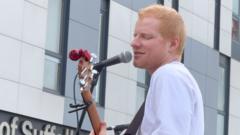
A kid on his way to a dentist appointment walks away with a brand-new guitar amplifier handed to him by a man worth an estimated £300 million.
That happened on the morning of June 5, 2026, on the concrete walkways of the Ipswich Waterfront. The man with the guitar was Ed Sheeran, returning to his childhood stomping grounds for an unannounced, hour-long pop-up gig. By the time the final chords of "Thinking Out Loud" bounced off the marina’s glass-fronted apartments, local traffic was paralyzed, hundreds of fans had flooded the harbor, and social media feeds were choking on shaky smartphone footage of the world's most successful busker.
To the casual observer, it was a heartwarming narrative of a global superstar staying true to his roots. The standard music press treated it exactly as such, running brief summaries about the local boy done good.
But stripped of the sentimentality, the impromptu concert on the River Orwell was not a spontaneous act of altruism. It was a calculated, masterfully executed corporate product launch masquerading as a grassroots event. The Ipswich performance marks the public debut of a major commercial partnership with British musical equipment giant Orange Amps. It highlights how the modern music economy relies on fabricated authenticity to sell physical hardware in an increasingly digital world.
The Illusion of Spontaneity
The modern pop-up concert relies entirely on the myth of the "last-minute" announcement. On the evening of June 4, Sheeran posted a brief Instagram story instructing fans to meet him at the Ipswich Waterfront at 9:00 AM the following morning.
The reality behind the scenes tells a different story. Orchestrating an event featuring an artist capable of selling out football stadiums requires significant preparation, even for a supposedly casual performance.
- The Security Logistical Grid: Police escorts and private security barriers do not materialize on a public pier within twelve hours without prior local council approval.
- The Infrastructure: The presence of professional audio staging, local support act Lianne Kaye—who was flown back from her holiday to open the set—and coordinated corporate branding indicates weeks of advance planning.
- The Corporate Alignment: Managing Director of Orange Amps, Sarah Yule, was present on the ground to oversee the rollout, confirming that the event was the launchpad for a major collaborative campaign culminating on June 10.
This is the new architecture of music marketing. The traditional press release is dead. In its place is the engineered viral moment, a strategy designed to make the consumer feel like they are part of an exclusive, organic experience rather than the target audience of a product activation.
Selling the British Valve Sound
To understand why a multi-platinum pop star is standing on a wooden pier playing through a custom-built amplifier, one must look at the economic landscape of musical instrument manufacturing. Orange Amps, founded in London in 1968, built its reputation on the heavy, warm valve sounds favored by classic rock icons.
The younger demographic of music creators is increasingly moving away from heavy physical amplifiers, opting instead for digital software plugins and laptop-based production suites. For a legacy brand like Orange, capturing the attention of the bedroom-pop generation is vital for survival.
Sheeran explicitly addressed this transition during his set. He noted that during his teenage years, he busked completely acoustically because he lacked an amplifier. The custom-designed Orange unit he debuted in Ipswich represents a bridge between traditional amplification and portable, street-level performance.
By gifting these units to passing school children and everyday spectators during the gig, Sheeran and Orange created highly shareable visual content. This approach positions high-end audio hardware as an accessible tool for the everyday creator, using a relatable narrative to drive consumer interest.
The Currency of Local Authenticity
Every major pop star faces the same long-term vulnerability: the risk of becoming an unapproachable corporate entity. Stadium tours, VIP ticketing tiers, and highly managed public relations campaigns can distance an artist from the core audience that built their career.
Sheeran has consistently used his ties to Suffolk to counter this trend. Whether shirt-sponsoring Ipswich Town Football Club or returning to local venues, these choices serve a strategic purpose. They anchor his global brand in a specific, tangible reality.
Corporate Megastar Persona <==================> The Busker on the Pier
(Stadium Tours, VIP Tickets)   [The Balance]   (Suffolk Roots, Free Gigs)
This local connection acts as a shield against criticisms of commercial over-saturation. A free hour on a rainy Friday morning in Ipswich generates the kind of authentic cultural capital that money cannot buy. It reminds the public of the artist's origins as a solo performer with an acoustic guitar, reinforcing his appeal as a self-made musician even as he operates at the highest levels of the global entertainment industry.
The Complications of Public Space Disruption
While the pop-up gig achieved its marketing goals, it also illustrated the challenges of introducing stadium-level celebrity events into everyday public infrastructure.
The Ipswich Waterfront is not designed to absorb sudden influxes of thousands of pedestrians and vehicles. Within thirty minutes of Sheeran taking the microphone, major surrounding thoroughfares including Fore Street, Duke Street, and Fore Hamlet were gridlocked. Commuters faced extensive delays, local bus routes were disrupted, and emergency services had to navigate a congested marina.
This raises broader questions about how modern cities manage flash-mob marketing. When a private commercial entity uses a public space for an unannounced promotional event, the municipality bears the resulting logistical costs.
The local economy experienced a brief surge in foot traffic for coffee shops and independent retailers along the marina. However, this was offset by the broader economic friction of a localized transport shutdown. It is a trade-off that local councils are increasingly forced to evaluate as brands look to move beyond traditional advertising spaces.
The Strategy Moving Forward
The Ipswich Waterfront performance demonstrates the evolving nature of celebrity endorsement deals. The era of the passive brand ambassador appearing in a glossy magazine advertisement has been replaced by active, narrative-driven partnerships.
The success of the June 5 activation will likely serve as a blueprint for the industry. Artists will continue to leverage their hometown narratives to launch commercial products, using public spaces as backdrops for content generation.
For the fans who stood on the pier or watched from their university windows, it was a memorable morning where a local hero came home. For the music industry, it was a demonstration of how to turn an ancient form of street performance into a highly effective corporate launch. The real test of this strategy will arrive on June 10, when the commercial products teased on the Ipswich flagstones officially hit the retail market.