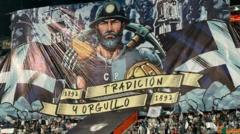
The romanticized narrative of British sports history loves a tidy migration myth. For decades, football historians have peddled a comforting, paternalistic tale about the silver mines of Hidalgo. The story goes like this: Cornish miners arrived in Real del Monte in the 1820s to revive failing silver mines, packed their leather footballs alongside their steam engines, and generously gifted the beautiful game to the grateful locals. It is a neat, linear story of cultural transfer.
It is also fundamentally wrong. Learn more on a related issue: this related article.
The idea that Cornish miners "brought football to Mexico" in the way modern fans understand it is a historical lazy consensus. It mistakes a localized corporate recreation for a national cultural awakening. It ignores the brutal realities of nineteenth-century industrial labor. Most importantly, it completely misinterprets how a British public school export actually transformed into a Mexican working-class obsession.
The Cornish did not plant the seeds of Mexican football. They built a walled garden. It took the dismantling of that garden by the Mexicans themselves for the sport to actually take root. Additional reporting by CBS Sports explores related perspectives on this issue.
The Company Town Myth: Football as a Corporate Silo
To understand why the standard narrative fails, look at the actual socio-economic structure of Pachuca and Real del Monte in the mid-to-late 1800s. The Compañía de Aventureros de las Minas de Real del Monte was not a cultural exchange hub. It was an insular, deeply segregated corporate enclave.
The Cornish miners who arrived in the wake of Mexican Independence were specialized technicians and engineers. They did not mix freely with the local population; they lived in distinct neighborhoods, spoke English, maintained British customs, and imported their own goods. When these miners kicked a ball around in the 1890s, they were not engaging in community outreach. They were practicing an exclusive, expatriate ritual designed to cope with isolation and reinforce British identity in a foreign land.
The early iterations of the Pachuca Athletic Club, founded around 1901, were not melting pots. They were elite, whites-only country clubs. The rosters of those early teams read like a Cornwall census: Pengelly, Bennett, Rule, Hogg. Local Mexican laborers were not invited to play. They were barely tolerated as spectators, often viewing the strange spectacle from behind fences or across the dirt plazas of the mining complexes.
To credit these insular enclaves with "founding" Mexican football is like crediting a foreign military base with introducing local culinary trends just because they cooked rations behind barbed wire. True cultural adoption requires integration, and the Cornish model was explicitly built on segregation.
The Class Divide the Historians Conveniently Ignore
Standard sports journalism frequently glosses over the massive structural barrier that prevented the Cornish game from spreading: the rules of the game itself.
The football played by British expatriates at the turn of the century was not the egalitarian street sport we know today. It was the highly codified, rigid version born in the English public school system—Eton, Harrow, and Charterhouse—and formalized by the Football Association in London. This version required specific equipment, manicured pitches, and a strict adherence to Victorian notions of "muscular Christianity" and amateurism.
For a Mexican mining peasant working grueling shifts in hazardous underground shafts, this elite British pastime was utterly inaccessible. The local population did not look at the Cornish miners playing football and think, I want to learn the nuances of the offside rule. They looked at it as an eccentric privilege of the ruling managerial class.
The real transformation of football in Mexico did not happen because the Cornish shared their toys. It happened when the British hegemony over the sport collapsed.
The Real Catalyst: The 1910 Revolution and Industrial Collapse
If you want to know when Mexican football actually began, stop looking at the 1901 founding date of Pachuca Athletic Club. Look instead at 1910—the outbreak of the Mexican Revolution.
The Revolution shattered the British corporate monopoly in Hidalgo. As violence escalated and the economic viability of the mines plummeted, the British exodus began. The Cornish engineers and managers packed up and went home, leaving behind their infrastructure, their empty fields, and their abandoned equipment.
Only when the British left did the Mexicans truly inherit the game. But they did not play the game the Cornish played. They democratized it.
The strict, rule-bound, amateur ethos of the British expatriate clubs was replaced by a raw, chaotic, and deeply creative street football. This was the "creolization" of the sport. Mexican youth took the basic concept of kicking a ball into a net and stripped away the elitist Victorian baggage. They did not need manicured pitches; they used cobblestone streets, dirt lots, and the very plazas where they had once been barred from entering.
This shift is precisely what historians miss when they focus on origins rather than adoption. Origin stories are easy; they are documented in neat corporate ledgers and club meeting minutes. Adoption stories are messy, unrecorded, and driven by the masses.
Dismantling the "People Also Ask" Fables
Look at the common questions surrounding this topic, and you see how deeply the misinformation runs.
Did Mexico's first football match happen in Pachuca?
Technically, the first organized matches between formal clubs occurred in the state of Hidalgo, involving Pachuca and teams like the Reforma Athletic Club from Mexico City. But calling these "Mexican football matches" is a misnomer. They were British matches played on Mexican soil. It is an administrative distinction that completely ignores the lack of Mexican participation. The first true Mexican football match occurred when local factory workers and street kids formed their own clubs, such as Club México in 1910, explicitly to challenge the British exclusionary system.
Why is Pachuca called the cradle of Mexican football?
It serves a marketing purpose. The city and the modern Liga MX club benefit immensely from the romantic, historic branding of being "the cradle." It drives tourism, merchandise, and a sense of historical prestige. But a cradle implies nurturing. The Cornish did not nurture Mexican football; they ignored the local population until geopolitical and economic forces stripped them of their control over the sport.
The Flawed Premise of Cultural Generosity
We love stories of cultural gifts because they allow us to view history through a lens of harmony. The competitor article positions the Cornish miners as benevolent ambassadors of sport. This is a dangerous distortion.
The spread of British sports throughout the global empire—whether it was cricket in India, rugby in South Africa, or football in Latin America—was a byproduct of economic imperialism. The sports were introduced to keep British administrators healthy, disciplined, and connected to the motherland. Any trickle-down effect to the local population was accidental, often resisted by the British elites who viewed the assimilation of their sports by "natives" as a dilution of their cultural superiority.
When Mexican workers finally entered the pitch, it was an act of subversion, not compliance. By beating the British at their own game on the pitches of Pachuca and Mexico City, Mexican players were reclaiming space and asserting national identity in the wake of a bloody revolution.
The Actionable Truth for Sports Historians
Stop tracing roots back to the person who owned the first ball. It is the laziest form of analysis. If you want to understand how a sport captures a nation's soul, look for the point of friction.
- Analyze the gatekeepers: Who is being excluded from the game? The real history begins when the gatekeepers lose control.
- Ignore the formal clubs: Elite clubs leave paper trails. The working class leaves a culture. Look at the factory leagues, the neighborhood tournaments, and the street variants.
- Follow the economics: Sports do not spread because they are fun; they spread because economic or political shifts create vacuums that allow the working class to appropriate them.
The Cornish miners gave Mexico a historical footnote. The Mexican working class gave Mexico its religion. Stop credit-grabbing for the miners and look at the people who actually built the church.