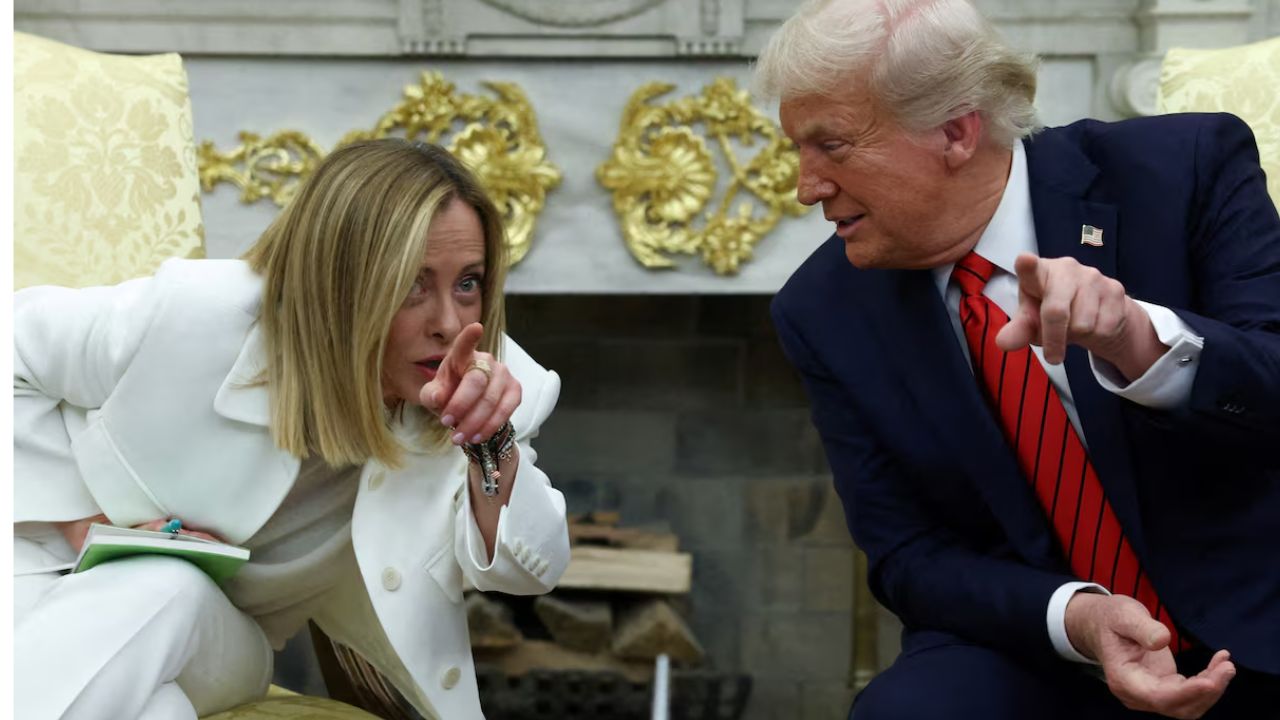
The diplomatic rupture between Washington and Rome over a purported G7 photo-op is not a schoolyard spat. It is the public unraveling of a calculated geopolitical marriage. When U.S. President Donald Trump boasted to Italian broadcaster La7 that Prime Minister Giorgia Meloni had begged him for a photograph, he treated a European head of state like an eager fan. Meloni retaliated within hours through a video carrying a lethal caption. Neither she nor Italy ever beg. Behind this sudden burst of public fury lies a deeper structural friction over war, papal authority, and the shifting center of gravity within the Western alliance.
Foreign Minister Antonio Tajani immediately canceled his scheduled trip to the United States. Rome closed ranks with unprecedented speed, drawing support from across the political spectrum, including opposition leaders and President Sergio Mattarella. To view this purely through the lens of political theater is to miss the underlying crisis. The transactional logic that defined early relations between Trump and European right-wing populists has hit an immovable wall of national sovereignty and conflicting strategic imperatives.
The Illusion of Right Wing Solidarity
When Meloni attended Trump’s second inauguration in early 2025, she was widely positioned as a diplomatic bridge between Washington and a skeptical European Union. She was the ideological translation layer. A European leader who spoke the language of national identity but remained committed to the institutional machinery of the West. Trump repeatedly showered her with praise, calling her fantastic and a friend.
The warmth was artificial. Populist alliances are fundamentally transactional, built on shared grievances rather than shared permanent interests.
The fracture began in earnest over diverging priorities in the Middle East and Eastern Europe. While Washington pushed for aggressive containment and escalation, Rome faced the immediate, destabilizing economic and migration consequences of regional conflict. The critical breaking point occurred in April, when Meloni explicitly refused to endorse the U.S.-backed conflict in Iran, branding it an unsustainable threat to Mediterranean security. Trump reacted by publicly questioning her courage in the pages of Corriere della Sera. Meloni swallowed the insult then, playing the long game of quiet diplomacy. She cannot afford to do so now.
Pope Leo and the Battle for the Catholic Right
To understand why the photo-op comment triggered such an aggressive counter-attack, one must look at Trump’s recent broadsides against Pope Leo. Following the pontiff’s sharp condemnation of the war in Iran, Trump launched a series of characteristic verbal assaults on the Vatican. For an American audience, attacking a religious figure is part of the standard culture-war playbook. For an Italian Prime Minister whose domestic coalition depends heavily on traditional Catholic voters, it is a direct threat to domestic stability.
Meloni’s political identity is anchored in the defense of traditional European values. Trump’s attacks on Pope Leo forced her to choose between transatlantic alignment and her core domestic constituency. She chose the Vatican.
By framing her resistance as a defense of national dignity, Meloni has successfully turned an international insult into a domestic asset. Lorenzo Castellani, a political scientist at Rome's Luiss Guido Carli University, noted that the incident effectively neutralizes opposition accusations that Meloni is merely a vassal to Washington. Trump unintentionally gave Meloni the ultimate platform to demonstrate her independence. Defense Minister Guido Crosetto made the stakes clear on social media, pointing out the immense diplomatic capital Meloni had spent to maintain ties with Washington despite Trump’s previous outbursts, only to have that effort dismissed as a vanity exercise.
The Strategic Divergence on Ukraine and Tariffs
Beyond the personal insults and religious friction lies a profound disagreement over the security architecture of Europe. Italy has maintained a firm stance on supporting Kyiv against Russian aggression, aligning itself with the broader European consensus. Trump's persistent skepticism toward NATO obligations and his administration's implementation of aggressive protectionist tariffs have systematically chipped away at the economic foundation of the relationship.
The numbers tell the story. Italian exports to the United States are heavily vulnerable to shifts in trade policy. When Washington weapons-grades its economy through tariffs while demanding absolute geopolitical fealty, European capitals are forced to recalculate their dependency.
Undersecretary Giovanbattista Fazzolari summarized the growing frustration in Rome, openly questioning whether Washington’s actions stem from deliberate intent or diplomatic ineptitude. The consensus among Italian officials is that Trump is actively damaging American influence across the continent. By alienating his most natural ideological ally in Europe, the U.S. president has signaled to other European capitals that no amount of alignment will protect them from arbitrary humiliation.
A New Era of European Autonomy
The immediate consequence of this dispute is the collapse of the bridge policy that Meloni attempted to build. Rome will no longer act as Trump's interlocutor in Brussels. Instead, Italy is likely to lean harder into European defense initiatives and strategic autonomy, a shift that Washington has historically sought to prevent.
The transatlantic alliance has survived decades of policy disagreements, from the Suez Crisis to the Iraq War. Those disputes, however, were argued on the grounds of strategy and intelligence. The current crisis is driven by a style of personalization that reduces statecraft to internet metrics and personal dominance.
Italian Justice Minister Carlo Nordio invoked the historical gravity of the relationship, referencing the American soldiers buried on Italian soil during the liberation from Nazi-Fascism, calling the current rhetoric a painful blow to fraternal ties. When a nation's defense establishment begins comparing current diplomatic slights to the sacrifices of World War II, the relationship has moved past the point of simple repair. The path forward will require Washington to recognize that sovereign allies cannot be managed through reality television tactics, or it must accept a deeply fractured Western front.