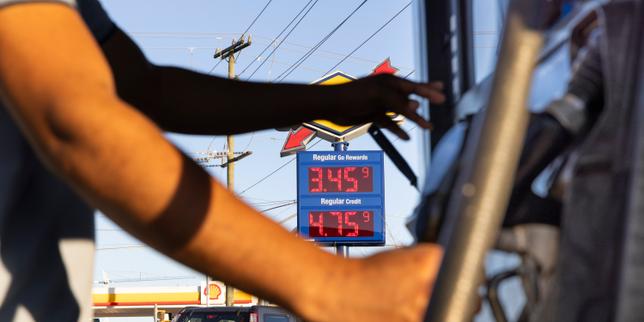
The United States economy is staring down a three-year inflation high of 4.2 percent, driven primarily by an energy crunch triggered by the escalating conflict with Iran and the closure of the Strait of Hormuz. For months, working families have felt the direct bite of this geopolitical standoff every time they visit the pump. Yet, inside the Oval Office, the official reaction defies conventional political gravity. President Donald Trump shrugged off the latest Bureau of Labor Statistics data, declaring, "I love the inflation." Beneath this bravado lies a complex, high-stakes gamble that hinges on secret maritime operations, an aggressive tariff regime, and an unprecedented attempt to reshape the Federal Reserve.
The headline numbers released on Wednesday show that the Consumer Price Index (CPI) climbed to 4.2 percent for the year ending in May, up from 3.8 percent in April. This marks the third consecutive monthly increase since hostilities broke out in late February, back when inflation sat at a manageable 2.4 percent. While mainstream analysis attributes this entirely to the immediate chaos in the Middle East, the reality is far more intricate. The current crisis is the result of three distinct economic forces colliding at once: wartime energy shocks, lingering domestic tariff burdens, and a dramatic structural shift within the central bank.
The Secret Oil War and the Strait of Hormuz Blockade
The primary driver of the May inflation spike is no secret. Energy costs accounted for over 60 percent of the monthly increase, with gasoline prices surging roughly 50 percent since the beginning of the year. When Iran effectively choked off the Strait of Hormuz—a maritime artery responsible for the transit of one-fifth of the world’s petroleum supply—global energy markets reacted with predictable volatility. Brent crude hovered near $94 a barrel at midday Wednesday, keeping the U.S. national average for a gallon of gasoline anchored stubbornly above $4.15.
However, the real story is how the administration is weaponizing this supply shock. Moments after the inflation data went public, Trump revealed that the U.S. has been executing covert nighttime raids to seize millions of barrels of Iranian crude oil.
"We took out the other night, 22 ships. Late at night, with no lights. Because they don't have any radar because we blasted the crap out of it," Trump told reporters in the Oval Office.
This aggressive interdiction strategy aims to artificially suppress global prices by forcefully injecting seized crude back into Western supply chains. The administration’s calculation is simple: weather the immediate political backlash of 4 percent inflation today, break Iran’s economic back through naval dominance tomorrow, and reap the rewards of a massive oil glut once the conflict ends. The president confidently predicted that once the war concludes, oil prices will drop "like a rock."
The Compounding Tariff Effect
Blaming the entire 4.2 percent inflation rate on Middle Eastern drone strikes oversimplifies a deeper structural vulnerability in the American economy. The energy shock did not occur in a vacuum. It was layered on top of an already sensitized supply chain weighed down by the sweeping import tariffs enacted by the administration in April 2025.
While core inflation—which strips out volatile food and energy costs—remained relatively stable at 2.9 percent in May, specific sectors show that protected domestic industries are passing higher input costs down to the consumer. For instance:
- Clothing and Apparel: Up 0.3 percent in May, sitting 4.8 percent higher than last year due to textile import levies.
- Logistics and Shipping: Industrial diesel spikes have forced logistics giants like UPS and FedEx to introduce heavy fuel surcharges, quietly inflating the baseline cost of moving goods across state lines.
- Agriculture: The combined weight of higher transportation costs and fertilizer tariffs has driven beef prices up by 10 percent, while staples like tomatoes and lettuce have jumped 32 percent and 25 percent respectively over the past year.
By the time the Iran war broke out in February, the American consumer was already operating with diminished purchasing power. The military conflict didn’t create the inflation cycle from scratch; it acted as an accelerant on a house that was already dry.
The Federal Reserve Coup and the Interest Rate Standoff
The most dangerous element of the current crisis is the looming civil war over monetary policy. High inflation traditionally demands higher interest rates to cool the economy. However, the Federal Reserve is entering uncharted political waters under its new leadership.
Last year, Trump replaced Jerome Powell with Kevin Warsh, a move designed to secure a more compliant central bank willing to slash borrowing costs. Warsh now finds himself in a virtually impossible position. He stepped into the role advocating for rate cuts to stimulate growth, but the reality of 4.2 percent inflation makes cutting rates an economic hazard that could trigger a wage-price spiral.
Traders in the financial futures markets are currently betting that the Fed will be forced to execute a quarter-point rate hike before the end of the year, directly defying the president's public demands for cheap credit. If the central bank yields to White House pressure and cuts rates anyway, it risks cementing high inflation as a permanent fixture of the domestic economy. If it raises rates to fight the energy shock, it could trigger an artificial slowdown just as voters head to the polls for the crucial midterm elections this November.
The Ground-Level Reality Facing Businesses
While Wall Street and Washington debate macroeconomics, small and mid-sized businesses are forcing structural changes to survive. The spike in energy costs has triggered an immediate surge in downstream service sectors that are typically insulated from commodity markets.
Due to the skyrocketing price of jet fuel, airline fares jumped 2.7 percent in May alone, marking a massive 26.7 percent increase year-on-year. This has altered consumer travel habits at the start of the peak summer season. Large commercial retailers report that consumers are no longer filling their tanks, opting instead to buy smaller, incremental amounts of gasoline during each visit to manage weekly cash flow.
At the same time, service industries like child care, home healthcare, and dental services are pushing prices higher to match the rising cost of living for their staff. This indicates that even if the conflict in the Middle East ends tomorrow and oil prices plummet as promised, the broader service economy has already begun adjusting its baseline upward. Once these second-round effects take root in corporate payrolls and service contracts, they become incredibly difficult to erase through diplomacy or naval actions alone.
The administration’s entire economic defense relies on the assumption that this inflation wave is a temporary, artificial spike that can be crushed through military and geopolitical leverage. It is a high-wire act with no safety net. If the war drags on into the winter, or if the Strait of Hormuz remains closed longer than the administration's strategic reserves can compensate for, the United States will face the grim reality of stagflation—where high prices lock into place just as economic growth begins to stall.
The coming months will determine whether the administration's aggressive policy mix of military interdiction, domestic tariffs, and a politicized Federal Reserve can force a swift resolution, or whether the American consumer will be left paying the premium for a foreign war indefinitely. Corporate leaders and consumers alike should prepare for heightened volatility, adjusting capital allocations under the assumption that $4 gas and a strained supply chain are the baseline reality for the foreseeable future.