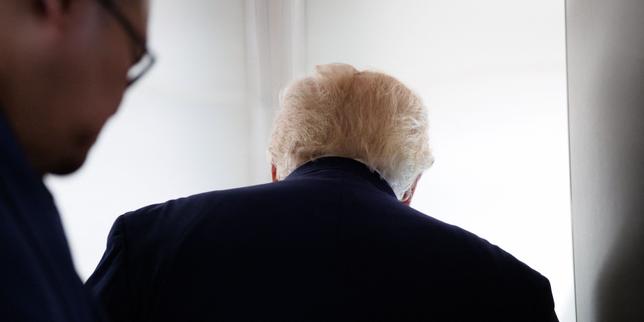
The televised blow-up between Donald Trump and NBC News anchor Kristen Welker was not a failure of media relations. It was a strategic exit. During an interview taped inside a barn in Chippewa Falls, Wisconsin, the friction between the president and the veteran anchor reached a boiling point after barely four minutes, ending with Trump standing up, labeling the network dishonest, and walking off the set.
To view this explosion as a simple fit of temper is to misunderstand the modern choreography of political warfare. This was an intentional deployment of the media-hostility playbook, engineered to shift focus away from domestic policy setbacks and an ongoing military conflict with Iran.
The confrontation did not begin over grand strategy. It started with money. Welker pushed the president on the Anti-Weaponization Fund, a planned $1.8 billion initiative designed to compensate individuals who claim they were victims of politicized prosecutions under previous administrations. The Department of Justice recently abandoned the creation of the fund following immense pressure from federal judges and Republican senators who expressed deep concerns over a lack of fiscal oversight.
When Welker pressed for details on how this fund would operate without traditional congressional guardrails, the conversation grew combative. Trump asserted that he still intended to see the money distributed, stating that if it were up to him, he would pay them what they deserve. As Welker moved the questioning toward whether individuals convicted of assaulting police officers during the January 6 Capitol riot would qualify for these payouts, the atmospheric tension inside the Wisconsin barn shifted noticeably.
Then came California. The state's protracted mail-in ballot counting process had been drawing public criticism from the administration, with the president making repeated claims of election interference without offering specific evidence. When Welker directly challenged the lack of evidentiary backing for those claims, pointing out that slow tallies are standard under California state law, the interview format broke down completely.
"All I have to do is look," Trump stated.
"But that is not evidence," Welker countered.
The exchange exposed the fundamental, unbridgeable divide between modern political messaging and traditional adversarial journalism. For a veteran reporter, evidence consists of verifiable documents, sworn testimony, and forensic audits. For the executive branch's current occupant, assertion acts as its own proof. When that assertion failed to quiet the room, the interview was over.
The geopolitical backdrop provided an even deeper source of friction. The administration is currently navigating an active military campaign against Iran, a conflict that began on February 28. This reality directly complicates the isolationist rhetoric used extensively during the previous campaign cycle, where voters were promised an era of non-intervention and an end to foreign entanglements.
Welker seized on this contradiction, forcing a defense of the current military strategy. The response was a pragmatic pivot. The president argued that the actions do not constitute an endless war because the operations have only been underway for three months. He emphasized that stopping Iran from attaining a nuclear weapon was a necessary service to the global order, even while acknowledging that previous strikes had already targeted Iranian nuclear infrastructure.
This foreign policy dance requires absolute control over the narrative. When an interviewer refuses to accept shifting benchmarks, the risks of staying on camera begin to outweigh the benefits of the airtime. Walking out ceases to be an emotional reaction; it becomes an effective damage-control mechanism. It changes the next morning's headline from a scrutiny of policy reversals to a familiar battle over media bias.
The mechanics of this exit are highly specific. By ending the session with an abrupt, direct dismissal, the political figure controls the final frame of the footage. It signals to a core constituency that the leader refuses to submit to the terms of an establishment institution. The actual details of the abandoned justice fund, the slow vote tallies in California, and the tactical realities of the Iranian theater are immediately eclipsed by the theater of the walkout itself.
Mainstream news outlets continue to treat these interviews as opportunities for policy clarification. That is a systemic miscalculation. The television studio is treated by the modern presidency as a hostile deployment zone where success is measured by narrative survival, not policy defense. When the questioning threatens to lock down a specific contradiction, the most effective move on the board is to flip the table and walk away.